Arbitral Tribunal Cannot Rewrite Contract Or Grant Relief Contrary To Its Terms: Supreme Court
The Court upheld the setting aside of a majority award which granted specific performance after disregarding the contractual sequence of obligations and introducing terms that the parties had not agreed upon.
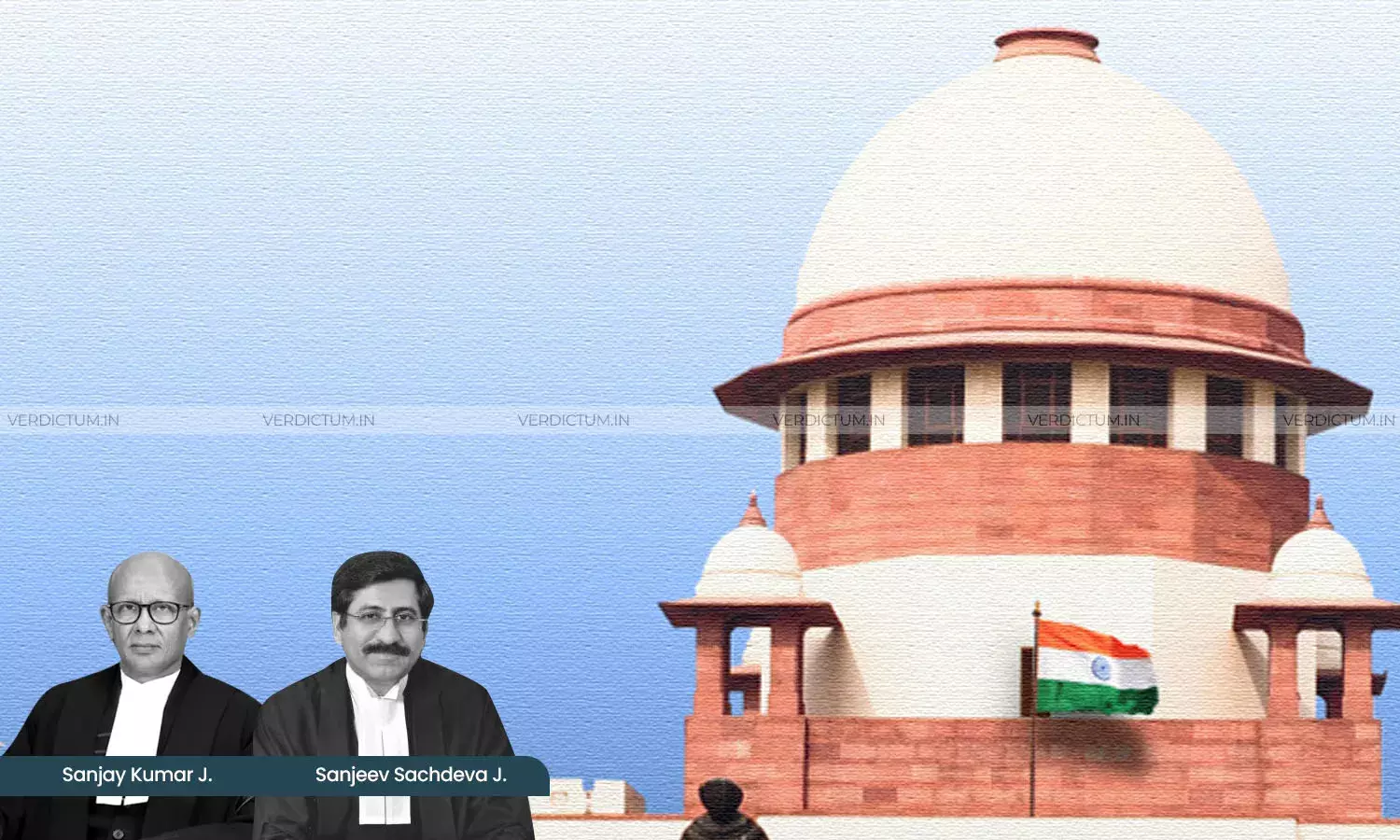
The Supreme Court has held that an arbitral tribunal cannot rewrite a contract, supplant its express provisions with new terms or grant relief contrary to the parties’ agreement.
The Court upheld the Bombay High Court’s decision setting aside a majority award which granted specific performance of a 2003 agreement titled “Agreement for Development” and directed the execution of a conveyance deed for the landowners’ share.
The Court was hearing appeals filed by the developer against the High Court’s exercise of appellate jurisdiction under Section 37 of the Arbitration and Conciliation Act, 1996. Although it did not restore the majority award, the Court directed the landowners to refund the amounts received under the agreement with 9% simple interest.
A Bench of Justice Sanjay Kumar and Justice Sanjeev Sachdeva held: “… the two learned arbitrators not only construed the express terms of the agreement contrarily but completely supplanted them with new terms, as per their own fancies. Their approach was clearly at variance with the edicts of this Court as to interpretation of the underlying contract. Their award, therefore, ought not to have granted the relief of specific performance to the appellant and its partners, by holding them entitled to execution of a deed of conveyance for the 2/9th share of the respondents, in total derogation of the agreement terms.”
The Bench added: “These were the aberrations in the majority award that weighed with the High Court while exercising appellate jurisdiction under Section 37 of the Act of 1996. Though the High Court also went into the issue as to whether the subject agreement was an agreement to sell or was merely for development, that exercise was not necessary, in the light of the correct finding by the High Court that Section 28(3) of the Act of 1996 stood violated by the rewriting of the contract in the majority award. In essence, the judgment dated 05.03.2024 passed by the High Court gave effect to the settled principle of law that it is not open to an arbitral tribunal to do so.”
Senior Advocate Darius Khambata appeared for the appellant. Senior Advocates Shyam Diwan and Aniruddha Joshi appeared for the respondents.
Background
The dispute arose after the landowners terminated the 2003 agreement and the parties invoked arbitration.
By a majority award delivered in December 2011, the tribunal declared the termination illegal and granted specific performance to the developer upon the deposit of approximately ₹10.91 crore. It directed the landowners to execute a conveyance deed for their 2/9th share. The dissenting arbitrator dismissed both the claim and the counterclaim.
The Principal District Judge upheld the majority award under Section 34. In appeal, the Bombay High Court set it aside after finding that the tribunal had disregarded the contractual terms, violated Section 28(3) and granted relief beyond the parties’ bargain.
Court’s Observations
Contractual Sequence Was Binding
The Court observed that it was unnecessary to conclusively classify the agreement as either a development agreement or an agreement to sell. The decisive consideration was that the contract prescribed the order in which the parties had to perform their respective obligations.
The Bench observed: “In any event, irrespective of the slotting of the subject agreement, in terms of whether it was only for development or it was also an agreement to sell, the performance of obligations envisioned thereunder was clearly set out. Once the agreement made it clear that the parties thereto were to perform their respective obligations in a particular order, the same was binding upon them and the agreement had to be given effect to as envisaged therein. Viewed in that context, it was not essential to identify and label the character of the agreement as it was the terms thereof, stipulating sequential performance of obligations, that assumed importance.”
The Court stated that Section 28(3) required the tribunal to decide the dispute by taking the contractual terms into account. Clear and explicit terms could not be replaced with a different arrangement.
Award Overlooked Payment And Conveyance Conditions
The Court found that the agreement required the consideration to be paid in a time-bound sequence and repeatedly declared time to be of the essence. Acceptance of the first six delayed instalments without protest cured those particular delays but did not erase the remaining payment schedule.
The Bench held: “Surprisingly, the majority award completely overlooked and ignored the obligations in the agreement and the sequence in which they were to be performed. Even if the award, on the analysis undertaken, proceeded on the premise that the subject agreement was an agreement to sell and was not just for development, it was not for the two learned arbitrators to rewrite its terms. As per the agreement, the total consideration payable to the respondents hinged upon later events that did not materialize by the date of the award.”
The Court noted that the consideration remained linked to future events, including sanction of the building plan, the available floor-space index and construction of basements. The tribunal nevertheless directed execution of the conveyance deed even though full payment had not been made and the final consideration remained indeterminate.
Award Introduced New Terms
The Court observed that the award adopted a rate six times higher than the stipulated rate without any supporting computation or reasons. It also adjusted payments made under an earlier memorandum despite the agreement expressly superseding prior arrangements.
The Bench stated: “Last but not the least, when the agreement stipulated the rate as ₹915/- per square foot for the FSI area that would be available at the time of sanctioning of the plan and the rate of ₹450/- per square foot for the extra FSI area, if the respondents’ adverse possession was regularized, it was not for the two learned arbitrators to come up with a new rate at which the consideration should be paid. Strangely, no computation exercise was undertaken in this regard and no reasoning was offered as to why the rate at six times the stipulated rate of ₹915/- per square foot was adopted, bringing the net rate to ₹5490/- per square foot. This direction in the majority award was, therefore, completely beyond the scope of the agreement and defied logic.”
The Court further found that the award included part of the property expressly excluded from the agreement and granted alternative damages without a contractual foundation.
Limited Review Did Not Protect Rewritten Contract
Relying on Gayatri Balasamy v. ISG Novasoft Technologies Limited (2025), the Court clarified that appellate jurisdiction under Section 37 is coterminous with, and as broad as, the jurisdiction under Section 34. The High Court could therefore test the award under Section 34 despite its earlier confirmation by the Principal District Judge.
Since both Section 34 applications had been filed before October 23, 2015, the Court held that the unamended Section 34 governed the challenge.
Referring to Associate Builders v. Delhi Development Authority (2015), the Bench observed: “It was observed that construction of the terms of the contract is primarily for an arbitrator to decide, unless the arbitrator construes the contract in such a way that it could be said to be something that no fair-minded or reasonable person could do. It was further observed that when a Court is applying the ‘public policy’ test to an arbitral award, it does not act as a Court of appeal and a plausible view of facts by the arbitrator necessarily has to be accepted, as the arbitrator is the ultimate master of facts.”
The Court nevertheless held that the majority award did not represent a plausible interpretation because it supplanted the contractual terms and imposed a bargain the parties had not made.
Conclusion
The Supreme Court disposed of the appeals without restoring the majority award and upheld the High Court’s finding that the tribunal had violated Section 28(3) by rewriting the contract.
Exercising jurisdiction under Article 142, the Court directed the landowners to refund the amounts received under the agreement with simple interest at 9% per annum from the date of each payment until actual refund. The developer’s court deposits were also directed to be returned with accrued interest. The parties were directed to bear their own costs.
Cause Title: Shreeram Builders v. Upendra Kantilal Thanawala and Others (Neutral Citation: 2026 INSC 1176)
Appearances
Appellant: Senior Advocate Darius Khambata; Advocate-on-Record Kunal Mimani; Advocates Kunal Vajani, Kartikey Bhatt, Prashant Alai, Abhinav Rana and Amitoj Chadha
Respondents: Senior Advocates Shyam Diwan and Aniruddha Joshi; Advocate-on-Record Samrat Krishnarao Shinde; Advocates Nivit Srivastava, Siddharth Dharmadhikari, Aditya Krishna, Pratyush Kalro, Anshula Laroiya, Yashvardhan Singh and Shambhavi Kanade