

Remand Not To Be Adopted In Ordinary Course When Parties Have Adduced Evidence In Accordance With Burden & Onus of Proof Fastened On Them: Supreme Court
The Supreme Court was considering a challenge laid against a Judgment remitting the matter to the Trial Court to frame issues in a partition suit.

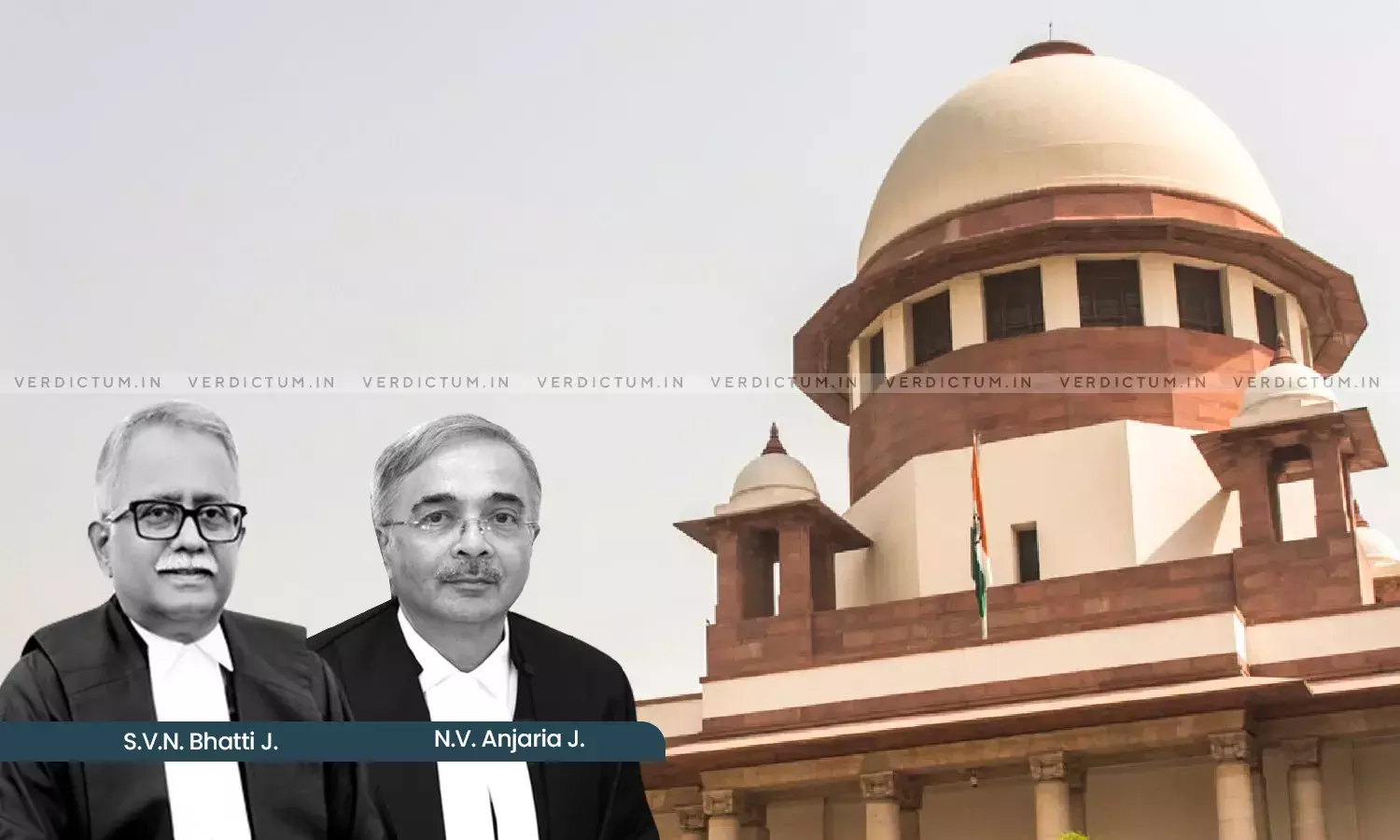
Justice S.V.N. Bhatti, Justice N.V. Anjaria, Supreme Court
While restoring the appeals in a Partition suit, the Supreme Court has held that remand is not to be adopted as a matter of ordinary course. The Apex Court held that the judgment of remand reflected the Appellate Court’s incorrect exercise of its discretion when the parties had adduced oral and documentary evidence in accordance with the burden and onus of proof fastened on them.
The Apex Court was considering a challenge laid against a Judgment allowing an appeal to the extent of one of the Items of the Plaint Schedule Property and remitting the matter to the Trial Court to frame issues, allow the parties to adduce further evidence, and thereafter dispose of the suit.
The Division Bench of Justice S.V.N. Bhatti and Justice N.V. Anjaria held, “Therefore, the Trial Court has not decided the Suit without relevant issues being presented by the pleadings of the parties. In our view, remand is not to be adopted as a matter of ordinary course, and the Judgment of remand reflects the Appellate Court’s incorrect exercise of its discretion. In the case at hand, the parties have adduced oral and documentary evidence in accordance with the burden and onus of proof fastened on them. At this stage, directions are given to reframe issues, adduce further evidence, and afford the parties a further opportunity to lead evidence. There were no circumstances preventing the first appellate court from deciding the points in issue. Consequently, remanding the case to the Trial Court is completely contrary to the legal principles laid down by this Court in the decisions mentioned above.”
“The correctness or otherwise of the case of the contesting parties is appreciated from the pleadings, issues, oral and documentary evidence, and a finding can be returned instead of remitting the matter to the Trial Court. Our view may not be understood as holding that the Appellate Court, in the given circumstances, cannot provide opportunities to the parties to adduce evidence, including after accepting a prayer under Order 41 Rule 27 of the Civil Procedure Code, 1908. We express our view that such discretion for remand is exercised when imminently warranted by the circumstances of a given case”, it added.
Advocate Sharanagouda Patil represented the Appellant while AOR Abhinav Garg represented the Respondent.
Factual Background
The Appellant was the second Defendant and the respondents were among the Plaintiffs in the Suit filed seeking Partition and separate possession of the plaint schedule items. A declaration was also sought that the Sale Deed executed by one Madiwalappa in favour of the second Defendant was illegal, null and void, and not binding on the Plaintiffs’ share and entitlement. The first Plaintiff Sharawwa died during the pendency of the Suit. The Plaintiffs contended that a Hindu Undivided Joint Family comprising the Plaintiffs and the first Defendant existed. Madiwalappa was the propositus. The Plaint Schedule Properties were ancestral properties inherited through Madiwalappa and his predecessors-in-interest.
In the year 1982, a registered sale deed for Suit Schedule Property Item No.5 was executed by Madiwalappa in favour of the second Defendant. Item No.5 comprised 5 Acres 12 Guntas of land situated in Amminbhavi village, Dharwad Taluk. The Plaintiffs alleged that the said Sale Deed was sham and bogus. Madiwalappa was addicted to bad habits and vices and thus the transfer of Item No.5 did not affect the rights and entitlements of the Plaintiffs and the first Defendant in Item No.5 of the suit property. The suit was thus filed in such circumstances. The Suit was decreed in part, resulting in the first appeal. The second Defendant, the only contesting party, did not dispute the case made out by the Plaintiffs and the defence taken by the first Defendant in claiming their share in the Suit Schedule properties.
After considering the pleadings and oral and documentary evidence, the Trial Court held that the Plaintiff failed to produce any credible evidence to prove that Madiwalappa was addicted to bad vices. The Sale Deed was registered in accordance with the law and was held valid in the eyes of the law. Regarding possession, the Trial Court had held that the recitals in the Sale Deed showed that possession was handed over to the second Defendant on the date of its execution. On the question of limitation, the Trial Court observed that the Plaintiffs challenged the Sale Deed thirty-three years after its execution. The Plaintiffs were denied the relief of declaration. The High Court, through the Impugned Judgment, while confirming the findings of the Trial Court on Item Nos.1 to 4 of the Suit Schedule, reversed the findings on Item No.5 and remitted the matter to the Trial Court.
Reasoning
On a perusal of the facts of the case, the Bench noted that the reason for remand assigned by the High Court was that, despite a plea that the Sale Deed was sham and nominal, no issue was framed. The Bench also took note of the Plaint and Written Statement. It was noticed that the first issue was a comprehensive issue regarding the partition and the third issue covered whether the sale of Item No. 5 of the Suit Schedule in favour of the second Defendant was valid or not.
The Bench was of the view that the Trial Court had not decided the suit without relevant issues being presented by the pleadings of the parties.
Thus, allowing the appeals, the Bench set aside the findings in the Impugned Judgment vis-à-vis the fifth item of the Suit Schedule, and the order of remand to the Trial Court. Restoring the appeals, the Bench requested the High Court to dispose of the Appeals on merits.
Cause Title: Shivappa v. Shantavva and Others (Neutral Citation: 2026 INSC 857)
Appearance
Appellant: Advocates Sharanagouda Patil, Anand Kolli, AOR Supreeta Sharanagouda, Advocate Kotresh A M
Respondent: AOR Abhinav Garg