

Candidate Can’t Be Said To Have Suppressed Or Furnished False Information When Existence Of Criminal Antecedent Was Not Within His Knowledge: Supreme Court
The appeal before the Supreme Court arose from a judgment of the Kerala High Court dismissing the appellant’s challenge to a termination order.

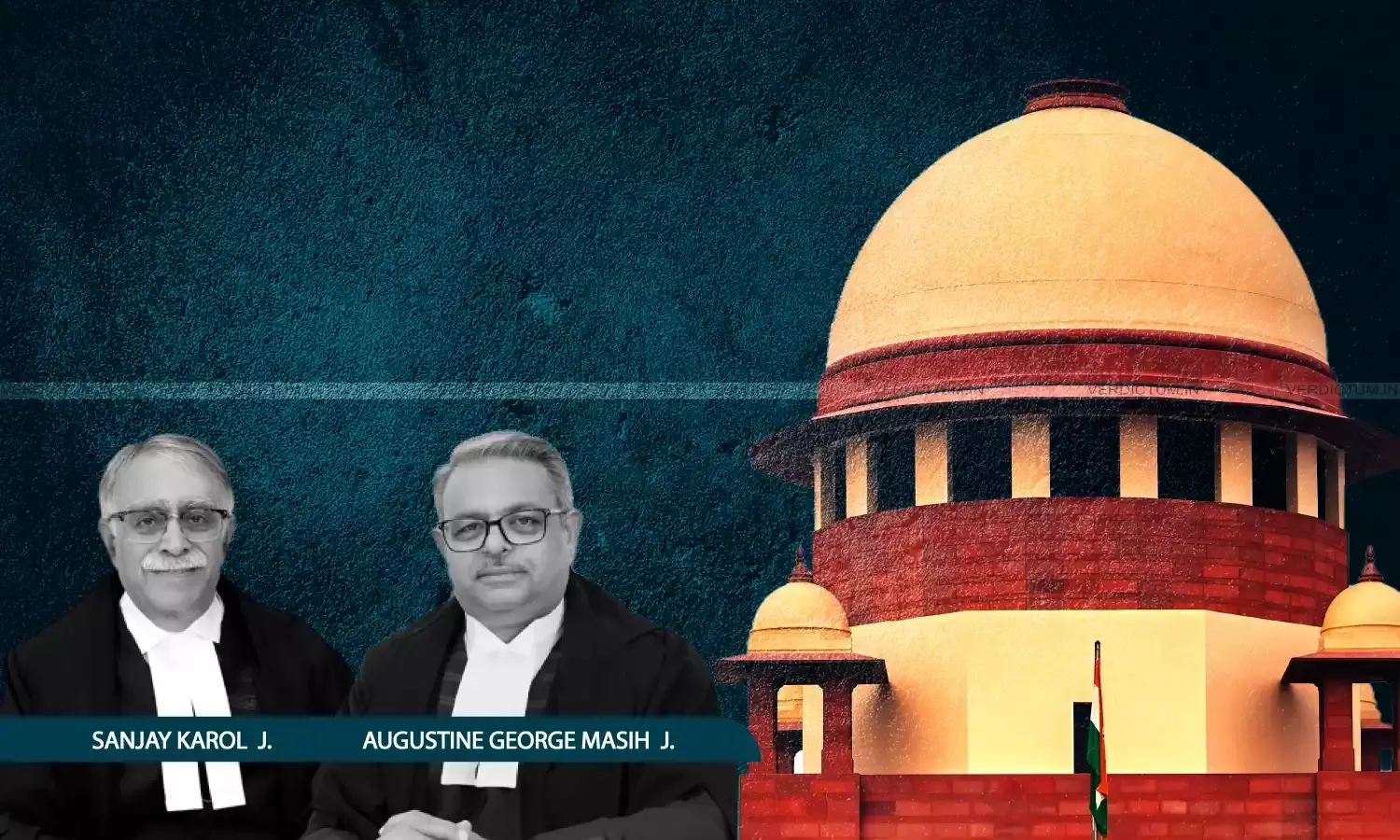
While directing the reinstatement of an employee, the Supreme Court has observed that where the very existence of a criminal antecedent is not shown to have been within the candidate's knowledge at the relevant time, he cannot be held to have suppressed or furnished false information in that regard.
The appeal before the Apex Court arose from a judgment of the Kerala High Court dismissing the appellant’s challenge to a termination order passed against him.
The Division Bench of Justice Sanjay Karol and Justice Augustine George Masih held, “Needless to say, knowledge of a fact is a necessary pre-requisite for its non-disclosure. The very concept of suppression presupposes an awareness of that which is suppressed; one cannot be said to have withheld or concealed something of which one had no knowledge in the first place. It would be both illogical and unjust to hold a candidate liable for suppression of information that was never within his knowledge to begin with.Therefore, where the very existence of a criminal antecedent is not shown to have been within the candidate's knowledge at the relevant time, he cannot be held to have suppressed or furnished false information in that regard, there being no suppression of a fact that was, to him, non-existent.”
Senior Advocate P.V Dinesh represented the Appellant while AOR Siddhartha Jha represented the Respondent.
Factual Background
The appellant was appointed to the post of Technician(Process) by the Fertilisers and Chemicals Travancore Ltd. in the year 2021 on a consolidated pay for an initial tenure of two years. At the time of joining, he submitted an attestation form declaring that there was no criminal case pending against him. A letter was thereafter forwarded by the respondent to the District Magistrate for verification of the appellant’s criminal antecedents. In response, the District Magistrate disclosed that a Non-Cognizable Report (NCR) had been registered against the appellant under Sections 323 and 504 of the IPC. Consequently, a show cause notice was issued to the appellant, directing him to furnish reasons as to why his services should not be terminated on the ground of furnishing false information.
The appellant claimed that he had not suppressed or given false information as he was not aware of the registration of the NCR. After granting a few more opportunities to substantiate his claim, a termination letter was issued to the appellant cancelling his appointment. The appellant approached the High Court by filing a Writ Petition challenging the order of termination, but the Single Judge held that the appellant's claim of being unaware of the NCR involved a disputed question of fact requiring proof. By the impugned order, the Division Bench concurred with the Single Judge and dismissed the appeal. It was in such circumstances that the appeal reached the Apex Court.
Reasoning
Dealing with the aspect of maintainability of the petition, the Bench clarified that the existence of an alternative remedy does not operate as an absolute bar to the exercise of writ jurisdiction, particularly where the challenge is to the legality of the order of termination itself.
The Bench explained that the order of termination must not be mechanical but must have regard to the form of suppression, the outcome of the criminal case, the nature of the employment and of the offence, and any special circumstances. “Termination is therefore not an automatic consequence of the disclosure of criminal antecedents; rather, the specific case of the employee must be considered, and the employer must apply its mind before arriving at a decision”, it added.
The Bench also set up a two-pronged test for the enquiry to be undertaken by the employer, before proceeding to terminate the services of an employee on the ground of suppression of information regarding criminal antecedents. “The first is one of fact: whether there has, in truth, been any suppression or furnishing of false information by the candidate, having regard to the extent of his knowledge at the relevant time and the circumstances in which the declaration came to be made. The second prong of enquiry requires the authorities to apply their mind to the specific facts and circumstances of the case including the type of the suppression, the nature of allegations, role and gravity of the offence, the nature of the post and the duties attached to it and wherever relevant the effect thereof, and the eventual outcome of the criminal proceedings, if concluded, in order to arrive at a considered conclusion as to whether the continuation of the employee in service would not be feasible and the only option available is termination from service. It is only where both these stages of enquiries are undertaken and not otherwise, that an order of termination on this ground can be said to be sustainable in law”, it held.
Applying the first prong, i.e. whether there had been any suppression or supply of false information on the part of the appellant, the Bench noted that the appellant, to the best of his knowledge and in a bona fide manner, stated in his verification form that there was no criminal case pending against him.
The Bench further noticed that the appellant had also brought on record a subsequent certificate issued by the Sub-Inspector of Police, Nichlaul, Maharajganj, Uttar Pradesh, disclosing that although the appellant was initially arrayed in the NCR, his name was later removed after investigation as no evidence was found against him. It was also certified that he was neither called to the police station nor was he arrested during the relevant period. “From the above, the claim of the appellant stands substantiated that, in the absence of any summons, and having never been called to the police station, arrested, or questioned, the appellant had no means of knowing about the NCR”, it added.
Dealing with the second prong of the enquiry i.e. whether the criminal antecedent and the suppression merited termination of employment, the Bench noted that there had been no specific findings regarding the specific nature of the offence and its impact on the nature of the post held by the appellant. “In light of the above, we answer the issue framed by us in the negative, and hold that the termination of the appellant was not permissible in law, as it fails on both the prongs, the order being illegal as well as without application of mind”, it stated.
Thus, allowing the appeal, the Bench set aside the order of termination of the appellant and directed reinstatement in service forthwith with all consequential benefits, except for backwages, which came to be restricted to 50%.
Cause Title: Shatrughn Yadav v. The Fertilizers and Chemicals Travancore Ltd. And Others (Neutral Citation: 2026 INSC 829)
Appearance
Appellant: Senior Advocate P.V Dinesh, Advocates Anna Oommen, AOR Abdulla Naseeh V.T.
Respondent: AOR Siddhartha Jha