

Posture & Dexterity Indispensable To Artisan Trades: Supreme Court Grants 10 Lakh For Prosthetic Leg To Carpenter As Motor Accident Compensation
Overturning the Uttarakhand High Court’s judgment, the Court noted that the man has not been able to pass stool in an Indian style outlet and has been severely handicapped in doing routine work.

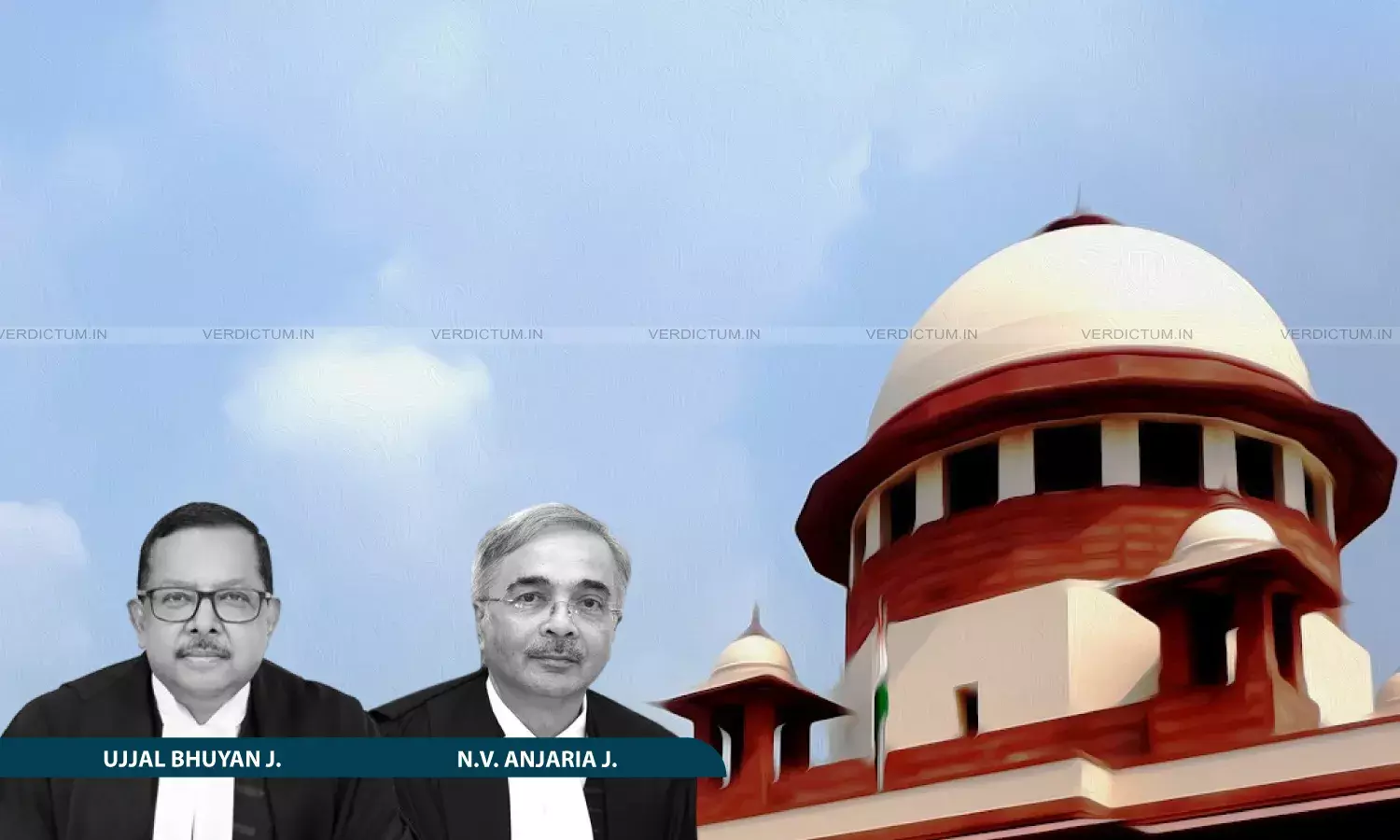
The Supreme Court has held that posture and manual dexterity are indispensable to artisan trades, and amputation affecting these essential skills can amount to 100% functional disability despite a lower medical impairment assessment.
Holding that a carpenter’s lower-limb amputation completely impaired his ability to perform essential work postures like squatting and sitting cross-legged, the Court awarded ₹10 lakh for prosthetic limb replacement and maintenance, emphasizing that functional loss must be assessed from the perspective of actual earning capacity.
Justice Ujjal Bhuyan and Justice N.V. Anjaria observed, “The carpenter is thus a skilled worker, who works to bring into existence various items of wood by his expertise and dexterity. When the income of the injured appellant carpenter is to be notionally assessed for the purpose of compensation, the fact and the aspect that the appellant was a skilled worker, cannot be overlooked, and has to be accounted for”.
“When the appellant is not able to sit either in a squatted way or with a crossed leg, it is evident that he will not be able to perform the carpentry work. It is essential and indispensable for a carpenter to sit to do the carpentry works. A carpenter cannot perform such work while in a standing position. For standing also, the appellant would need support. Therefore, the actual effect of amputation resulting out of the accidental injury for the appellant is total in terms of the work in which he is engaged and he is to perform, which really does not match and does not augur well with the extent of 70% disability as medically indicated. The disability of the appellant has to be appreciated and assessed in the context of the occupation of the appellant, activity of work he used to do as carpenter. The functional disability of the appellant claimant has to be taken properly and reasonably at 100%”, the Bench further observed.
Advocate Ashwani Garg appeared for the appellant, and Advocates Abhishek Gola and K.K. Bhat appeared for the respondents.
In the matter, the dispute arose from a vehicular accident on November 9, 2004, when the appellant, a 38-year-old skilled carpenter, was traveling on his motorcycle and was hit by a rashly driven Jeep coming from the wrong side of the road.
The appellant sustained grievous injuries to his right leg, which ultimately required amputation above the knee to save his life. Because of this amputation, the appellant became permanently incapacitated from pursuing his independent carpentry business, which served as the sole source of income to support his dependent family.
Seeking redress, the claimant initially moved the Motor Accident Claims Tribunal-cum-Additional District Judge, Kotdwar, which quantified the total compensation at Rs. 4,77,823 with 4 percent annual interest. Discontented, the claimant appealed to the High Court of Uttarakhand at Nainital.
The High Court enhanced the compensation to Rs. 11,51,423 with 6 percent interest per annum by raising the notional monthly income to Rs. 5,000, though it strictly maintained the permanent disability evaluation at 70 percent as certified by medical authorities. The appellant then moved the Supreme Court seeking a just enhancement.
The Supreme Court noted that a clear conceptual distinction exists between a medically certified physical impairment and the functional disability suffered by an individual in their chosen occupation.
Since a carpenter cannot effectively execute tasks while standing without support or without the ability to sit in a squatted position, the court concluded that the real-world effect of the amputation was a total deprivation of his livelihood, justifying a 100 percent functional disability assessment. Furthermore, the court recalculated the notional monthly income to a realistic standard of Rs. 9,000 for skilled workers.
Allowing the appeal, the Court enhanced the total compensation payable to the appellant to Rs. 35,95,923 with 6 percent interest per annum from the date of the claim petition until realization. The bench directed Respondent No. 1, United India Insurance Co. Ltd., to deposit the balance additional amount of Rs. 24,44,500 with the Claims Tribunal within six weeks. The tribunal is ordered to disburse the sum directly to the bank account of the appellant following proper verification.
Cause Title: Shankar Dutt v. United India Insurance Co. Ltd. And Others (Neutral Citation: 2026 INSC 656)
Appearances:
Appellant: Ashwani Garg, Advocate.
Respondents: Abhishek Gola and K.K. Bhat, Advocates.