

Property Legally Bought In Wife’s Name Is Her Exclusive Property; Application Of Section 33 Of Indian Succession Act Misplaced: Supreme Court
The Supreme Court was considering an appeal filed by the original defendant challenging the judgment passed by the Chhattisgarh High Court in a Second Appeal.

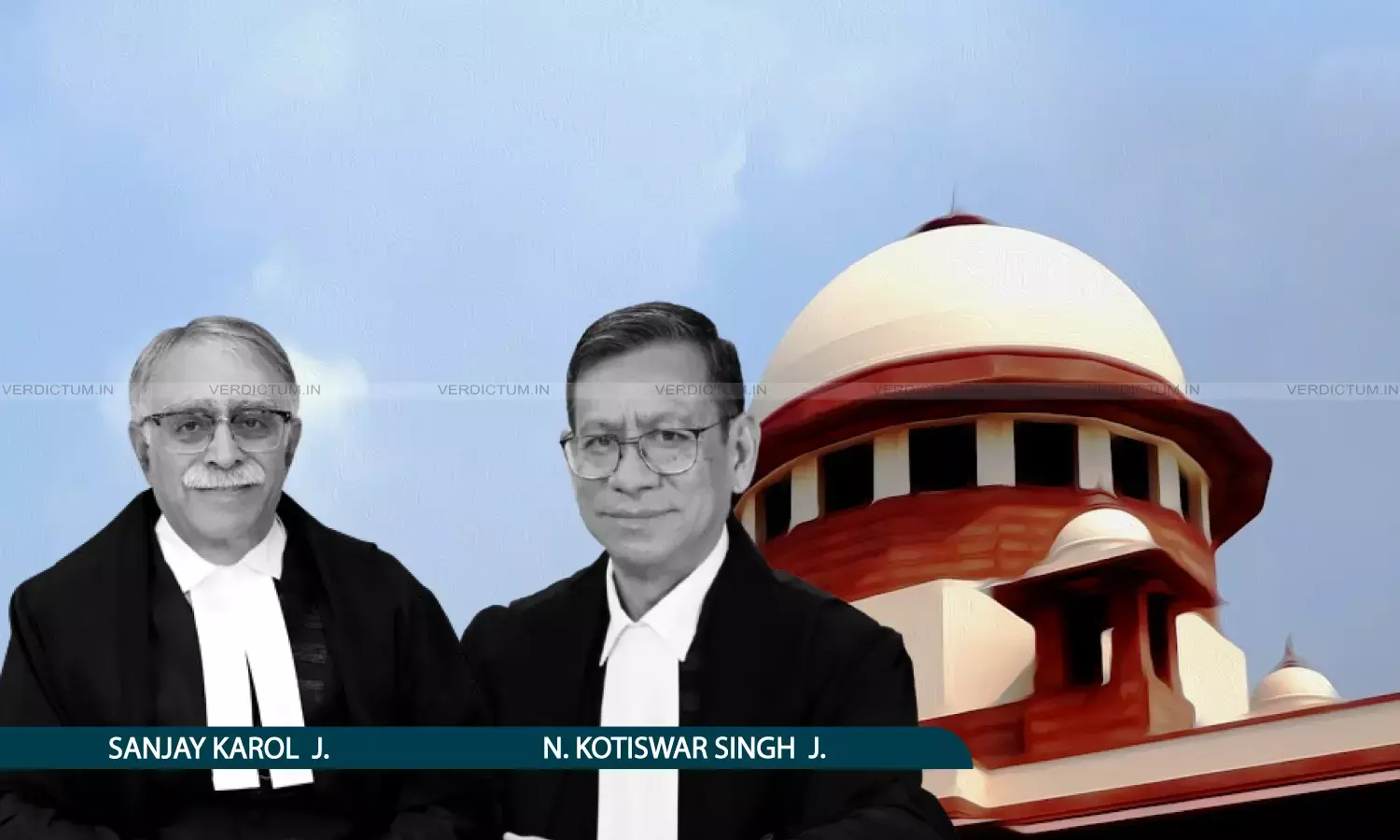
Justice Sanjay Karol, Justice N. Kotiswar Singh, Supreme Court
The Supreme Court has observed that for the application of Section 33 of the Indian Succession Act, it is essential that the deceased person regarding whom the succession dispute is, is a male. The Apex Court further held that when a man legally bought the property in the name of his wife, the application of this provision would be misplaced since the property would be in the name of the wife and the same would be her exclusive property.
The Apex Court was considering an appeal filed by the original defendant challenging the judgment passed by the Chhattisgarh High Court in a Second Appeal.
Referring to the Indian Succession Act, 1925, the Division Bench of Justice Sanjay Karol and Justice Nongmeikapam Kotiswar Singh explained, “For the application of Section 33, as it appears from the plain text of the section, it is essential that the deceased person regarding whom the succession dispute is, is a male. It provides for 3 situations when a male has died intestate and details the portions in which his widow and others, either kindred or descendants lineal in nature, would inherit the property. Each of the scenarios provided therein, need not be explained by us.”
Advocate Ayushi Pandey represented the Appellant while Senior Advocate Priya Hingorani represented the Respondent.
Factual Background
The plaintiffs and defendants are step-siblings. The plaintiffs’civil suit was decreed, and the sale deed executed by the defendants was held to be invalid. The plaintiffs were held entitled to 1/4th share of the property in question. The Defendants were entitled to vacant possession of a specified portion. In the First Appeal filed by the original defendants, the decree of the Civil Court was set aside, and it was held that both plaintiffs and defendants collectively were entitled to half share each from their respective mother. However, since the defendants had sold their share to the sixth Defendant, the sale was held to be valid. The High Court held the two widows of Mattus Anthony (MA), namely Filomina and Shyam Bai, together entitled to 1/3rd of the property, and the children of Filomina (plaintiffs) being the lineal descendants of MA, entitled to 2/3rd of the property.
MA had two wives, Filomina and Shyam Bai. Filomina had three children. Shyam Bai had one son. The parties are Christian by faith. MA, in the year 1959, bought the portion of land for consideration of INR 300, in the name of his two wives. Filomina died in 1985. MA died in 1991, and Shyam Bai died in 2000, with her son John Antony predeceasing her in 1985. The defendants, in 2002, sold their share, i.e., half of the total 1776ft² to the sixth defendant (Marium Anthony). This led the Plaintiffs to file the suit in question. The High Court posed a question as to whether, for the purpose of succession, one or both the wives of MA be considered entitled. It was concluded that the term widow as it appears in Section 33 ISA would cover both widows. It was further held that the Plaintiffs were the lineal descendants of MA.
Reasoning
The Bench was of the view that with respect to the part of the property in the name of Filomena, one third would rest with MA and the remaining two thirds would go to her successors in interest (Plaintiffs). As per the Bench, the property always rested (owned) with the 2 wives of MA and the application of section 33 via section 35, would only limit to the one half of the property that belonged to Filomena”, it stated.
The Bench also clarified that one-third share would be divided amongst the four children of MA and Shyam Bai. As per the Bench, the defendants, i.e. the children of John Anthony, would receive portions out of only the 1/5 th share that fell in the share of John Anthony. The one-fifth share received by Shyam Bai through MA, according to the Bench, was assimilated into her property and the division of said property upon her death would include this share.
The Bench further held that half of the property in the name of Shyam Bai would be distributed only amongst her children. “There is no concept of joint family property as under Hindu law, applicable here. When property is inherited, it is done so as tenants-in-common. It is not the case that Shyam Bai had willed her portion to anyone. She too had died intestate. Section 38 would govern the scenario”, it added.
The Bench thus set aside the orders of the Court below and allowed the appeal.
Cause Title: Shakuntala & Ors. v. Robert Anthony & Ors. (Neutral Citation: 2026 INSC 765)
Appearance
Appellant: Advocate Ayushi Pandey, AOR Satish Pandey
Respondent: Senior Advocate Priya Hingorani, AOR Vikrant Singh Bais, Advocate Neema Singh, AOR Nikhil Jain, Advocates Aditi Ladda, Divya Jain, Arveen Sekhon, AOR Ankita Sharma, Advocates Arjun D Singh, Ishika Neogi