

Right To Travel Abroad Not Absolute: Supreme Court Sets Aside Order Allowing Accused To Travel To USA Despite Availability Of Medical Facilities In India
The Bench noted that the right to travel abroad under Article 21 is not absolute and must be balanced against the complainant's right to a speedy trial.

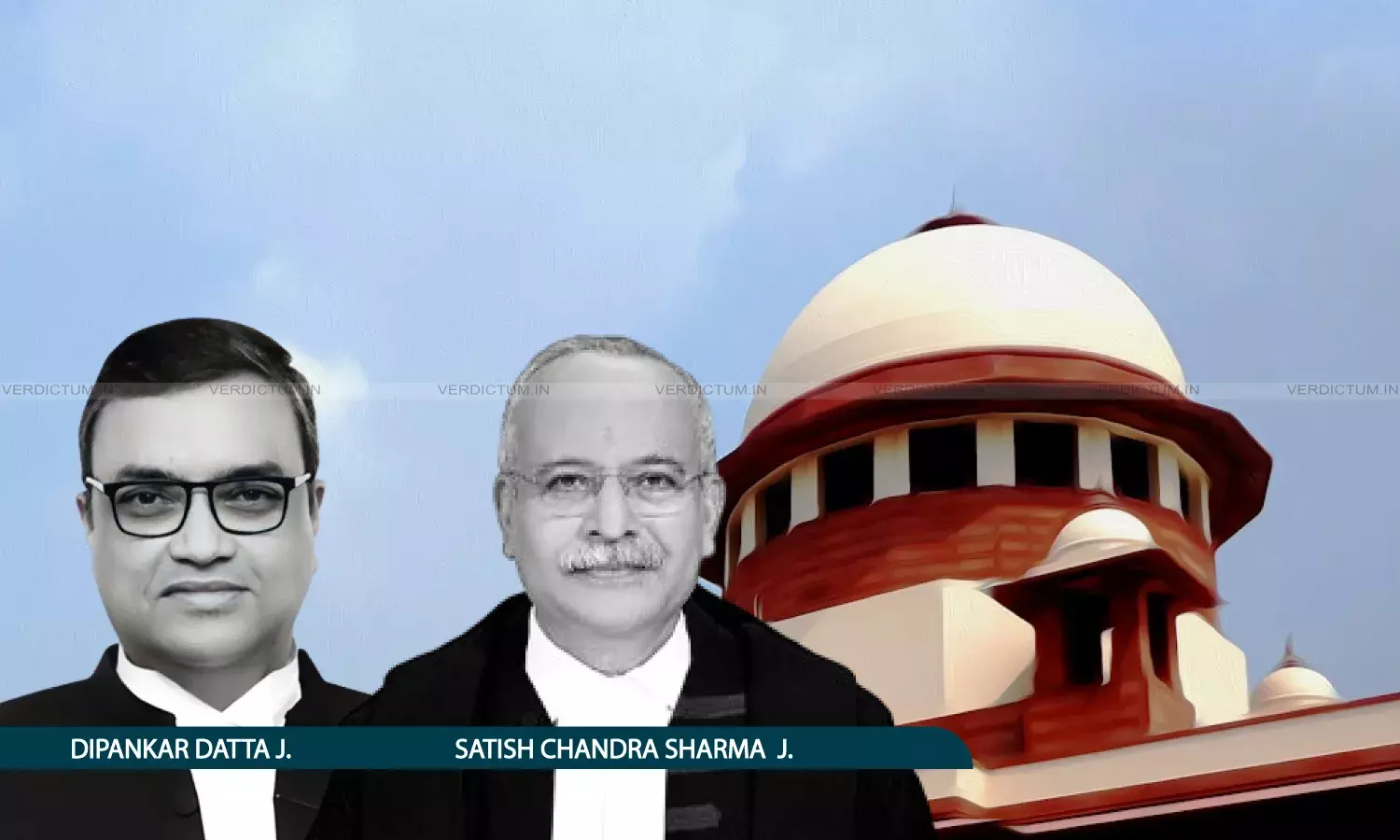
Justice Dipankar Datta, Justice Satish Chandra Sharma, Supreme Court
The Supreme Court has set aside a Telangana High Court order permitting an accused facing trial for abetment of suicide to travel to the United States for medical treatment, holding that the High Court was "indulgent" rather than judicially restrained in granting such permission despite the availability of comparable medical facilities in India.
The Court reiterated that the right to travel abroad under Article 21 of Constitution of India is not absolute and must be balanced against the complainant's right to a speedy trial and the broader societal interest in effective administration of criminal justice.
The Court further noted that an accused who files successive petitions, obtains interim protection, and then withdraws those petitions before final adjudication, while simultaneously leaving the country on a suspended Look Out Circular without seeking leave of the Court, cannot claim that conditions restricting foreign travel amount to an infringement of fundamental rights.
A Division Bench comprising Justice Dipankar Datta and Justice Satish Chandra Sharma observed, “Having regard to the trajectory of the proceedings right from the date the FIR was registered, the conduct of the respondent no.2, the nature of his ailment, and the medical facilities available in India (which, we believe, are comparable with any facility available in any foreign country), we have no doubt in our mind that the High Court instead of exercising judicial restraint was indulgent towards the respondent no.2 and permitted him to travel to the USA even though all medical facilities exist domestically”.
Senior Advocate K. Parameshwar appeared for the appellant and Senior Advocate Niranjan Reddy appeared for the respondent.
The appellant had lodged a complaint in October 2014 regarding the suspicious unnatural death of her father. Following investigation, an FIR was registered and a chargesheet was filed against the respondent No. 2 in February 2016 for offences under Sections 120-B and 306 read with Section 34 IPC.
However, despite the chargesheet having been filed a decade ago, the matter still remained at the stage of committal.
The respondent, a US citizen with family and business in India, had filed multiple petitions before the High Court over the years, obtained interim protections and then withdrew the petitions before their final adjudication.
In 2016, he obtained an order suspending the Look Out Circular and left India in 2017, returning only in April 2025 when he was arrested at the Rajiv Gandhi International Airport, Hyderabad. Upon release, he sought return of his passport and permission to travel to the USA for medical treatment, stating he had suffered two brain strokes in 2023.
Thereafter, the Magistrate directed release of the passport while clarifying that prior court permission would be required for foreign travel. The State's revision petition succeeded before the Sessions Court, which reversed the Magistrate's order and directed deposit of the passport.
The High Court, in revision, set aside the Sessions Court order and permitted travel to the USA subject to conditions, citing twelve appearances before the Magistrate and medical needs.
Now, the Supreme Court holding that the High Court erred in permitting travel, noted the trajectory of proceedings showed a consistent pattern of the respondent seeking judicial intervention at every turn to impede the trial, obtaining interim protection and withdrawing petitions before final adjudication.
“…Suffice it to observe that the right to a speedy trial is equally an integral facet of Article 21. While Article 21 undoubtedly guarantees the fundamental right to personal liberty, which includes the right to travel abroad, such right cannot be viewed in isolation. A balance must be struck between the individual liberty of the respondent no. 2 on the one hand and the right of the appellant to a speedy trial together with the larger societal interest in ensuring the effective administration of criminal justice, on the other”, it said.
Consequentially, the impugned High Court order and the Sessions Court order were both set aside. The Magistrate's order of May 7, 2025 was restored.
The respondent was not required to deposit his passport but was restrained from leaving the country without express permission of the Sessions Court after committal. Civil, police and airport administration were directed to coordinate to ensure compliance.
The Court encouraged expediting the process of committal. All observations were clarified as not constituting findings on the merits.
Cause Title: Seesa Santosh v. The State of Telangana and Anr. (Neutral Citation: 2026 INSC 628)
Appearances:
Appellant: K. Parameshwar, Senior Advocate.
Respondents: Niranjan Reddy, Senior Advocate.