

Can Section 5 Limitation Act Be Extended To Appeals Filed Under Section 85(3A) Of Finance Act, 1994? Supreme Court To Examine
The Bench issued notice in a Special Leave Petition challenging a Telangana High Court order.

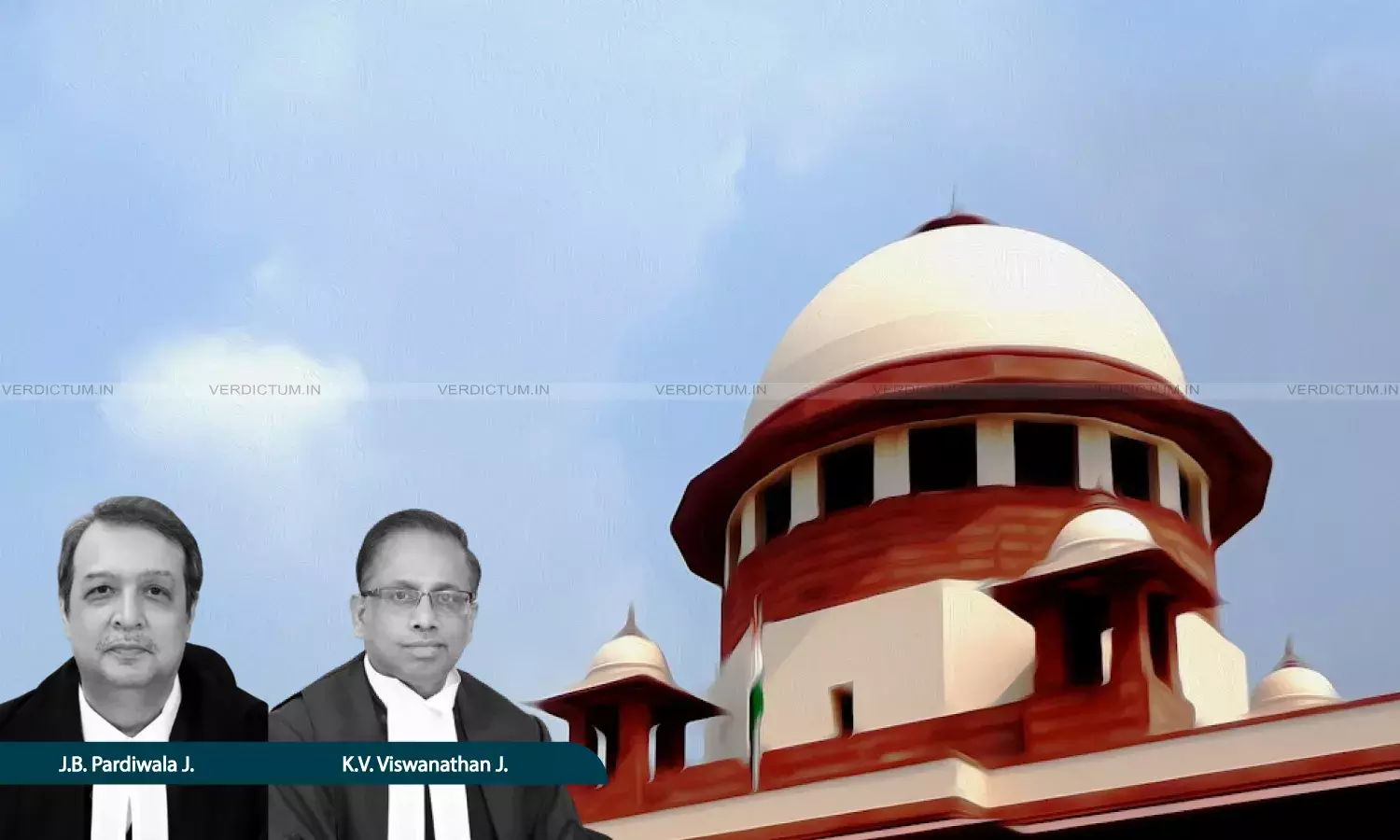
Justice J.B. Pardiwala, Justice K.V. Viswanathan, Supreme Court
The Supreme Court has issued notice in a Special Leave Petition raising the question whether the benefit of Section 5 of the Limitation Act, 1963, which allows for the condonation of delay upon showing "sufficient cause," can be extended to appeals filed under Section 85(3A) of the Finance Act, 1994.
The Telangana High Court had previously refused to interfere with an appellate authority’s decision to dismiss an appeal that was filed with an "abnormal" delay of over two and a half years—a period significantly beyond the condonable limit typically permitted under service tax laws.
The Bench of Justice JB Pardiwala and Justice KV Viswanathan observed, "The short point that falls for our consideration is whether for the purpose of condoning delay insofar as Section 85(3) A of the Finance Act. 1994 is concerned, whether Section 5 of the Limitation Act would apply or not...Issue notice, returnable in four weeks."
Senior Advocate K. Parameshwar appeared for the Petitioner.
The Petitioner referred to a Three-Judge Bench decision of the Apex Court in “Commissioner of Customs & Central Excise vs. Hongo India Private Limited & Another” (2009) and also the decision of the Two-Judge Bench of this Court in the case of “Union of India vs Popular Construction Co.” (2001).
Before the Telangana High Court, a writ petition was filed challenging the show-cause notice culminating in the Order passed by the Commissioner of Central Tax and Central Excise and Order-in-Appeal passed by the Commissioner of Appeals, as arbitrary, illegal, violative of the principles of natural justice and without jurisdiction.
The case began when the Adjudicating Authority received information from Income Tax Authorities regarding the petitioner's income for the financial years 2015-16 and 2016-17. The petitioner, Morthala Sidda Reddy, reported income of approximately Rs. 2.99 crore and Rs. 1.47 crore for those years but failed to file service tax returns (ST-3). After the petitioner failed to respond to several departmental correspondences, the authority construed his income as consideration for taxable services under Section 72 of the Finance Act, 1994.
Consequently, a show-cause notice was issued, demanding service tax of ₹72,20,229 along with interest and penalties. Since no reply was filed and notices for personal hearings went unserved, the adjudicating authority passed an ex-parte Order-in-Original. The petitioner eventually filed an appeal before the Commissioner (Appeals), but it was dismissed, due to an abnormal delay of more than two and a half years, which was beyond the authority's condonable jurisdiction.
Before the High Court, the Petitioner argued that he provided works contract services for various State Government projects, which he believed were exempt from service tax. He claimed that he never received the initial departmental communications or the notices for personal hearings as they were returned unserved. He stated that both he and his tax consultant suffered from severe Covid-19 complications during the relevant period.
The Respondents maintained that the petitioner failed to disclose taxable services and ignored multiple statutory correspondences. It was asserted that the Order-in-Original was passed following the standard procedure when the petitioner remained absent despite notices being sent to his registered address.
The High Court observed that the adjudicating authority had indeed issued several notices to the petitioner’s registered address and provided three separate opportunities for personal hearings. It noted that the petitioner was constantly absent during these proceedings.
Regarding the delay, the High Court found that the petitioner failed to provide sufficient or valid grounds to justify the "inordinate and abnormal" delay of more than two and a half years.
Citing Supreme Court precedents, the High Court emphasized that such long delays must be explained properly to entitle a party to condonation. Ultimately, the Court held that the Appellate Authority was justified in rejecting the appeal due to laches and dismissed the writ petition as being devoid of merit.
Accordingly, the matter is now before the Apex Court for further consideration.
Cause Title: Morthala Sidda Reddy v. The Union of India and others [Special Leave to Appeal (C) No(s). 7778/2026]
Appearances:
Petitioner: Senior Advocate K. Parameshwar, Advocate on Record Sandeep Singh, Advocate Tadimalla Bhasker Gowtham, Advocate M. Parameswara Reddy, Advocate M. Chandrakanth Reddy, Advocate Prasad Hegde, Advocate N. Sai Kaushal, Advocate Veda Singh, Advocate Aditi Garg, Advocate Vallari Km, Advocate Godavari V Durga Prasad, Advocate Shambhavi Shiva.