

Tribunal Hijacked By MCA: Apex Court Says Autonomy Of Tribunal Is Impinged & Seeks Proposal From NCLAT & NCLT On Infrastructure Deficiencies
The Court declined to restrain the removal of the contractual staff, stating that it did not wish to “tie down” the President of the NCLT.

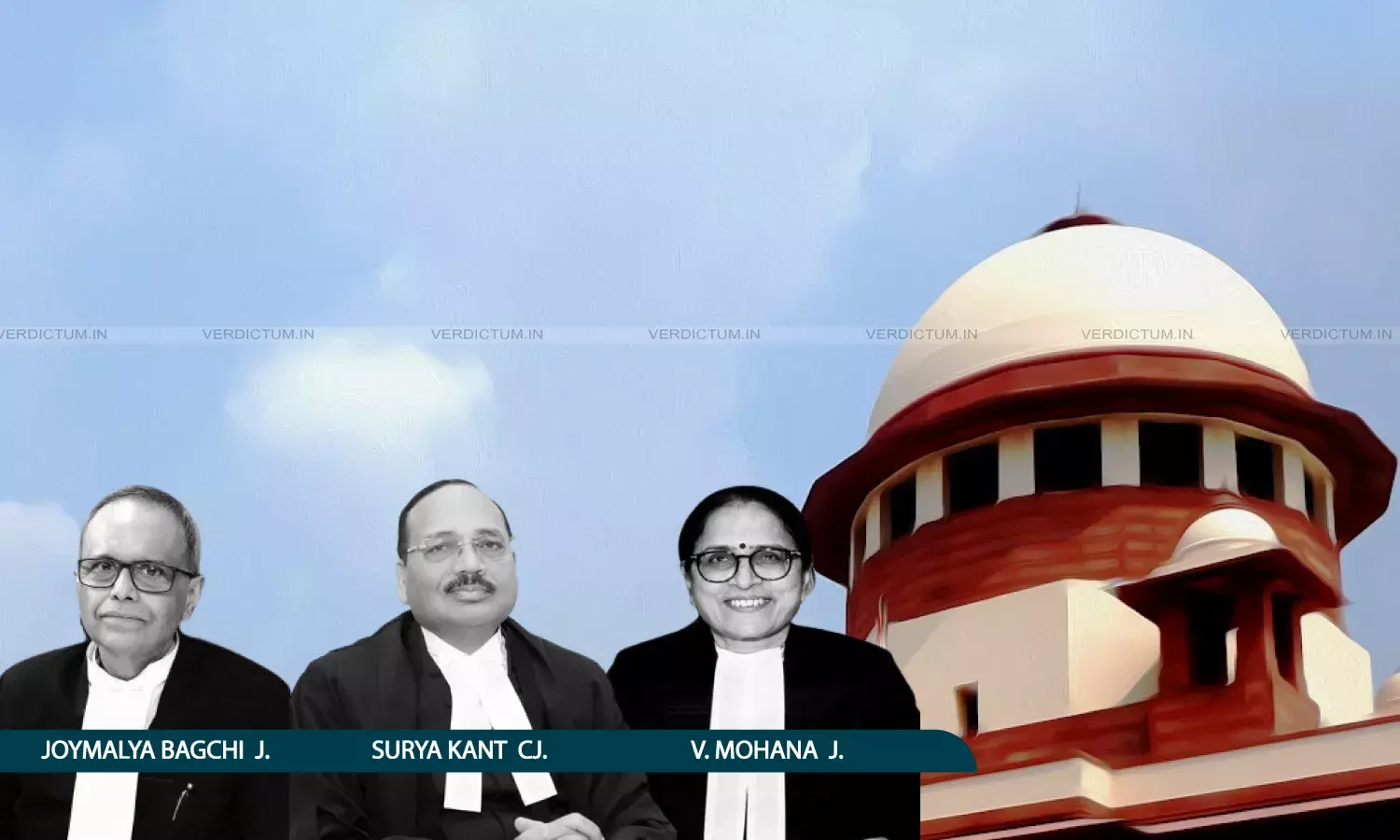
CJI Surya Kant, Justice Joymalya Bagchi, Justice V. Mohana, Supreme Court
The Supreme Court asked the Presidents of the National Company Law Tribunal (NCLT) and the National Company Law Appellate Tribunal (NCLAT) to submit a comprehensive proposal on the requirements needed to strengthen the day-to-day functioning of the tribunals, including land, buildings and supporting staff, within four weeks.
The Apex Court was hearing a suo motu case regarding the appointment of judicial and technical members and inadequate infrastructure in the NCLT.
It was observed that the matters had highlighted the deficient infrastructure and lack of supporting staff hampering the tribunals’ functioning.
In a connected matter concerning the outsourcing of recruitment of tribunal staff to a private entity, the Bench orally observed that the NCLT had been “completely hijacked” by the Ministry of Corporate Affairs, impinging on the institution’s autonomy, and issued notice on the plea.
The Bench of Chief Justice Surya Kant, Justice Joymalya Bagchi and Justice V Mohana ordered, "These matters have highlighted the inefficient, deficient infrastructure and lack of supporting staff, which is hampering the day-to-day functioning of these tribunals. A status report has been filed highlighting the lack of amenities. Now, it seems to us that the most appropriate authority to assist us in the matter would be the learned Presidents of the NCLT and NCLAT. We therefore request them to submit a comprehensive proposal with respect to the requirements that would strengthen the day-to-day functioning of the tribunals."
The Bench also observed that the Tribunal had been hijacked by the Ministry of Corporate Affairs, which impinged on the autonomy of the institution, and that this required examination.
It said, "This system, the tribunal, we are compelled to observe this has been completely hijacked by Ministry of Corporate Affairs. That is the problem, and that is impinging on the autonomy of the institution. it's what you need to look into."
AG R Venkataramani proposed a joint meeting with the President of the NCLT, the government and the Bar so as to figure out the matters which are on priority.
To which Senior Advocate Sanjiv Sen replied that this must have been done in the last month after the previous directions of the Court.
"As far as infrastructure is concerned, it is collapsing. The roofs are collapsing. The 8th floor of the Principal Bench has been shut down. 7th floor has been shut down. Two floors have been shut down. All courts are functioning at half strength. It is in shambles...Union has not filed its suggestions", he added.
Senior Advocate Arundhati Katju submitted, "Because they are short-staffed, and because of the exigencies, certain categories of matters end up being taken up. Certain categories, for example for personal guarantors, because they are kept at the end of the list for whatever prioritization, they never end up reaching. So whatever, this is not an adversarial litigation."
The Court suggested, "We can request the President of NCLT as well as President of NCLAT to send their viewpoints because they are the best persons to know the internal institutional functioning and what their requirements are."
The Bench noted that the Attorney General had suggested a meeting and directed that it be held in the interim to ensure that basic amenities were made available to the Tribunals at the earliest.
"The proposal may also include the requirement of land and building, as well as requisite staff. The NCLT may also consider the desirability of having an officer in the rank of Deputy or Joint Registrar for every bench, for the purpose of upkeep of the judicial record. Let all such requirements be examined and placed before us by the learned President. We will appreciate if the requisite information is forwarded to this court within four weeks, post the memorandum so dated. We issue a direction to communicate these orders to the NCLT and NCLAT", the Court added in the order.
In another connected matter, the Counsel for the Petitioner submitted that the entire process of appointment, from Deputy Registrars and Assistant Registrars to stenographers, had been outsourced to a private entity, allegedly a foreign company operating in India.
It was contended that such staff were attached to the discharge of judicial functions, and that appointments had therefore to be made in accordance with the recruitment rules. It was further submitted that the outsourcing had been effected by the Ministry of Corporate Affairs (MCA) and not by the President of the NCLT.
She submitted, "But they have now awarded the contract, so the people who are already discharging their duties, they are likely to be removed on the 1st or the 2nd of November. There are people who have been appointed since 2018-2019 and have been continuing till date. There may be some more recent appointments. They are contractual, but they were appointed for NCLT, but today these employees will be the employees of that particular company. They will not even be government employees, not even under the government. They will be employees of a private entity, the private entity will outsource these people to NCLT all over the country. That will completely affect the judicial discharge of functions."
Chief Justice Kant said, "We will not entertain this plea on behalf of the employees who have personal interest involved in this issue. Those who themselves came through this very method, we will definitely consider this aspect once the NCLT President points out to us. Merely because this is something like railway traveling, that because I have entered into the bogey, I will not allow now everyone. Every point, you are so entered to this in the same manner. Now, you don't want the others to come."
Counsel clarified that the contention was not to resist others but to maintain that, while recruitment could be outsourced, the employer-employee relationship must continue with the NCLT. The Bench agreed that the recruitment process might be handled by an agency but held that the employees had to be under the NCLT. It expressed concern as to how the fidelity of the functioning system was to be protected.
Counsel submitted that the employees had been appointed by the Government, which was obliged to make all resources available to the NCLT, and that there was no overlap between the petition pending before the Bombay High Court and the present petition. The Bench observed that the matters were similar. Counsel prayed that, till the Court decided the manner of appointment, the existing employees should not be removed abruptly.
The Bench stated that the contract had been awarded and that, in all likelihood, all present personnel would be required to leave by 1 or 2 November. It asked how those who had worked for a long period had been appointed. Counsel submitted that the employees, though engaged on a contractual basis by the MCA and not entitled to HRA or DA, ordinarily enjoyed regularisation after a stipulated period. The Bench stated that it did not approve of the said system and that regularisation could not follow where there had been no competitive process.
Counsel relied on Rule 10 of the NCLT recruitment rules, which provides for regularisation, and learned counsel added that the advertisement also so provided. It was submitted that termination of the employees “lock, stock and barrel” would be arbitrary and violative of Articles 14 and 16 of the Constitution. Counsel prayed for a fixed date for any termination and for a direction that there be no termination without the approval of the President.
The Bench made strong oral observations regarding the conduct of certain contractual employees, citing the Bombay instance in which the original records were allegedly removed and FIRs were registered, and observed that such employees harassed judicial Members. It opined that complete autonomy must rest with both Presidents and that the power of appointment must rest with the President alone. It stated that it would not allow the private contractors to continue.
"All of you are also back-door entrants, and you are creating trouble wherever you are. In Bombay instance, I know it that how these so-called contract employees, they ran away along with the original record, and FIRs had to be registered. There, they don't care about the judicial members, they don't care about the technical members. Technical members still are manipulating certain things. I don't want to say in open court. But judicial members, these very employees are harassing them, these contractual employees. So let them also go, this company also will be disbanded. The complete autonomy must be with both the presidents", the Court said.
The Bench declined to issue any such direction, stating that it did not wish to tie down the President and wished to leave him full autonomy, the only concern being the time within which the exercise was completed.
Accordingly, the Court issued the notice in the plea.
Previously, the Court had remarked while directing the Centre to identify infrastructural amenities urgently required by the National Company Law Tribunal benches in consultation with the NCLT president.
Cause Title: In Re: Appointment of Judicial and Technical Members and Inadequate Infrastructure in National Company Law Tribunal (NCLT) and Ancillary Issues Vs [SMW(C) No. 16/2026] and Ziyaul Haq v. Union of India [W.P.(C) No. 1385/2026]