

Complainant Seeking Restitution Of Amount Paid Doesn’t Make It Civil Dispute Or Efface Allegations Of Cheating: Supreme Court
The Supreme Court was considering an appeal whereby the complainant challenged the anticipatory bail granted to the accused.

While cancelling the anticipatory bail granted to an accused in a case of cheating, the Supreme Court has held that the mere fact that the complainant seeks restitution of the amount paid does not efface the allegations of cheating or fraud.
The Apex Court was considering an appeal against the order of the Allahabad High Court granting anticipatory bail to the second respondent (accused) in connection with an FIR registered under Sections 406, 420, 467, 468, 471, 506, 120-B and 34 of the Indian Penal Code. Aggrieved by the grant of such protection, the complainant had approached the Court.
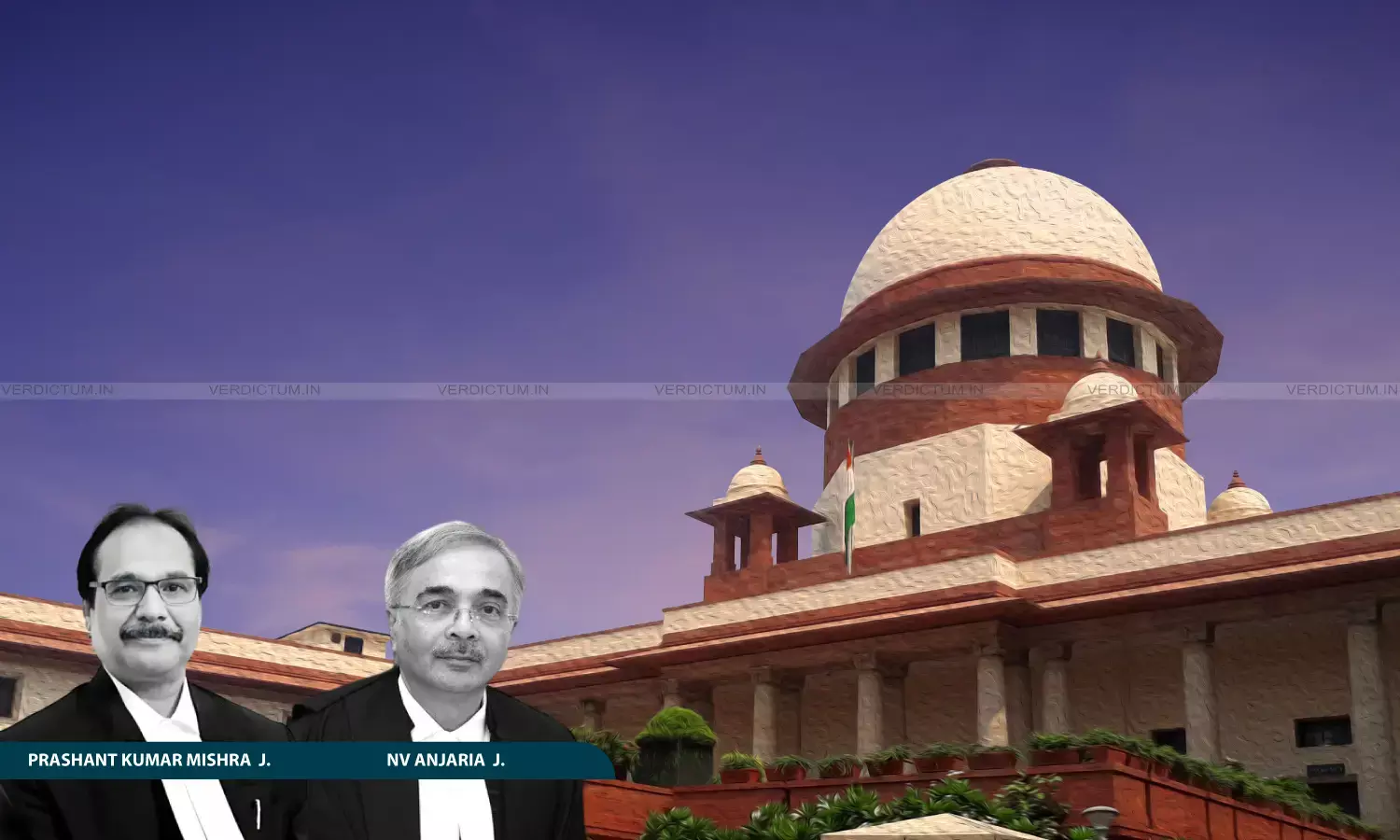
The Division Bench of Justice Prashant Kumar Mishra and Justice N.V. Anjaria held, “Equally, the observation of the High Court that the complainant has sought refund of the amount in the FIR, thereby indicating a civil dispute, cannot be accepted as a ground to dilute the criminal allegations. It is well settled that the existence of a civil remedy does not preclude criminal proceedings where the ingredients of a criminal offence are prima facie made out. The mere fact that the complainant seeks restitution of the amount paid does not efface the allegations of cheating or fraud.”
Advocate Rohit Pandey represented the Appellant while AOR Shaurya Sahay represented the Respondent.
Factual Background
The FIR came to be lodged by the complainant alleging a large-scale financial fraud in relation to a residential property in Lucknow, which was represented to be jointly owned by the second Respondent and her daughter. According to the complainant, acting on such representation, he entered into an agreement to sell. A sum of Rs 3,55,00,000 was paid in instalments through various modes, as acknowledged in the agreement. It was alleged that despite the receipt of substantial consideration, the second respondent and her son proceeded to execute a sale deed in favour of a third party, thereby transferring the entire property. The complainant asserted that the daughter had no ownership interest in the property, rendering the earlier representation false.
Upon demanding either the execution of the sale deed or the refund of the amount paid, the complainant was allegedly threatened. It was in such circumstances that the FIR came to be registered. Aggrieved by the grant of anticipatory bail, the complainant preferred an appeal before the Apex Court seeking cancellation of the same.
Reasoning
The Bench noted that the High Court had relied on the fact that the agreement to sell was notarised and not registered. “This reasoning, in our view, is misplaced. The nature or form of the agreement does not, by itself, determine the existence or otherwise of a criminal offence. The allegation is not merely of breach of contract, but of fraudulent inducement and subsequent conduct inconsistent with the representations made. The absence of registration does not, therefore, neutralize the criminality alleged”, it added.
The Bench further noticed that any consideration of material and relevant factors which ought to have guided the exercise of discretion of granting anticipatory bail to the Respondent was conspicuously absent in the impugned order. The allegations pertained to an economic offence involving a substantial sum, coupled with assertions of deliberate conduct in alienating the property to a third party after receipt of a major portion of the sale consideration. The Bench noticed that while dismissing the quashing plea preferred by the second Respondent and her son, the High Court itself had recorded the existence of multiple criminal antecedents of a similar nature against the accused persons.
Considering such aspects, the Bench stated, “Despite this, the impugned order of the High Court is completely silent on this aspect. The omission to consider such relevant factors, particularly in a case involving allegations of economic fraud, renders the exercise of discretion by the High Court unsustainable.”
On a perusal of the facts, the Bench stated that the allegations pertained to an economic offence involving a substantial amount, coupled with assertions of deliberate and premeditated conduct on the part of the second Respondent and her son in inducing the complainant to part with a significant portion of the consideration and thereafter transferring the property to a third party. The Bench further found that the second Respondent and her son were not readily available during the course of investigation and coercive steps were required to secure their presence. “Having regard to the nature of the allegations, the magnitude of the transaction, the antecedents attributed to Respondent No. 2, and the requirements of a fair and effective investigation, we are of the considered view that the grant of anticipatory bail to Respondent No. 2 at this stage is not warranted”, it stated.
Holding that the impugned order did not reflect a proper application of mind, the Bench set aside the same and cancelled the anticipatory bail granted to the second Respondent.
Cause Title: Saurabh Agrawal v. State of Uttar Pradesh (Neutral Citation: 2026 INSC 548)
Appearance
Appellant: Advocates Rohit Pandey, Adhyayan Gupta, Ashtha Shrivastav, Aryama Dubey, Amit Kr Mishra, Ipsit Pallav, Utkarsh Chauhan, Ajay Pratap Singh, Tannu Tyagi, Hridyesh, Aditya Kumar Tiwari, AOR Sadhana Sandhu
Respondent: AOR Shaurya Sahay, Advocates Aman Jaiswal, Sharvi Sharma, Vikas Bansal, Ashish Singh, AOR Vidushi Bajpai