Order XXII Rule 10 CPC Plea Barred By Res Judicata If Same Transfer Was Earlier Decided On Merits Under Order I Rule 10 CPC: Supreme Court
The Court held that Order I Rule 10 CPC and Order XXII Rule 10 CPC operate in distinct fields, but clarified that a transferee cannot re-agitate the same impleadment claim under a different provision if the earlier rejection on the same transfer and facts had attained finality.
The Supreme Court has held that an application under Order XXII Rule 10 CPC would be barred by res judicata where an earlier impleadment application under Order I Rule 10 CPC was decided on merits after examining the same transfer, the same interest and the same facts, and the order was neither appealed nor reviewed.
The Court was hearing an appeal arising from a property dispute in which subsequent purchasers sought impleadment under Order XXII Rule 10 CPC after their earlier impleadment plea under Order I Rule 10 CPC, based on the same registered sale deed, had been rejected by the High Court.
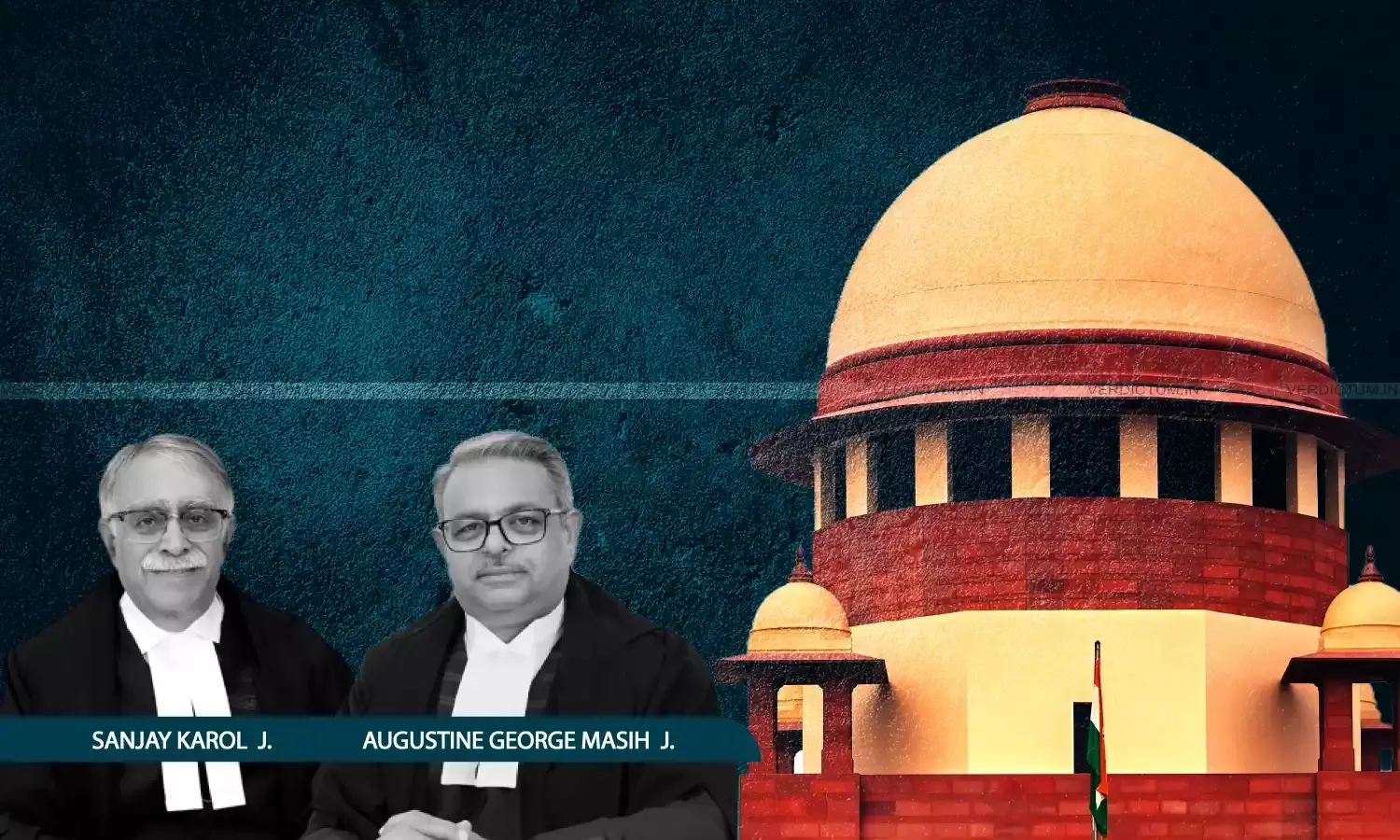
A Bench of Justice Sanjay Karol and Justice Augustine George Masih observed:
“Where the Order I Rule 10 application was considered and rejected on its merits i.e., the court actually examined the transferee's claim, the genuineness/bona fides of the transfer, and the nature of the interest, and that order was not appealed or reviewed, a second application under Order XXII Rule 10 raising the claim based on the same transfer, same interest, same facts would ordinarily be barred by the principles of res judicata as issue has been decided on merits and attained finality."
This bar however, the Bench added: "...would not apply if, the earlier rejection was on a technical or procedural ground without an adjudication on the merits of the transferee's interest, or there is a fresh devolution or assignment after the rejection of an application under Order I Rule 10, giving rise to a distinct cause not earlier considered, or when the earlier order is itself under challenge and has not attained finality.”
Senior Advocate Rajive Bhalla appeared for the petitioner, while Senior Advocate Sumeet Mahajan appeared for the respondents.
Background
The litigation arose from a property dispute in which the original plaintiff claimed rights in certain properties left behind by a deceased owner. The Trial Court dismissed the suit, but the First Appellate Court partly reversed that decision and accepted the appellant’s claim of adoption while recognising rights in part of the property.
A second appeal was thereafter filed before the High Court, and cross-objections were also filed. During the pendency of the litigation, two subsequent purchasers acquired part of the property through registered sale deeds.
The subsequent purchasers first sought impleadment in the main appeal under Order I Rule 10 CPC. That application was dismissed. Years later, after the main appeal and cross-objections were dismissed for non-prosecution and only the cross-objections were restored at the instance of the appellant, the subsequent purchasers again moved applications, this time invoking Order XXII Rule 10 CPC, along with applications for restoration and condonation of delay.
The High Court allowed their applications, restored the main appeal, and impleaded them in both the main appeal and the cross-objections. The appellant challenged that order before the Supreme Court.
Court’s Observations
The Supreme Court first examined Section 11 CPC and the doctrine of res judicata. It noted that the principle applies even at subsequent stages of the same proceeding where an issue has already been decided, and that an erroneous judicial decision binds the parties unless corrected in appeal or review.
The Court stated: “It is, by now, a settled position that the doctrine of res judicata is applicable on subsequent stage(s) of same proceedings if, the question or issue involved has been decided at an earlier stage of same litigation as held in S. Ramachandra Rao (supra). Further, it is also well settled, as laid down in several decisions, that a judicial decision binds whether it is right or wrong. An error of law or fact, committed by a judicial or quasi-judicial body cannot be impeached otherwise than in appeal, unless it relates to a matter of jurisdiction.”
Explaining the scope, the Court elaborated: “Order XXII Rule 10 of the CPC is a specific enabling provision governing devolution of interest during the pendency of a suit or appeal. Its operation is distinct from the general joinder of party power under Order I Rule 10. The court's power under Order XXII Rule 10 is triggered by a factual event by an assignment, creation, or devolution of interest and not merely by a party's desire to join proceedings. Only a prima facie satisfaction of devolution is required and no detailed inquiry into title is conducted at this stage. The provision applies at every stage, including appellate proceedings, and a subsequent purchaser who acquires interest pendente lite may seek substitution or addition through this route. Therefore, the dismissal of an application under Order I Rule 10 of the CPC does not, as a general rule, operate as res judicata to bar a subsequent application under Order XXII Rule 10.”
The Bench also noted that res judicata cannot be invoked unless there has been a conscious adjudication on merits, while remarking: “It has been reiterated by the Supreme Court repeatedly that to attract the doctrine of res judicata there must be conscious adjudication of an issue. A plea of res judicata cannot be claimed unless the judgment carries an expression of an opinion on the merits.”
The Court explained that Order I Rule 10 concerns the addition or deletion of necessary or proper parties, while Order XXII Rule 10 deals with the assignment, creation or devolution of interest during the pendency of litigation.
The Bench observed: “The two provisions address fundamentally distinct legal situations, and a rejection under one does not constitute a final adjudication on the merits of the other. Order I Rule 10 CPC governs the addition or deletion of parties who are necessary or proper parties to the suit ab initio, i.e., parties who ought to have been joined at the inception of the suit. Order XXII Rule 10 CPC governs the situation where interest in the subject matter of the suit devolves upon a third party during the pendency of the suit, i.e., a transferee or assignee pendente lite.”
However, the Court added that the two remedies may overlap in some factual situations because both may seek impleadment of a party.
Applying the law to the main appeal, the Court found that the subsequent purchasers had earlier sought the same relief of impleadment on the basis of the same registered sale deed. That earlier rejection, though factually erroneous, had attained finality.
The Court held: “The record reveals that the subsequent purchasers had previously sought an identical relief of impleadment under Order I Rule 10 of the CPC, predicated upon the same registered sale deed executed in their favour. The right to seek substitution or impleadment, if any under Order XXII Rule 10 of the CPC, had squarely accrued and was triggered at the time of filing the initial application.”
The Bench added: “Consequently, the underlying issue regarding the subsequent buyer’s right to be impleaded on the strength of the said title was earlier directly and substantially in issue between the same parties, litigating under the same title, before a court of competent jurisdiction, and was conclusively decided against them.”
Thus, the Court held that the later Order XXII Rule 10 application in the main appeal was an impermissible re-agitation of the same issue under a different statutory route.
The Supreme Court, however, distinguished the position in relation to the cross-objections. It noted that the earlier Order I Rule 10 application had been filed only in the main appeal, not in the cross-objections.
The Court observed: “However, as noted above the earlier application under Order I Rule 10 of the CPC was filed for impleadment in the main appeal only and not in the cross-objections. Therefore, the principle of res judicata will not apply qua the application filed under Order XXII Rule 10 of the CPC in the cross-objections preferred by the Appellant.”
The Court further found that after the main appeal and cross-objections were dismissed for non-prosecution, the cross-objections alone were restored. Since the prior owners did not seek restoration of the main appeal despite requests, the subsequent purchasers faced prejudice in relation to the property purchased by them.
The Bench noted: “This resulted in material change in circumstances causing grave prejudice to the rights of the subsequent purchasers because of non-prosecution by the prior owners qua the property purchased which is the subject-matter in the cross-objections. Also, the possibility of a collusion between the Appellant and sellers of the subsequent purchasers - Respondent Nos. 3 and 4 cannot be ruled out.”
Conclusion
The Supreme Court partly allowed the appeal. It set aside the High Court’s order to the extent it restored the main appeal and impleaded the subsequent purchasers in that appeal. However, it upheld the High Court’s order allowing their impleadment as respondents in the cross-objections.
Cause Title: Sanjiv Kumar v. Shakuntla Devi and Others (Neutral Citation: 2026 INSC 747)
Appearances
Petitioner: Senior Advocate Rajive Bhalla with Advocates Shubham Bhalla, Yash, Anchita Nayyar, Yajur Bhalla, Kamal Joshi, Rohit Pandey, Alex Noel Dass and Ragini Sharma
Respondents: Senior Advocate Sumeet Mahajan with Advocates Saksham Mahajan and Chritarth Palli