Can Article 226 Jurisdiction Be Divided Into Civil And Criminal To Bar Intra-Court Appeals? Supreme Court Refers Question To Larger Bench
The Bench questioned whether classifying writ jurisdiction according to the underlying dispute creates a division not found in Article 226 and restricts access to an intra-court appellate remedy.
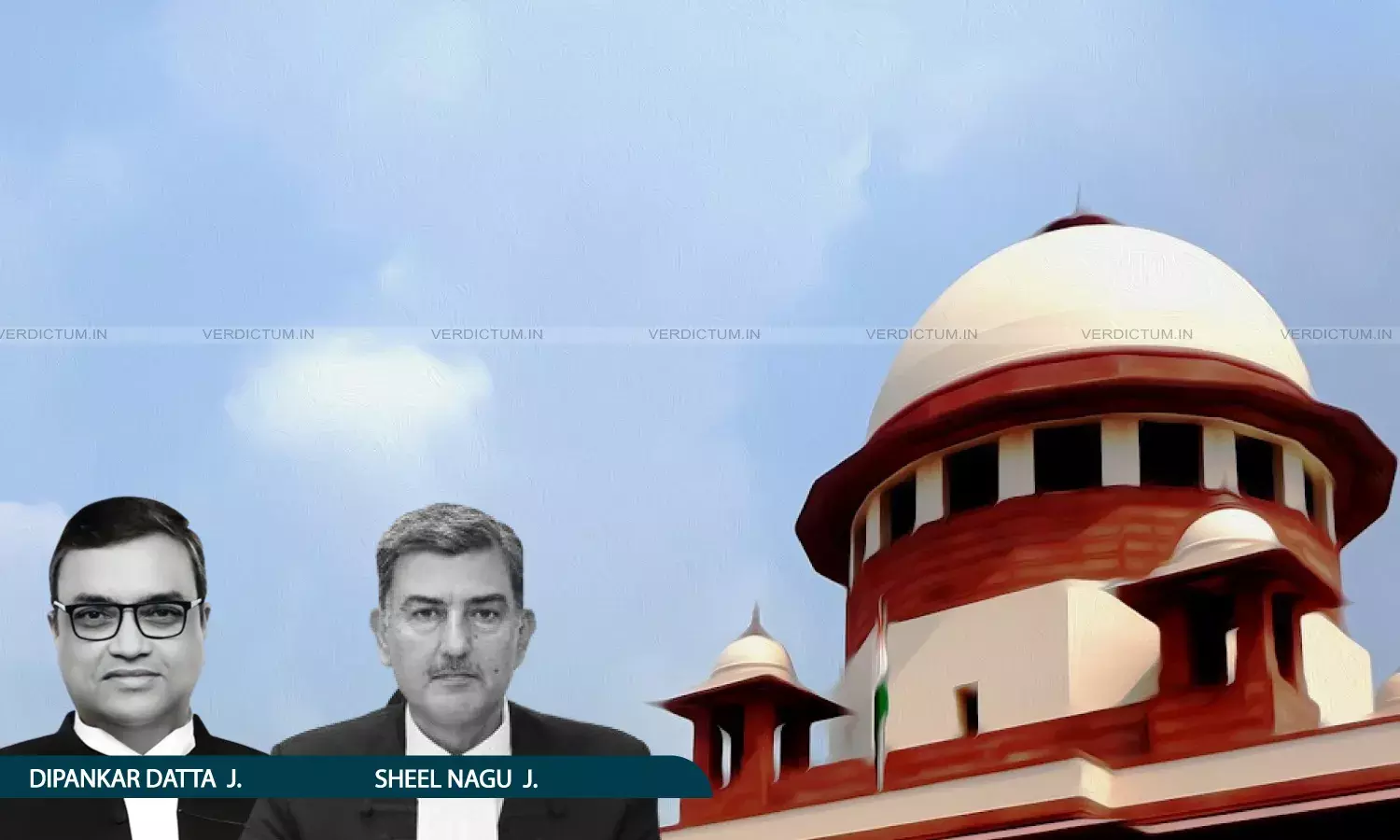
Justice Dipankar Datta, Justice Sheel Nagu, Supreme Court
The Supreme Court has referred to a larger Bench the question whether Article 226 jurisdiction can be classified as civil or criminal based on the subject matter of a writ petition, thereby excluding an intra-court appeal under the applicable Letters Patent.
The Court was hearing an appeal by an alleged contemnor against an interim order of the Allahabad High Court’s Lucknow Bench. The High Court had rejected his compliance affidavit in a civil contempt proceeding and directed his personal appearance if its earlier writ order remained unimplemented.
A Bench of Justice Dipankar Datta and Justice Sheel Nagu expressed doubts about the correctness of the existing position that a writ proceeding arising from a criminal matter amounts to the exercise of criminal jurisdiction.
The Bench observed: “The decision in Ram Kishan Fauji (supra), with respect, proceeds on the premise that Article 226 contains within it two jurisdictions – civil and criminal – and that the subject matter of the lis can determine the nature of the jurisdiction. Neither historical context nor the constitutional text nor the scheme of the Letters Patent nor settled judicial principle prior to such decision supports this division as well as the view that the writ court’s dealing with a criminal matter would amount to the exercise of ‘criminal jurisdiction’, thereby barring an intra-court appeal. Article 226, in plain terms, confers a single, original, special, and extraordinary constitutional jurisdiction. Such jurisdiction is also neither civil nor criminal, but sui generis.”
Additional Solicitor General K.M. Nataraj appeared for the appellant. Advocate Gunjan Kumar appeared for the respondents.
Background
The dispute originated from a writ order quashing two administrative communications and directing the authorities to consider the respondents’ candidature for recruitment as Assistant Prosecution Officers. The appellant submitted that he subsequently rejected the respondents’ candidature and placed that decision before the contempt court through a compliance affidavit.
The Single Judge hearing the contempt application rejected the compliance affidavit. The Judge concluded that the earlier writ order required the State to appoint the respondents and directed the concerned officer to appear personally if the order was not complied with.
The appellant argued that a contempt court could not judicially review the correctness of an order passed in purported compliance with a writ direction. He further contended that a Special Appeal was barred because contempt jurisdiction was essentially criminal in nature and invoked the Supreme Court’s jurisdiction under Article 136.
The Supreme Court stated that it would not examine whether the Single Judge had exceeded the limits of contempt jurisdiction. It confined its consideration to whether the appellant had an intra-court appellate remedy before the High Court.
Court’s Observations
Article 226 Confers A Single Constitutional Jurisdiction
The Bench reasoned that Article 226 confers upon High Courts an extraordinary, original constitutional jurisdiction to enforce fundamental rights and other legally protected rights. According to the Bench, the existence of this jurisdiction does not depend on whether the facts originated in civil or criminal law.
The Bench explained that the nature of the grievance, the right asserted and the relief sought are relevant, but the criminal origin of a dispute cannot convert writ jurisdiction into ordinary criminal jurisdiction merely to exclude an intra-court appeal.
The Bench stated stated: “Writ remedy under Article 226, being a public law remedy, its invocation presupposes a public law element, i.e., infringement of a legally protected right and failure of public duty. Existence of the jurisdiction does not depend on whether the factual matrix originates in civil or criminal law. What is relevant is the nature of the grievance: whether a legally protected right has been infringed and also as to whether the right claimed is capable of being judicially enforced through a writ. The subject matter of a writ petition – whether having its roots in contract, service, taxation or criminal complaint – is not decisive of the nature of jurisdiction.”
The Bench further reasoned that the classification of writ petitions as “civil” or “criminal” for roster and listing purposes was only an arrangement for administrative convenience. It reasoned that such administrative classification could not be elevated into a substantive division of the constitutional jurisdiction conferred by Article 226.
Effect On Access To Justice
The Bench observed that treating every writ petition involving a criminal element as an exercise of criminal jurisdiction could produce an anomalous result. It noted that intra-court appeals may remain available in land acquisition or taxation matters, while a person asserting a violation of personal liberty under Article 21 may be required to approach the Supreme Court directly under Article 136.
Referring to the Constitution Bench ruling in Anita Kushwaha v. Pushap Sudan (2016), which recognised access to justice as a facet of Articles 14 and 21, the Bench observed: “The result is that an order refusing to quash an FIR, which determines criminal guilt of none and does not involve any punishment, is treated on a par with a conviction and sentence, thereby barring an intra-court appeal. Thus, what Ram Kishan Fauji (supra) does is to conflate the high prerogative writ jurisdiction with the ordinary criminal jurisdiction, and creates an asymmetry.”
The Bench further noted that requiring a litigant to approach the Supreme Court under Article 136 involved practical barriers, including distance and the expenses associated with presenting and arguing a case in Delhi.
It added: “The wide and expansive writ jurisdiction which could be exercised by a Division Bench (an appeal being a continuation of the lis), to our mind, has been judicially restricted and curtailed in pursuance of an approach adopted in Ram Kishan Fauji (supra), which tends to violate Articles 14 and 39A; resultantly, it is access to justice which is rendered a casualty.”
The Bench also observed that although the right of appeal is statutory, it is a substantive, vested and valuable right. It stated that where the provision conferring that right permits two constructions, courts should prefer the interpretation which sustains and enlarges the appellate remedy.
Civil Contempt Is Not Criminal Jurisdiction
Turning to the immediate dispute, the Court held that proceedings for civil contempt are generally in the nature of a “Special Civil Jurisdiction”. It referred to S.A.L. Narayan Row v. Ishwarlal Bhagwandas (1965), P. Mohanraj v. Shah Bros. Ispat (P) Ltd. (2021) and High Court of Judicature at Allahabad v. Raj Kishore Yadav (1997) while explaining the independent and sui generis character of contempt jurisdiction.
The Bench observed that describing contempt proceedings as quasi-criminal did not make them ordinary criminal prosecutions.
The Court explained: “Contempt being quasi-criminal in nature means that it resembles criminal law in its consequences of conviction and punishment, but is not actually criminal prosecution. The trial is neither for an offence punishable under the Indian Penal Code, 1860/Bharatiya Nyaya Sanhita, 2023/other penal laws nor is the guilt determined in terms of the procedure spelt out in the Code of Criminal Procedure, 1973/Bharatiya Nagarik Suraksha Sanhita, 2023/other procedural laws.”
In light of S.A.L. Narayan Row (1965) and P. Mohanraj (2021), the Court held that civil contempt proceedings were not decided through the exercise of criminal jurisdiction. It observed that precedents holding otherwise might no longer constitute good law.
Appeals Against Orders Going Beyond Contempt Jurisdiction
The Court relied on Midnapore Peoples’ Cooperative Bank Ltd. v. Chunilal Nanda (2006) and Ajay Kumar Bhalla v. Prakash Kumar Dixit (2024) while explaining the permissible scope of contempt proceedings. It stated that a contempt court should ordinarily determine whether contempt has been committed, the punishment, if any, and matters incidental thereto.
The Court separately reiterated that an appeal under Section 19(1) of the Contempt of Courts Act is maintainable only against an order imposing punishment for contempt.
The Bench stated that where a Single Judge deciding a contempt application goes beyond those limits and adjudicates the merits of the underlying dispute or affects substantive rights, the resulting order may be challenged through an intra-court appeal if the applicable Letters Patent or High Court rules permit it.
The Bench observed: “These decisions make it clear that a broad-brush description of contempt as criminal, quasi-criminal, or possessing attributes of criminal proceedings cannot, ipso facto, attract exclusion against orders passed in the exercise of contempt jurisdiction. The determinative question is not whether contempt entails punitive consequences, but what jurisdiction the Court was actually exercising when it passed the order impugned. Nomenclature alone cannot answer that question!”
The Court identified, without making the list exhaustive, circumstances in which an intra-court appeal may lie. These included orders binding a person not covered by the original writ direction, rejecting an order purportedly passed in compliance, travelling beyond the original order, or finally determining disputed questions affecting the parties’ rights.
Reference To Larger Bench
The Court acknowledged that Ram Kishan Fauji (2017) was delivered by a three-Judge Bench and was ordinarily binding upon it. However, considering its reasoning and the Constitution Bench judgment in Anita Kushwaha (2016), the Bench referred the following questions for consideration by an appropriate larger Bench:
“Does the decision in Ram Kishan Fauji v. State of Haryana, (2017) 5 SCC 533 correctly interpret the Letters Patent governing the various high courts on maintainability of intra-court appeals in the light of the nature of jurisdiction conferred by Article 226 of the Constitution, adverted to above? Does the ratio not, effectively, negate proper access to justice at the intra-court appellate level, apart from creating a division in Article 226 not contemplated by the framers of the Letters Patent or the Constitution? Should the decision in Ram Kishan Fauji (supra) be revisited in view of the discussions in paragraphs 49 to 51 of this opinion?”
Conclusion
The Supreme Court granted the appellant liberty to present a Special Appeal before the Allahabad High Court within a fortnight, if so advised. It left his contentions on the merits open for the appellate Bench. Pending applications, if any, were also disposed of.
The Court stayed the pending contempt proceeding for two months. It clarified that the larger Bench reference would remain pending and directed the Registry to place the opinion before the Chief Justice of India for appropriate administrative orders.
Cause Title: Sanjay Prasad v. Madhusudan Dwivedi & Others (Neutral Citation: 2026 INSC 1128)
Appearances
Appellant: Additional Solicitor General K.M. Nataraj; Advocates Sharath Nambiar, Vinayak Sharma, Indira Bhakar, Vatsal Joshi, Chitransh Sharma, Anuj Srinivas Udupa, Satvika Thakur, Nikita Capoor, Yogya Rajpurohit, Ritika Ranjan, S. Subramanium, Ishan Bhaduri and Sahaj Joshi; Advocate-on-Record Ruchira Goel
Respondents: Advocate Gunjan Kumar (AOR)