Accused Need Not Prove Prosecution Case False In Every Respect: Supreme Court Upholds Acquittal In Murder Case
The Apex Court refused to interfere with a concurrent acquittal in a murder case, holding that the prosecution's evidence, read as a whole, did not exclude reasonable doubt about the accused’s role.
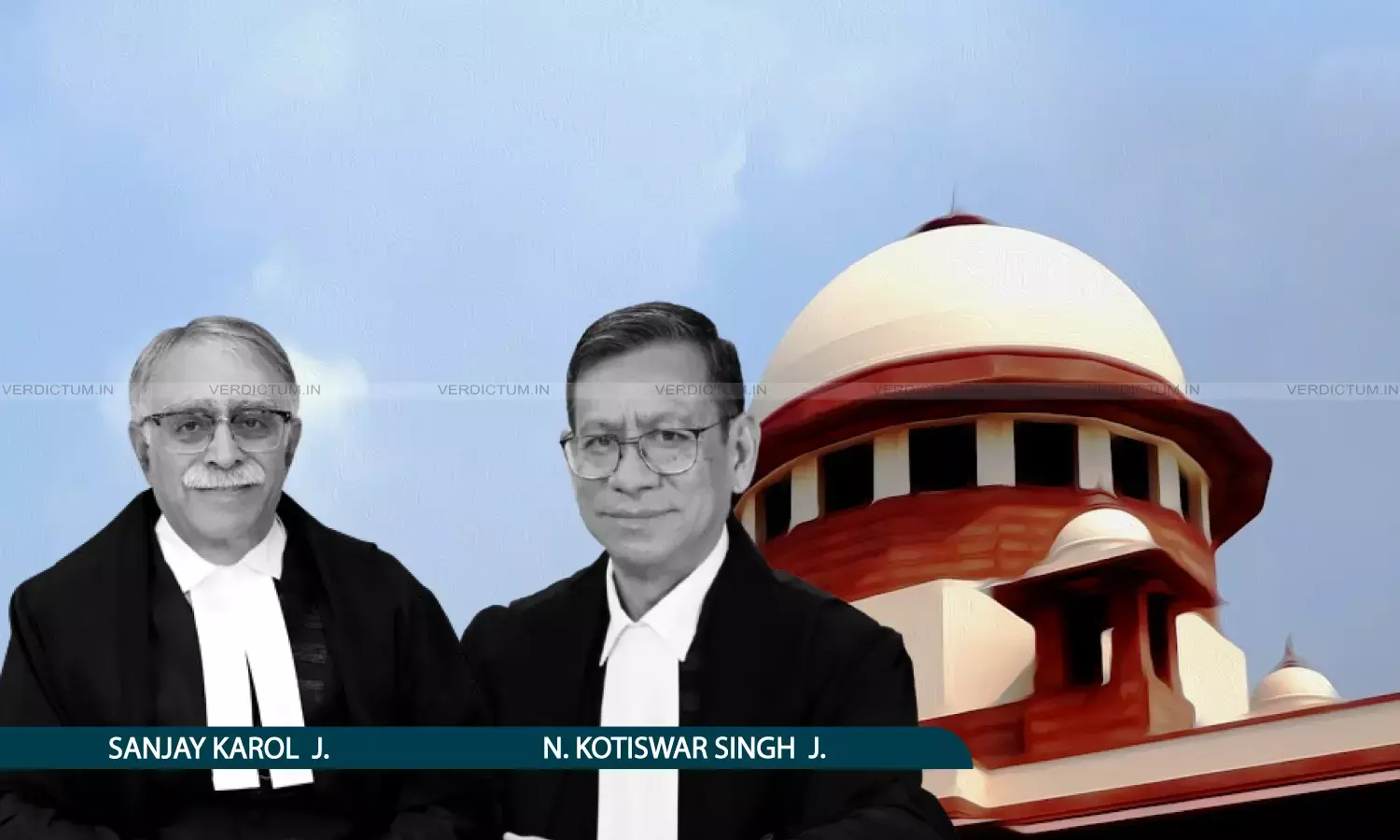
Justice Sanjay Karol, Justice N. Kotiswar Singh, Supreme Court
The Supreme Court, while upholding the acquittal of a murder accused in a case involving an alleged assault with a country-made firearm, has held that an accused need not prove the prosecution's case false in every respect, and that the creation of a reasonable doubt is sufficient to dislodge the prosecution's case.
The Court was hearing an appeal against a concurrent acquittal in a murder case, where the Trial Court had acquitted the accused, and the Patna High Court had affirmed the acquittal after finding that the prosecution's case was not free from doubt.
A Bench of Justice Sanjay Karol and Justice Nongmeikapam Kotiswar Singh, while refusing to interfere with the acquittal, observed:
“It is not necessary for the accused to demonstrate that the prosecution case is false in every respect. It is sufficient if the evidence creates a reasonable doubt as to whether the prosecution has proved the charge beyond reasonable doubt.”
Advocate Fauzia Shakil appeared for the appellant, while Senior Advocate Anjana Prakash appeared for the respondents.
Background
The case arose from an incident in which the deceased was allegedly shot dead after being surrounded by several accused persons. The prosecution alleged that the acquitted accused had fired one of the shots that struck the deceased on the right side of the chin.
The Trial Court acquitted the accused of offences under Section 302 read with Section 34 IPC and Section 27 of the Arms Act. The deceased’s son challenged the acquittal before the High Court, which dismissed the appeal after noting inconsistencies between the ocular version and medical evidence, non-examination of material independent witnesses, the hostility of two independent witnesses, and reliance on related witnesses whose testimony required closer scrutiny.
The matter then reached the Supreme Court, where the issue was whether the concurrent acquittal suffered from perversity, manifest illegality or gross misappreciation of evidence warranting interference under Article 136 of the Constitution.
Court’s Observations
The Supreme Court began by noting that the case came before it after two courts had already found the prosecution's case insufficient. It said the question was not whether another view was possible, but whether the view taken by the courts below was so unreasonable that no court could have taken it.
The Court observed: “The view taken by the Courts below may not be the only possible view. The Appellant has attempted to demonstrate that the injury on the chin corresponds to the role attributed to the Respondent No. 2. However, the question is not whether another view is possible. The question is whether the view taken by the Courts below is so unreasonable that no court could have taken it.”
The Bench held that the High Court had not affirmed the acquittal on fanciful grounds, but after considering circumstances relevant to a criminal trial.
The appellant argued that the eyewitnesses consistently attributed the fatal shot to the accused and that the medical evidence corroborated the injury on the chin. The Court, however, found that the prosecution's version had to be assessed as a whole.
The Bench noted that the FIR and eyewitnesses attributed distinct shots to different accused in a particular manner, while the post-mortem evidence showed three firearm tracks and did not fully correspond with the detailed ocular version.
The Court stated: “This assumes significance because the present case is not one where there is a single eyewitness speaking to a single injury. The prosecution has built its case on a detailed attribution of separate shots by separate assailants. Where such detailed attribution is not fully supported by medical evidence, and where independent witnesses do not support the prosecution, the court must be slow in overturning an acquittal.”
The Court then considered the prosecution’s failure to examine all independent witnesses named in the chargesheet. It noted that five independent witnesses had been cited, only two were examined, and neither supported the prosecution.
The Court observed: “It is true that non-examination of independent witnesses is not always fatal. If the evidence of examined witnesses is otherwise cogent, reliable and trustworthy, non-examination of other witnesses may not affect the prosecution's case. However, this principle cannot be applied mechanically in every case.”
The Bench held that the omission assumed importance because the prosecution itself had treated those witnesses as material.
The Court stated: “The argument that hostile witnesses do not completely efface the prosecution's case is again correct as a proposition of law. But where the prosecution case is otherwise attended by contradictions between ocular and medical evidence, doubtful presence of interested witnesses, and lack of independent corroboration, the hostility of independent witnesses assumes greater significance.”
The Supreme Court also considered the plea of alibi raised by the accused. It noted that a plea of alibi must be proved with a high degree of certainty, but clarified that the acquittal did not rest solely on that plea.
The Court held: “Thus, even if the alibi is kept aside, the prosecution is still required to stand on its own legs. The weakness of the defence or the falsehood of the plea of defence does not relieve the prosecution of its burden. Where the prosecution evidence itself creates reasonable doubt, the accused is entitled to acquittal, even if his defence plea is not found credible.”
The Court refused to substitute its own view merely because the appellant had offered an alternative interpretation of the evidence.
The Bench observed: “The benefit of doubt doctrine is not an empty formality. Where the evidence leaves room for reasonable doubt, the court must lean in favour of the accused. This is particularly so where the accused has already secured acquittal from the Trial Court, and the acquittal has been affirmed by the High Court, strengthening his case of innocence.”
Conclusion
The Supreme Court held that the prosecution had not established guilt through clear, cogent and unimpeachable evidence sufficient to reverse a concurrent acquittal. It found that the ocular version, when read with the FIR, post-mortem report, doctor’s testimony, hostility of independent witnesses, non-examination of other independent witnesses and surrounding circumstances, did not exclude reasonable doubt.
The Court accordingly dismissed the appeal, affirmed the acquittal recorded by the Trial Court and upheld by the Patna High Court, and discharged the accused from his bail bonds subject to compliance with Section 437-A CrPC, if applicable.
Cause Title: Sanjay Kumar v. The State of Bihar & Anr. (Neutral Citation: 2026 INSC 735)
Appearances
Appellant: Advocate Fauzia Shakil
Respondents: Senior Advocate Anjana Prakash, Advocates Azmat Hayat Amanullah, Rebecca Mishra, Vanshita Gupta, Nitya Sharma, Ekta Kundu, Neha Singh, Abhijeet Nilesh and Ashish Choudhury