

Criminal Proceedings Are Not A Measure Of Recovery Of Money: Supreme Court
The Supreme Court was considering an appeal challenging the decision to set aside the order refusing cognizance.

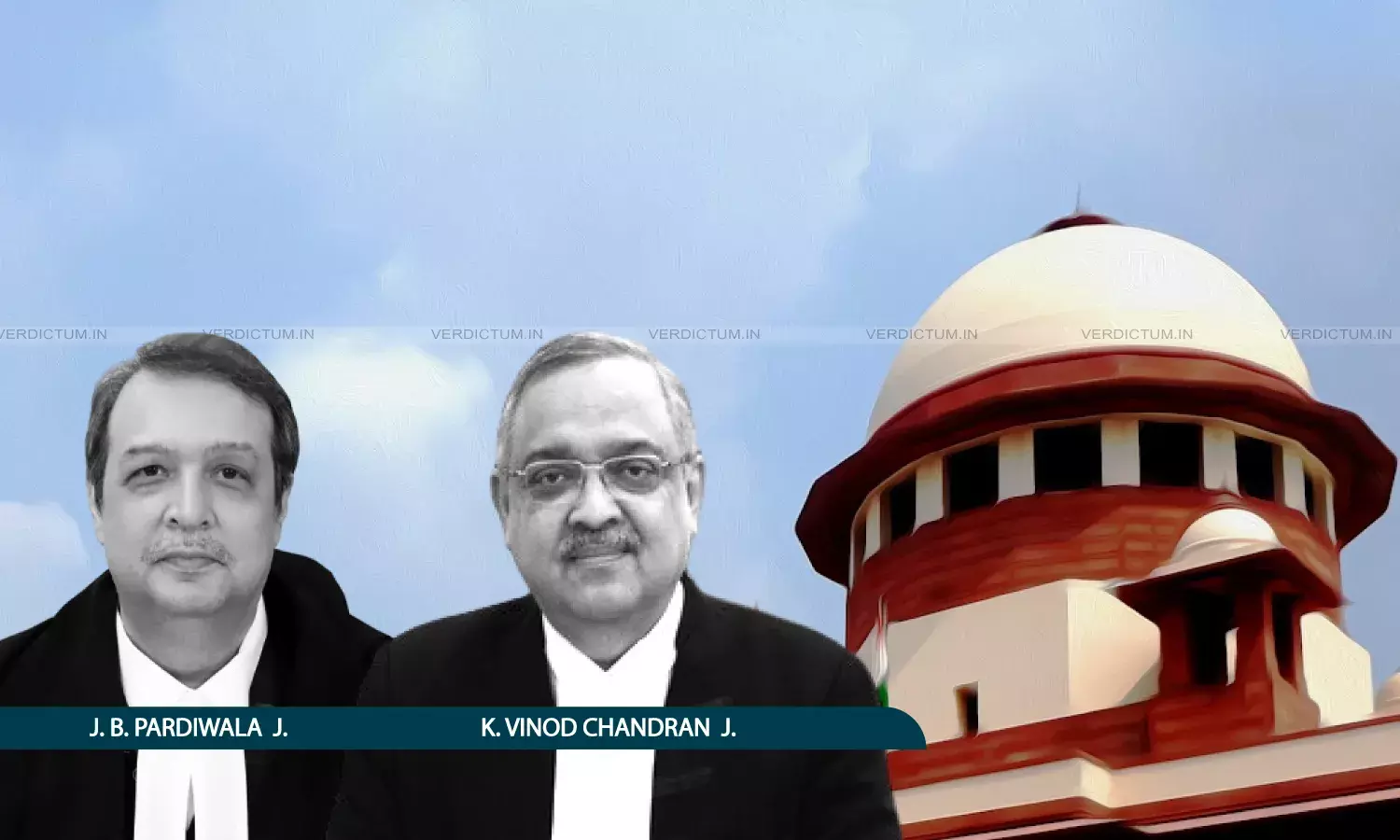
Justice J. B. Pardiwala, Justice K. Vinod Chandran, Supreme Court
While restoring an order refusing cognizance, the Supreme Court has held that if there is a money transaction and the litigant has a demand for its return, the remedy is not to initiate criminal proceedings but to file a civil suit for recovery.
The Apex Court was considering an appeal challenging the decision to set aside the order refusing cognizance.
The Division Bench of Justice J. B. Pardiwala and Justice K. Vinod Chandran held, “Another aspect noticed by the High Court was that there was a money transaction found on investigation. If there is a money transaction and the appellant has a demand for its return, the remedy is not to initiate criminal proceedings but to file a civil suit for recovery. As we noticed, the second installment is said to have been made on 27.01.2020 and the first complaint raised before the Superintendent of Police was on 13.03.2023, which is clearly after limitation had expired to file a suit for recovery of money.”
AOR Pallav Mongia represented the Appellant while AOR Shaurya Sahay represented the Respondent.
Factual Background
The allegation, on which the respondent initiated the criminal complaint, was that the second respondent was duped on the pretext of a sale of a flat towards which he paid an amount of Rs 10 lakh, by way of two installments. Neither was the money paid back nor was the flat sold to the second respondent, was the allegation. There was also an allegation that the appellant summoned the second respondent on the pretext of refund of money and then assaulted him. On the ground that the money having been handed over in 2019-2020, in 2023 a written complaint was made to the Superintendent of Police by the second respondent. After receiving no response, the respondent instituted a complaint case before the Chief Judicial Magistrate, Unnao.
After inquiry, the police confirmed that there existed no flat as pointed out by the appellant and submitted the call data records to show that the appellant was present at Lucknow on the alleged date of assault. There was also a proceeding under the Negotiable Instruments Act, 1881 with reference to Rs 10 lakh pending against the wife of a land broker, which was from the same transaction. The Chief Judicial Magistrate dismissed the complaint, holding that the dispute was civil in nature.
A criminal revision was filed in which there was a remand made, upon which the Additional Chief Judicial Magistrate, Unnao again took up the matter, considered the issues and dismissed the complaint. This order was affirmed in a revision. The revisional court upheld the order of the ACJM, finding that the enquiry report of the Police with documentary proof was contrary to the oral testimony. The application filed under Section 482 of the Cr. PC was allowed by the High Court and the same came to be challenged before the Apex Court.
Reasoning
Considering that the appellant, impleaded as respondent, was not heard by the High Court, the Bench stated, “In fact, the High Court dispensed with the notice to the 2nd respondent since he had no right to be heard at the pre-cognizance stage. The High Court should have noticed that if a remand is made, setting aside the order refusing cognizance, then that would necessarily prejudice the person against whom allegations are raised.”
The Bench took note of the fact that the first complaint raised before the Superintendent of Police was after the limitation had expired to file a suit for recovery of money. “Time and again this Court has noticed that criminal proceedings are not a measure of recovery of money and civil disputes cannot be converted into criminal prosecution as an arm-twisting method to coerce the accused arrayed to satisfy the demand of money raised”, it stated.
Thus, allowing the appeal, the Bench restored the order refusing cognisance and dismissing the complaint.
Cause Title: Sandeep Shukla v. State of U.P. (Neutral Citation: 2026 INSC 817)
Appearance
Appellant: AOR Pallav Mongia, Advocates Ishita Nayak, Kashish Lalwani
Respondent: AOR Shaurya Sahay, Advocates Aman Jaiswal, Sharvi Sharma, Shivam Raghuwanshi, Nitish Kumar Mishra, Ramji Dwivedi, AOR Sriram P.