

Constitutional Courts Can't Remain Mute Spectators: SC Seeks Action Against Officer For Two-Decade Delay In Criminal Investigation
The Supreme Court was considering a matter where there had been an inordinate delay of nearly two decades in the investigation of a criminal complaint.

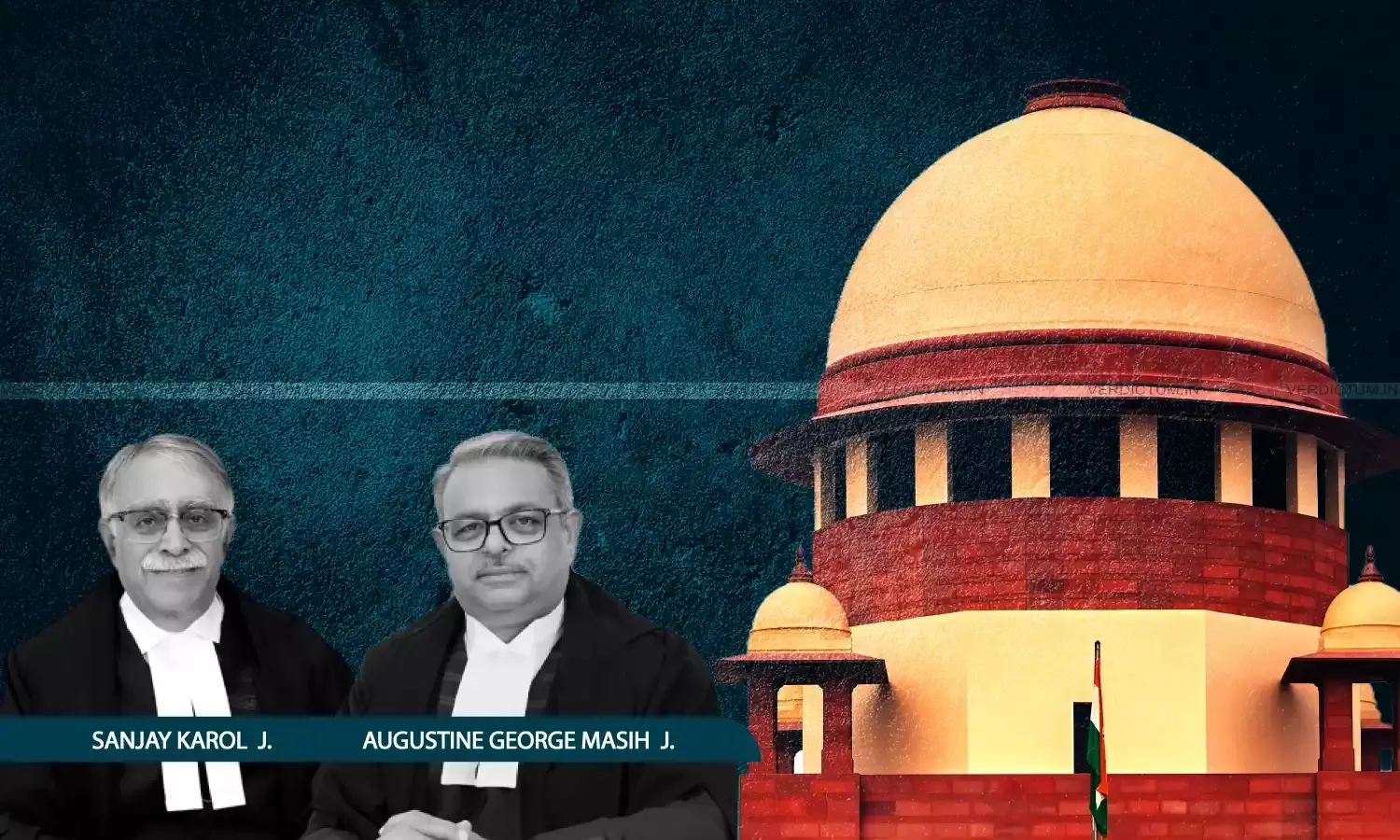
While dealing with a case where there was a delay of nearly two decades in the investigation of a criminal complaint, and it was alleged that the case records were lost during an active investigation, the Supreme Court has ordered an expedited investigation and also asked the State to file an affidavit on the specific action taken against the erring Officer involved.
The Apex Court was considering a matter where there had been an inordinate delay of nearly two decades in the investigation of a criminal complaint.
The Division Bench of Justice Sanjay Karol and Justice Augustine George Masih ordered, “This Court is of the view that it is incumbent upon constitutional courts to not remain mute spectators, when such prolonged investigations are brought to its notice. Therefore, in such peculiar circumstances, the High Court ought to have exercised its extraordinary jurisdiction to intervene in the present matter.”
“Furthermore, the State of Gujarat to file an affidavit indicating:
a. Specific action taken against the officer involved, the stage of such action and whether taken to its logical conclusion;
b. Despite directions of the JMFC to conclude further investigation after the loss of records, why was the JMFC not informed of the inability to reconstruct records and track witnesses etc.; and
c. Compliance with direction to conclude investigation”, it ordered.
Advocate Aastha Mehta represented the Appellant, while AOR Mehmood Umar Faruqui represented the Respondent.
Factual Background
The father of the appellant instituted a complaint before the Judicial Magistrate against the respondents under Sections 120B, 406, 420, 463, 468, 471, and 114 of the Indian Penal Code. It was alleged therein that the subject property was self-acquired by him. Subsequently, when he was on the Hajj pilgrimage in the year 2002, the accused persons forged his signature and prepared a forged partition deed along with a bogus sale deed regarding the subject property. On the basis of such forgery, their names were entered into the Revenue Records. Upon consideration of an application filed by the original complainant before the Gujarat High Court, the Court directed the preparation of the investigation report. In this report, it was stated that the accused persons had prepared forged documents and forged signatures of the complainant. The JMFC directed the police to take action and carry out further investigation.
Thereafter, an application was filed by the original complainant before the JMFC praying for appropriate orders to the investigating officer as neither the investigation was concluded nor a final report was submitted in the complaint. The JMFC directed the investigating officer to specify within a period of 10 days as to whether the investigation remained pending or had been concluded. The Addl. Judicial Magistrate again directed the investigating officer to carry out the investigation and file a charge sheet. The original complainant was constrained to file another application before the High Court, praying for directions to the investigating officer to file a charge sheet, but the same was rejected.
Reasoning
The Bench at the outset made it clear that the High Court ought to have taken note of the inordinate delay in filing the chargesheet and intervened in the matter at hand. “The right to speedy trial is intrinsically linked to Article 21 of the Constitution”, it stated.
The Bench noted that nearly two decades had passed since the initiation of the complaint by the original complainant, and it was a matter of serious concern that, despite the lapse of such an inordinate period of time, the investigation was yet to reach any meaningful conclusion. “From a bare perusal of the record, it is evident that the original complainant had run from pillar to post, for filing of a chargesheet in connection with his complaint, but to no avail”, it added.
It was the stand of the State that in the absence of the original case records and inability to conclusively trace all relevant witnesses, the investigation could not be carried out to its logical conclusion. It was further submitted that during re-investigation, the original case papers remained untraceable and disciplinary proceedings were initiated against the officer concerned and appropriate action was taken in accordance with the law. On this aspect, the Bench stated, “Upon consideration of the stand of the State, we find that from the order of the High Court ordering re-investigation, nearly a decade has passed. Even in the case that during the investigation the police were not able to trace the relevant witnesses, ordinarily an appropriate report seeking closure should have been filed before the JMFC. We find no reason from the record, as to why the complaint and investigation have remained pending till date.”
The Bench was of the view that incidents such as this, wherein case records are lost during an active investigation, have to be taken with utmost seriousness as such incidents strike at the very core of the criminal justice system, rendering bona fide complaints inactionable.
The Bench thus directed the State of Gujarat and Police Station Bhiloda, to conclude the investigation within a period of six weeks and file an appropriate report with the JMFC containing all investigative material and if so, the lack thereof.
Cause Title: Sahil Abdulsattar Mansuri v. Safimahamad Fafirbhai Mansuri (Neutral Citation: 2026 INSC 626)
Appearance
Appellant: Advocates Aastha Mehta, Prerana Mohapatra, Prina Sharma, AOR Anshuman Srivastava
Respondent: AOR Mehmood Umar Faruqui, AOR Swati Ghildiyal, Advocate Neha Singh