

Children’s Court Cannot Try Child As Adult Without Reasoned Order U/S 19(1) Juvenile Justice Act : Supreme Court
The Court set aside the conviction of a child in conflict with law who had been tried as an adult, holding that once a Juvenile Justice Board transfers a heinous offence case under Section 18(3) of the Juvenile Justice Act, the Children’s Court must first pass a reasoned order under Section 19(1) deciding whether the child should be tried as an adult.
The Supreme Court has held that a Children’s Court cannot proceed to try a child in conflict with law as an adult merely because the Juvenile Justice Board has transferred the case after a preliminary assessment, and that the Children’s Court must independently pass a reasoned order under Section 19(1) of the Juvenile Justice (Care and Protection of Children) Act, 2015 before taking the matter further.
The Court was hearing an appeal against the judgment of the High Court of Punjab and Haryana, which had affirmed the conviction of the appellant under Section 302 IPC and the sentence of rigorous imprisonment for fourteen years.
The appellant was around sixteen-and-a-half years old at the time of the offence. Though the Juvenile Justice Board had conducted a preliminary assessment under Section 15 of the Act and transferred the matter to the Children’s Court under Section 18(3), the Children’s Court proceeded with the trial without first passing an order under Section 19(1).
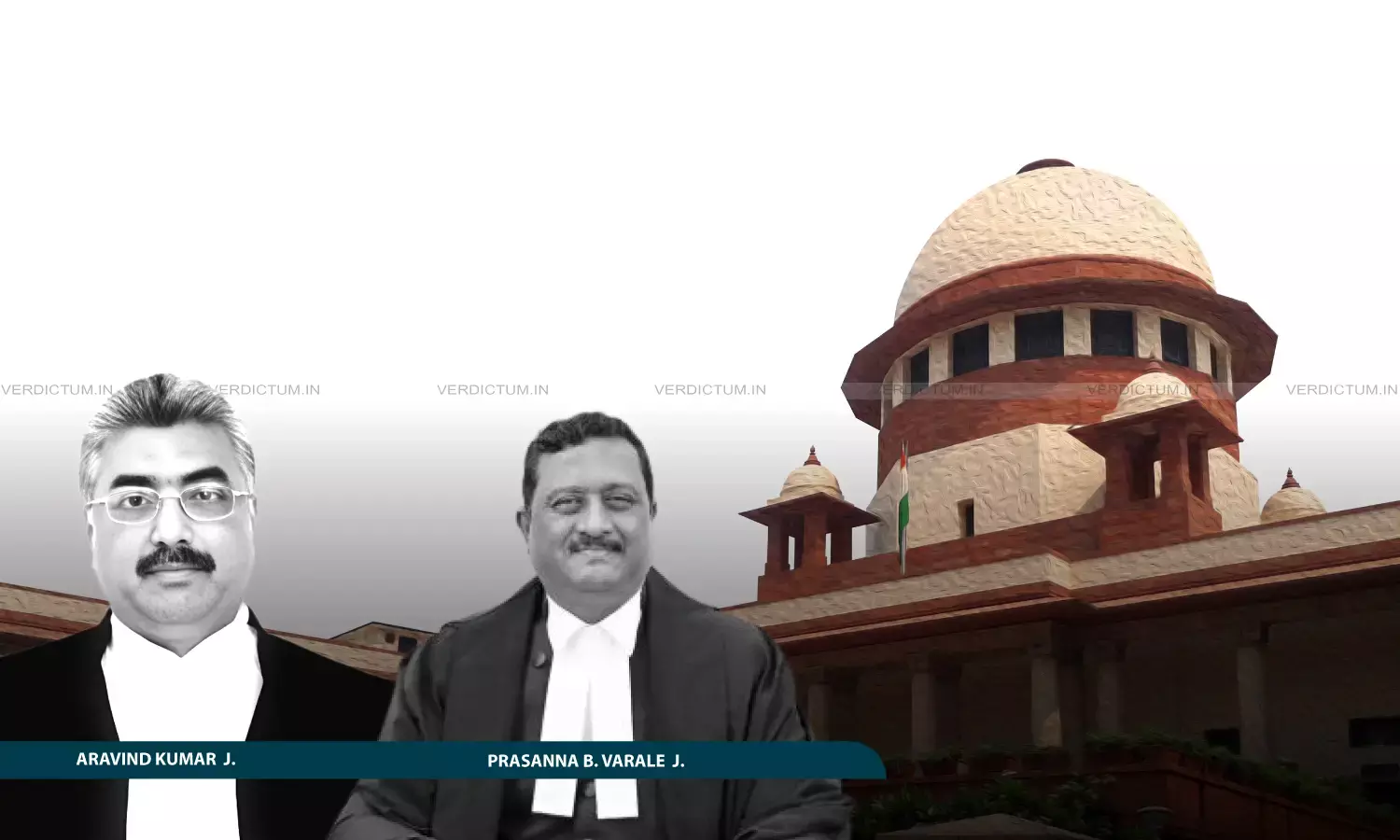
A Bench of Justice Aravind Kumar and Justice Prasanna B. Varale held that “passing of an order under Section 19(1) of the Act is mandatory in nature and without passing an order under Section 19(1), the Children’s Court cannot proceed with the matter further.”
The Bench further found it appropriate to “issue a word of caution and a direction to Children’s Courts across the country that upon receipt of records pursuant to transfer/committal under Section 18(3) of the Act by the Juvenile Justice Board, the first duty of the Children’s Court, after taking cognizance of the matter, is to pass a reasoned order under Section 19(1) of the Act upon due assessment of the ‘child in conflict with law’ before it proceeds further in the matter.”
Advocate Ashish Pandey appeared for the appellant, while Advocate Keshav Mittal appeared for the respondent-State.
Background
The case arose from an incident in which the appellant, along with others, was accused of assault leading to death. Since the appellant was a child in conflict with the law, the Juvenile Justice Board conducted a preliminary assessment under Section 15 of the JJ Act to determine whether he had the mental and physical capacity to commit the alleged offence, the ability to understand its consequences, and the circumstances in which the offence was allegedly committed.
After the assessment, the Board transferred the matter to the Children’s Court under Section 18(3), taking the view that the appellant should be tried as an adult. The Children’s Court thereafter tried the appellant, convicted him under Section 302 IPC, and sentenced him to fourteen years’ rigorous imprisonment. The High Court affirmed the conviction and sentence.
Before the Supreme Court, the appellant contended that even after transfer by the Juvenile Justice Board, the Children’s Court was required to pass a separate order under Section 19(1) of the JJ Act. Since no such order had been passed, it was argued that the trial itself stood vitiated.
Court’s Observations
The Court began by examining the statutory scheme of the JJ Act, including the definitions of “child”, “child in conflict with law”, “Children’s Court”, “heinous offences” and “juvenile”, along with Sections 8, 14, 15, 18 and 19. It noted that Section 15 enables the Juvenile Justice Board to conduct a preliminary assessment in heinous offence cases involving a child above sixteen years, while Section 18(3) permits transfer of the matter to the Children’s Court.
However, the Court made it clear that a transfer under Section 18(3) does not end the statutory inquiry. Once the matter reaches the Children’s Court, Section 19(1) requires that Court to decide whether there is a need to try the child as an adult or whether the matter should proceed as an inquiry by the Board.
The Court observed: “After committal of the matter under Section 18(3), the Children’s Court had taken cognizance of the matter. What ought to have been done is, upon receipt of the records pursuant to committal from the JJB, the Children’s Court was required to pass an order as prescribed under Section 19(1) of the Act on the preliminary assessment whether there is need to try the appellant as a child or as an adult. However, without passing any such order the matter was proceeded and appellant was tried as an adult, which culminated into the impugned judgments.”
The Bench held that Section 19 is not a mere procedural formality, because the decision whether a child is to be tried as an adult determines the entire course of the proceeding and the consequences that may follow.
The Supreme Court relied on its earlier decisions, including Ajeet Gurjar v. State of Madhya Pradesh (2023) and Thirumoorthy v. State represented by the Inspector of Police (2024), to reiterate that the statutory safeguards governing children in conflict with law must be strictly followed.
The Court stated: “From the above discussion it becomes abundantly clear and evident that the intention of the Act is to have Section 19(1) as mandatory.”
Referring to the consequences of non-compliance, the Court said that Section 19(1) determines whether the Children’s Court will proceed with a Sessions trial or adopt the procedure applicable to an inquiry by the Board.
The Court distinguished the case from situations where a mere irregularity may be cured. It held that failure to comply with Section 19(1) affects the root of jurisdictional procedure, because the Children’s Court had never made the statutorily required decision on whether the appellant should be tried as an adult.
The Court observed: “Though in Thirumoorthy (supra) there was non-compliance with both Sections 15 and 19 of the Act, in the present case there is compliance with Section 15, but there is non-compliance with Section 19(1) of the Act. We had, for some time, considered the possibility of reducing the sentence to the period already undergone, or of limiting the sentence to a maximum of three years. However, we are unable to adopt such a course. In the absence of compliance with Section 19(1), which is determinative of the procedure to be followed by the Court, whether a Sessions trial or a summons case, the entire trial stands vitiated. We are, therefore, left with no option but to follow the course adopted in Thirumoorthy.”
The Court therefore held that the conviction and sentence could not be sustained.
The Supreme Court also considered whether the matter should be sent back to the Children’s Court for fresh consideration. It declined to do so, noting that the appellant was now about twenty-four years old and had already undergone incarceration for more than six years.
The Court noted: “In Thirumoorthy (supra), the appellant was about 23 years of age at the time of the judgment. In the present case, the appellant is now 24 years old. At this stage, it would not be feasible for the Children’s Court to undertake a meaningful assessment of the mental capacity of the appellant that was prevailing at the time when crime occurred. Further, having regard to the fact that the trial has already been concluded and the appellant has undergone incarceration for a period exceeding six years, we are of the considered view that no useful purpose would be served by remitting the matter to the Children’s Court.”Allowing the appeal, the Court set aside the conviction recorded by the Children’s Court and affirmed by the High Court, holding that the trial had been conducted in breach of the mandatory requirement under Section 19(1) of the JJ Act.
Conclusion
Allowing the appeal, the Court set aside the conviction recorded by the Children’s Court and affirmed by the High Court, holding that the trial had been conducted in breach of the mandatory requirement under Section 19(1) of the JJ Act.
The Court held: “In view of the foregoing, the conviction recorded by the Children’s Court, having been rendered in non-compliance with the mandate of Section 19(1) of the Act, cannot be sustained. Accordingly, the judgment of conviction and the consequential sentence imposed in CIS No. SC/11/2019 passed by the Court of Additional Sessions Judge, Kaithal dated 13/14.03.2019 and affirmed by the High Court of Punjab and Haryana in CRA-D-649-2019(O&M) dated 16.12.2023 are hereby set aside for non-compliance with Section 19(1) of the Act.”
The Court consequently acquitted the appellant and discharged his bail bonds.
Cause Title: Sagar v. The State of Haryana (Neutral Citation: 2026 INSC 692)
Appearances
Appellant: Ashish Pandey, AOR, with Advocates Ranbir Singh Kundu, Kirti Aggarwal, Akash, Shitanshu Saklani, Shubham Mavi and Manish Kumar Yadav
Respondent: Keshav Mittal, Advocate, with Samar Vijay Singh, AOR, and Advocates Sabarni Som, Gaj Singh, Anuj Sehrawat, Sahil Gandass, Gaurav Dhull, Aman Dev Sharma, Anil Thakran, Abhilasha Yadav, Amit Yadav, Pradeep Yadav, Ayush Rao and Bhavesh Kumar Verma
