

Scripted Enquiry Fatal To Prosecution When "Innocent Persons Being Crucified": Supreme Court Acquits 9 Surviving Convicts In 2008 Murder Case
The Court held that a delayed FIR & failure to prove injuries of ‘injured eyewitnesses’ indicated an investigation aimed at deliberate arraignment.

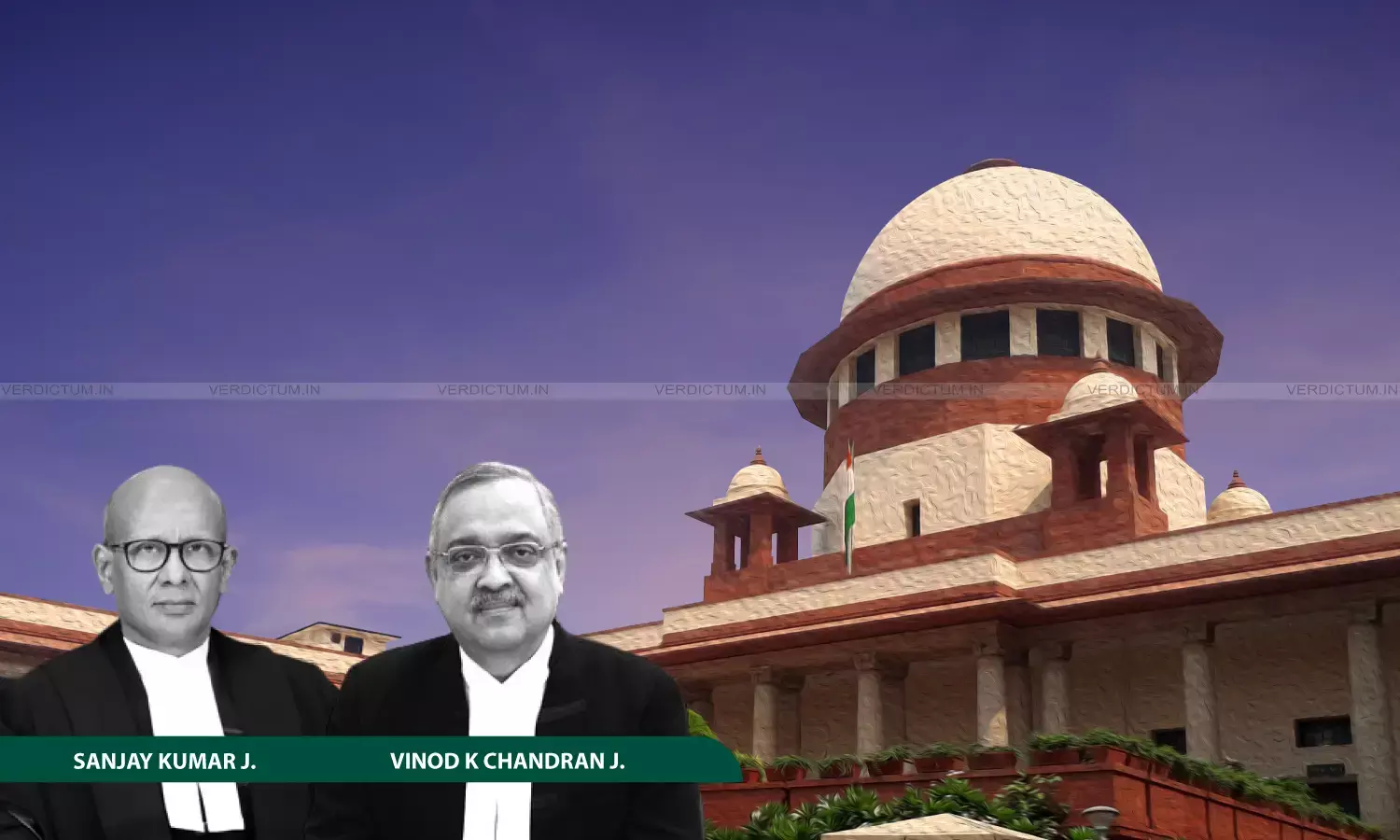
The Supreme Court has held that a scripted enquiry has lethal consequences, particularly when it creates the possibility of totally innocent persons being "crucified". Consequentially, the Court acquitted the 11 appellants before it, though it noted that two had passed away during the long pendency of the appeal.
The Court further clarified that the higher credibility typically accorded to "injured eyewitnesses" is lost when the prosecution fails to prove the very injuries alleged. In this case, the lack of medical certificates and the failure to match blood samples from the scene meant the witnesses could not be granted greater credence than mere "chance witnesses". The Bench concluded that the collective failure to record immediate statements of available witnesses and the lack of forensic analysis on seized weapons pointed toward a narrative constructed after the fact.
Justice Sanjay Kumar and Justice K. Vinod Chandran observed, “It is unfortunate that PW18, the police officer who reached the spot immediately after the incident took place, on the basis of an information over telephone, failed to follow due procedure to put the criminal investigation in motion as per the Code of Criminal Procedure, 1973. Be it ignorance, inefficiency or malicious motivation, the crime is left unresolved and considerable time and money has been spent in the prosecution of 16 persons, some of whom died during trial and the others suffered incarceration for long periods…”.
“An inept investigation or a scripted enquiry, both are fatal to criminal prosecution; but the latter has lethal consequences when there is a possibility of totally innocent persons being crucified…”, the Bench noted at the outset.
Senior Advocate Vibha Datta Makhija appeared for the appellants and Chinmoy Sharma, Senior AAG appeared for the respondent.
As per the facts, on July 08, 2008, the deceased and several companions were traveling on motorbikes when they were allegedly waylaid by a steel wire tied across the road. A group of 16 persons reportedly attacked the victim with sharp weapons, leading to his death and the severing of his left hand.
Although the police reached the spot within minutes based on a General Diary entry, no FIR was registered for two days. The eventual FIR was based on a complaint by a relative (PW1) who was not an eyewitness, yet named 13 individuals and claimed he could identify 12 others on sight.
Of the 16 persons charge-sheeted, one died during trial, while the remaining 12 were convicted by the trial court and sentenced under Sections 147, 341, 326, 307, 323 and 302 read with Section 149 of IPC.
The High Court subsequently upheld the conviction for 11 of the accused, and while these 11 individuals approached the Supreme Court, where two more passed away before the final verdict.
Now, the Supreme Court found the investigation to be "alarmingly doubtful" and noted that the presence of the eyewitnesses at the spot was not established unequivocally. Furthermore, the prosecution failed to produce the seized motorbikes in court or provide documents proving their ownership.
The Bench also critiqued the failure to send seized weapons for forensic analysis, concluding that the two-day delay in filing the FIR was likely used for "due deliberation" to falsely implicate the accused.
“The prosecution case is also that the eyewitnesses having met at the Karbala Bazar were travelling on four motorbikes to their homes in the locality. All the four bikes were seized by the police from the P.O, by the seizure list Annexure P4 detailing the engine number, chassis number and the registration number of the bikes with a description of the make and color along with the owners’ name and specifically indicating who drove each bike and who was travelling pillion. If such an account was made by any of the eyewitnesses, it is strange that the I.O did not record an FIS, then and there with the name of the assailants arrayed as accused. In the given circumstances, we are unable to give any credence to Annexure P4, which proclaims the seizure to have been made at the spot, immediately after the crime; alarmingly doubtful…”, it noted.
The Court expressed regret that "ignorance, inefficiency or malicious motivation" left the crime unresolved while innocent people suffered long periods of incarceration. It directed the State and its Department of Home to better equip and educate investigating officers on proper procedures under the Code of Criminal Procedure.
Cause Title: Sadek Ali @ Md. Sadek Ali and Anr. v. The State of Assam and Anr. (Neutral Citation: 2026 INSC 421)
Appearances:
Appellants: Vibha Datta Makhija, Senior Advocate appeared for the appellants.
Respondent: Chinmoy Sharma, Senior AAG.