

Article 311 Not Applicable To ICAR Employees; Autonomous Society Staff Do Not Hold Civil Posts Under Union Or State: Supreme Court
The Court clarified that employees of autonomous bodies like ICAR are governed by their own rules and bye-laws, and do not enjoy the constitutional protections available to holders of civil posts under Article 311.
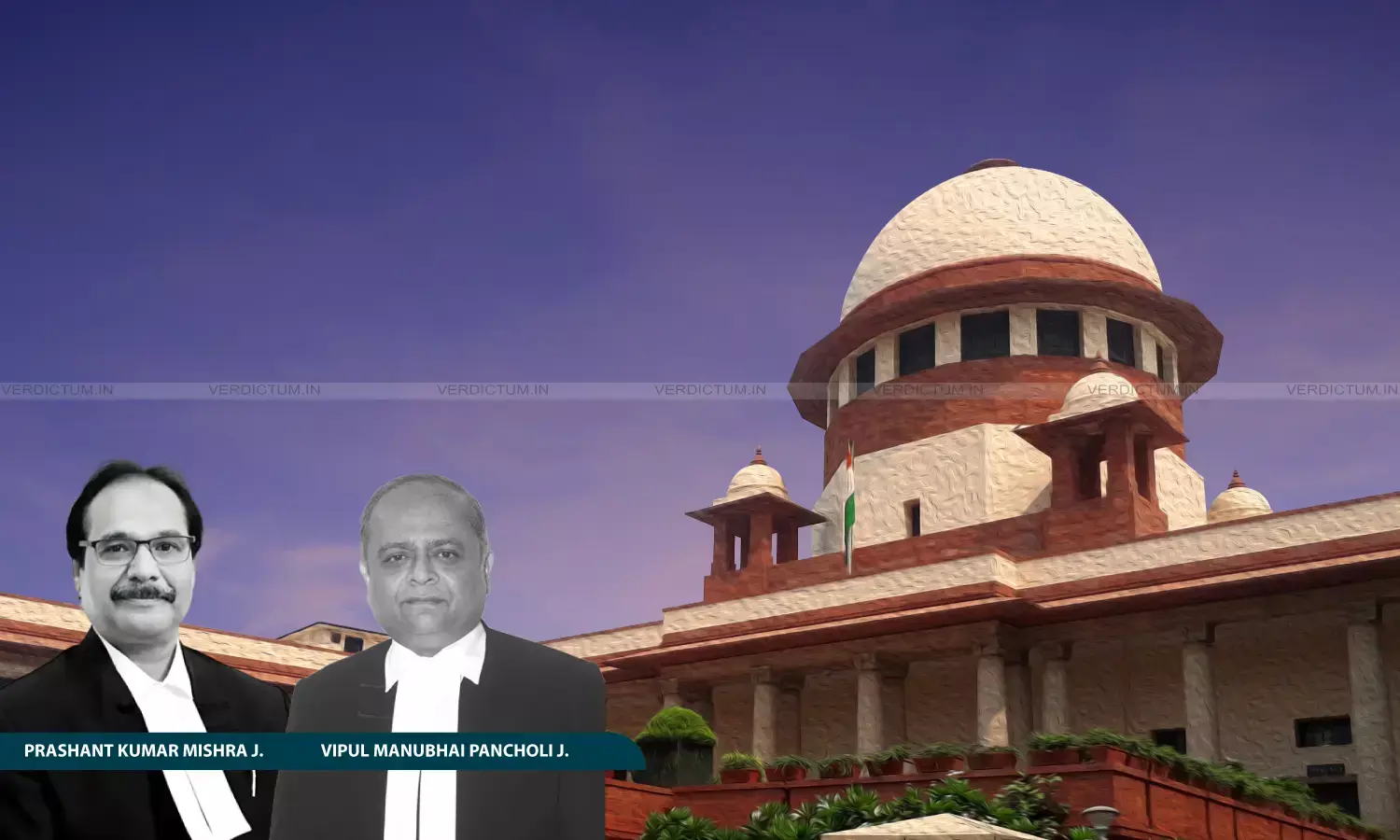
Justice Prashant Kumar Mishra, Justice Vipul M. Pancholi, Supreme Court
The Supreme Court has held that Article 311 of the Constitution does not apply to employees of the Indian Council of Agricultural Research (ICAR), as it is an autonomous society and its employees do not hold civil posts under the Union or the State.
The Court was hearing civil appeals challenging the curtailment of tenure of an officer appointed to a research management position in ICAR, where the appellant contended that such curtailment amounted to a reduction in rank without compliance with the safeguards under Article 311(2).
A Bench of Justice Prashant Kumar Mishra and Justice Vipul M. Pancholi observed: “the appellant has claimed the protection of Article 311 of the Constitution; specifically, that under Article 311(2), he could not have been 'dismissed or removed or reduced in rank' without an enquiry as contemplated therein, … Such a submission is totally unsustainable, … Article 311 applies only to civil servants or those who otherwise hold a ‘civil post’ under the Union or the State”
“ICAR, the respondent no.2 herein, functions as an autonomous Society which reports to the Department of Agricultural Research and Education, Ministry of Agriculture. Its recruitment, conditions of service, and any matters arising therefrom are governed by the rules and bye-laws of ICAR, including the dispute at hand, … thus, Article 311 is not attracted at all”, the Bench further added.
Senior Advocate Prashant Bhushan appeared for the appellant, while T. Mahipal, AOR, appeared on behalf of the respondents.
Background
The appellant, an employee of ICAR, was appointed to a higher post for a fixed tenure subject to the condition that such tenure could be curtailed by further orders.
During the course of service, adverse Annual Assessment Reports were recorded against him, following which the competent authority curtailed his tenure and reverted him to his previous position.
Aggrieved, the appellant approached the Central Administrative Tribunal, which upheld the action. The High Court affirmed the Tribunal’s order, leading to the present appeals before the Supreme Court.
Court’s Observation
At the outset, the Court examined the applicability of Article 311 and held that its protection is confined to persons holding civil posts under the Union or the State, and cannot be extended to employees of autonomous bodies governed by independent statutory or administrative frameworks.
The Court noted that ICAR is an autonomous society reporting to the Ministry of Agriculture, and its service conditions are regulated by its own rules and bye-laws. Consequently, the appellant could not claim constitutional protection under Article 311.
On the merits, the Court analysed the nature of the appellant’s appointment and observed that the tenure was not guaranteed but expressly subject to curtailment by further orders. It held that the appellant had no enforceable right to continue for the full tenure.
“… CAT, at the first instance, had correctly observed that the appellant had no ‘enforceable right’ to complete the full five-year term, … The instant case is not one of the respondent-Authorities cutting short a prescribed minimum tenure having a basis in some statute and/or binding judicial direction, … Rather, at the time of appointment, the concerned Authority had expressly reserved the power to curtail the tenure at any point before five years by issuing further orders”, the Court remarked.
The Court further reiterated that judicial review in service matters is limited to examining the decision-making process and not the merits of the decision, unless the action is shown to be arbitrary, mala fide, or in violation of statutory provisions.
“Of course, this power is not absolute, but the judicial review of its exercise is subject to the well-settled standards governing administrative discretion i.e., review must be narrowly confined to assessing whether the action was arbitrary or irrational, tainted by mala fides, or colourable in nature, particularly vis-à-vis whether it imposes penal or stigmatic consequences without following the required disciplinary or natural-justice procedures”, the Court added.
The Court also examined whether the order was stigmatic and held that references to “unsatisfactory” performance in assessment reports do not, by themselves, amount to stigma requiring a disciplinary enquiry. It further found that the appellant had been allowed to represent against the adverse reports and that the authority had acted within its administrative discretion.
The Court rejected the allegation of mala fides, observing that “allegations of colourability and/or mala fides must be supported by clear, cogent and specific material, and cannot be inferred merely from the sequence of events or surrounding circumstances”.
The Court also held that the pendency of a separate enquiry into alleged misconduct did not preclude the authority from curtailing tenure based on performance assessment, stating that “the enquiry expressly pertained to specific charges of misconduct against the appellant, and could not stand in the way of the curtailment of his tenure on the basis of the concerned respondent-Authority’s assessment of his overall performance”.
Conclusion
The Court held that Article 311 did not apply to the appellant and that the curtailment of his tenure and reversion to his earlier post did not violate any legal or constitutional provision.
Accordingly, the Court dismissed the appeals and upheld the orders of the Tribunal and the High Court.
Cause Title: Sadachari Singh Tomar v. Union of India & Ors. (Neutral Citation: 2026 INSC 427)
Appearances:
Appellant: Senior Advocate Prashant Bhushan; Advocates Nisha Tiwari; Cheryl D’Souza
Respondents: T. Mahipal, AOR; Advocate Abhishek Kumar Gupta
