

Tribunal Is Not Merely A Forwarding Authority But The Primary Adjudicatory Forum: Supreme Court Sets Aside "Mechanical" Foreigner Declarations
The Court quashed ex parte foreigner opinions across 27 cases and remanded the matters for fresh, substantive determination on merits under strict timelines.

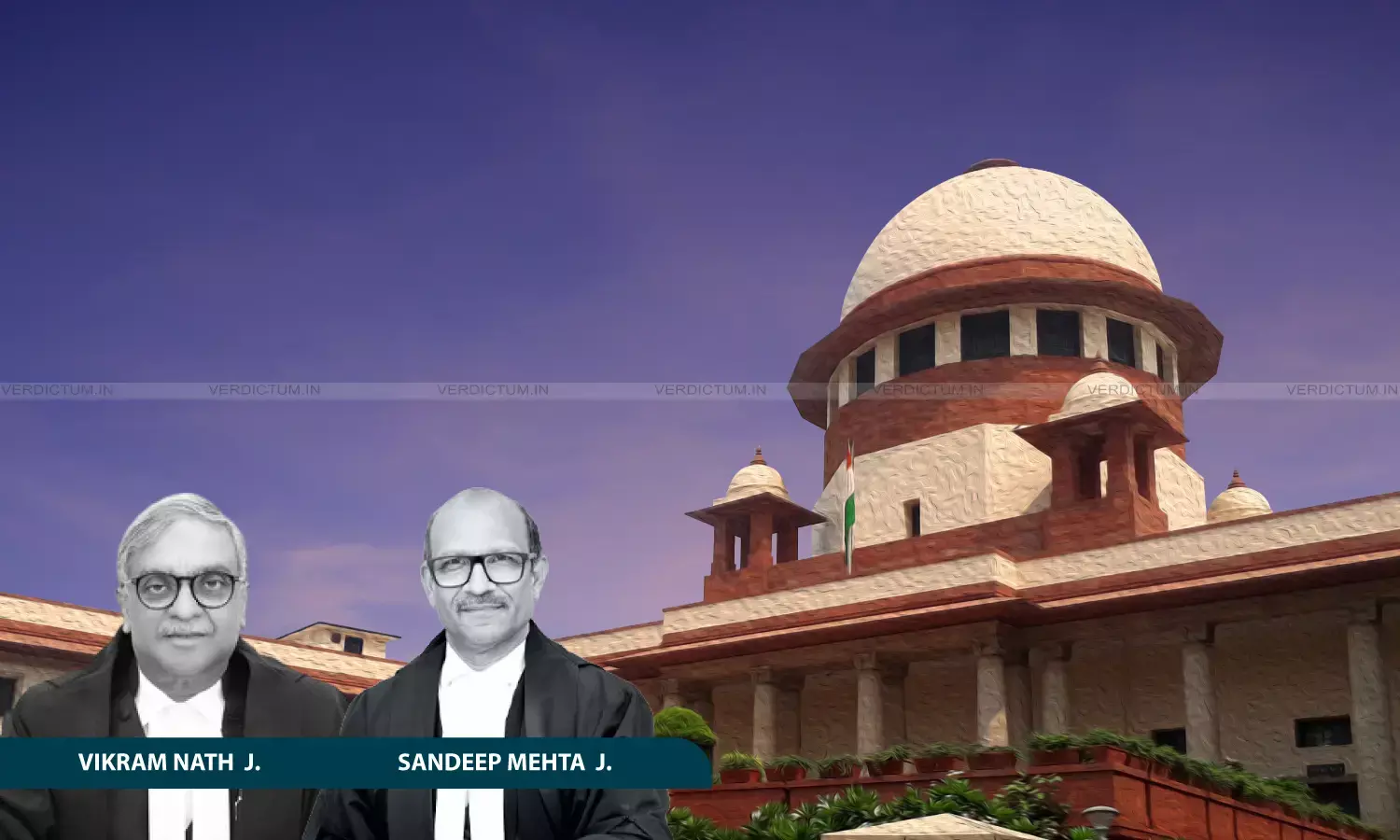
Justice Vikram Nath, Justice Sandeep Mehta, Supreme Court
The Supreme Court held that a Foreigners Tribunal is not merely a forwarding authority but is the primary adjudicatory forum tasked with deciding referred questions of nationality. Expanding upon this principle, the Court declared that because citizenship status carries grave, lifelong legal and constitutional consequences, any adjudication determining it must reflect genuine application of mind and a lawful, fair process rather than mechanical default decrees.
The Bench ultimately intervened by setting aside the impugned Gauhati High Court judgments along with the corresponding ex parte opinions of the various Foreigners Tribunals in Assam. Recognizing that the critical fact-finding task cannot be bypassed by an initial factual appreciation in writ proceedings, the Court remanded all 27 matters to their respective tribunals to permit the appellants to formally pitch their defence and documents on the merits.
A Division Bench comprising Justice Vikram Nath and Justice Sandeep Mehta observed, “Paragraph 3 of the 1964 Order clearly identifies the Tribunal as the forum before which the factual inquiry has to be undertaken. Paragraph 3(1) gives the proceedee an opportunity to make a representation and produce evidence. Paragraph 3(10) requires the Tribunal to take such evidence as may be produced by the concerned Superintendent of Police. Paragraph 3(11) empowers the Tribunal to hear such persons as it considers necessary. Paragraphs 3(15) and 3(16) require the Tribunal to return its opinion with a concise statement of facts and conclusion…”.
“…These provisions show that the Tribunal is not merely a forwarding authority. It is the primary adjudicatory forum for deciding the question referred”, it said.
Senior Advocates Sanjay Hegde, Salman Khurshid, Tayenjam Momo Singh, Abdur Razzaque Bhuyan appeared for the appellants and Tushar Mehta, Solicitor General, Aishwarya Bhati, A.S.G., Chinmoy Sharma, Senior. A.A.G. appeared for the respondents.
As per the facts, the lead matter involved a family from Karbi Anglong, where an Illegal Migrants (Determination) Tribunal declared them foreigners in 1997 through an entirely ex parte proceeding. Although a notice was reportedly received by the lead proceedee’s late husband, none of the family members appeared, engaged a legal counsel, or submitted a written statement, causing the reference to be decided completely in their absence.
In the matter, 27 connected references where different Foreigners Tribunals across Assam issued ex parte or effectively ex parte declarations classifying the proceedees as foreigners. These statutory tribunal opinions were subsequently upheld by the Gauhati High Court, which systematically dismissed the proceedees' writ petitions or appeals by mechanically relying upon their failure to discharge the statutory burden of proof.
The Court categorized the appeals into three types: total non-appearance, cases where the High Court evaluated evidence for the first time, and cases where proceedees appeared but left midway.
The Court noted that a proceedee's default or absence does not change the statutory duty of the tribunal to independently evaluate the state's reference material under Paragraphs 3(15) and 3(16) of the Foreigners (Tribunals) Order, 1964. It clarified that Section 9 of the Foreigners Act, 1946, does not operate in a vacuum, nor does it transform a proceedee's absence into absolute proof of the state's allegation.
“Even in a case where the proceedee fails to appear despite service, the Tribunal continues to act as a quasi judicial forum. It must satisfy itself that notice was duly served in accordance with law. It must examine whether the main grounds were made available to the proceedee. It must consider the evidence produced by the State. It must assess whether the material placed before it is capable of supporting the conclusion that the proceedee is a foreigner. It must record reasons, even if briefly. An ex parte proceeding may dispense with the participation of the absent party, but it does not dispense with objective consideration and meaningful adjudication by the Tribunal”, the Bench noted.
“The statutory scheme, therefore, has two complementary features. The first is that the proceedee carries the burden of proving that he or she is not a foreigner. The second is that the Tribunal must ensure a fair procedure, meaningful notice, consideration of material, and a reasoned opinion. These features are not in conflict. They operate together. The burden under Section 9 of the 1946 Act arises and is discharged within the procedural safeguards of Paragraph 3 of the 1964 Order”, the Bench noted further.
Delivering its operative directions, the Court set aside all the High Court judgments and tribunal opinions, remanding the entire batch back to the respective tribunals for fresh adjudication. The Court ordered the appellants to appear before the concerned tribunals within four weeks to submit their written statements, public records, and affidavits of evidence.
“In proceedings before the Foreigners Tribunal, this principle assumes particular importance. The person proceeded against is often required to establish facts relating to ancestry, residence, identity and family linkage through old public documents. Such a person cannot be expected to discharge the statutory burden under Section 9 of the 1946 Act unless the main grounds of the allegation are disclosed and a meaningful opportunity is afforded to file a response and produce evidence. The opportunity contemplated by Paragraph 3 of the 1964 Order must therefore be an effective opportunity, and not a merely formal one”, the Bench said.
Crucially, the Bench directed that no coercive steps are to be taken against the appellants until fresh opinions are rendered, stipulating that the tribunals must make an endeavour to decide the references expeditiously, preferably within six months.
Cause Title: Sabitri Dey @ Swasthi Dey & Ors. v. Union Of India & Ors. (Neutral Citation: 2026 INSC 694)
Appearances:
Appellants: Sanjay Hegde, Salman Khurshid, Tayenjam Momo Singh, Abdur Razzaque Bhuyan, Senior Advocates, Talha Abdul Rahman, AOR, Rupali Samuel, Faizan Ahmed, Aditi Soni, Sudhanshu Tewari, Satyajeet Kumar, AOR, Kamakshi S. Mehlwal, AOR, Syed Mehdi Imam, AOR, Milan Laskar, Advocates.
Respondents: Tushar Mehta, Solicitor General, Aishwarya Bhati, A.S.G., Chinmoy Sharma, Sr. A.A.G. Shuvodeep Roy, AOR, Deepayan Dutta, Saurabh Tripathi, Vijay Deora, Aditya Agarwal, Advocates.