

Mere Marking Of Document As Exhibit Not Proof Of Its Content: Supreme Court Reiterates
The Supreme Court rendered such findings while dealing with a civil matter pertaining to testamentary proceedings.

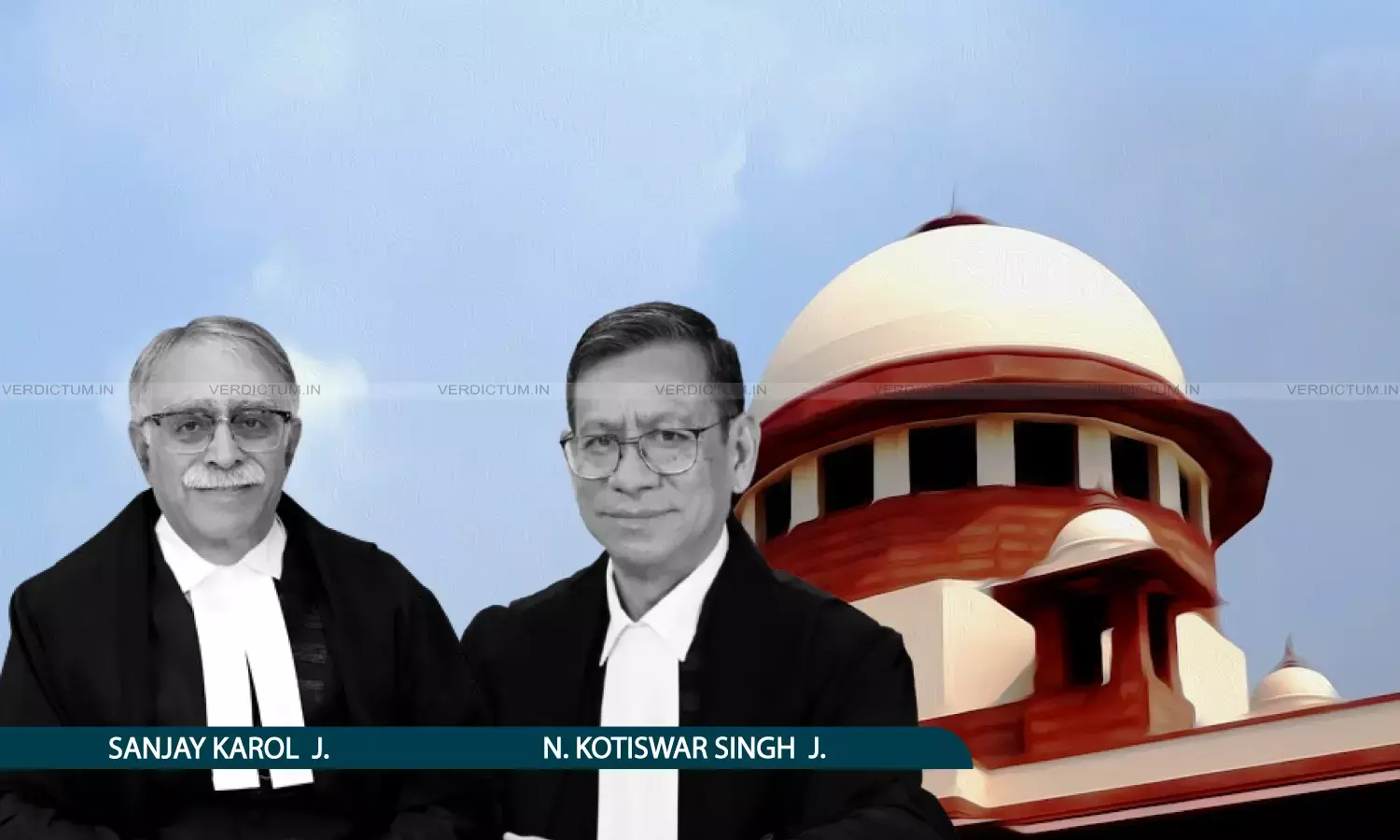
Justice Sanjay Karol, Justice N. Kotiswar Singh, Supreme Court
While dealing with a civil matter pertaining to testamentary proceedings, the Supreme Court has reiterated that mere marking of a document as an exhibit is not proof of the contents thereof. The Apex Court further held that the contents of the documents which have been marked/exhibited would have to be proved in accordance with law.
The Apex Court was considering an appeal against the impugned judgment passed by the Madras High Court.
he Division Bench of Justice Sanjay Karol and Justice Nongmeikapam Kotiswar Singh held, “It is also settled law that mere marking of a document as an exhibit, is not a proof of the contents thereof.”
“Therefore, in the instant case, the contents of the documents which have been marked/exhibited will have to be proved in accordance with law. We find no reason to eschew them, at this stage”, it added.
AOR K. K. Mani represented the Appellant while AOR Vijay Kumar represented the Respondent.
Factual Background
The case dates back to the year 2019 when, the plaintiff, being the respondent filed a suit seeking probate of the will of one late C. Shyamalavalli before the Madras High Court. The suit remained pending. The defendant being the appellant filed a written statement in the aforesaid suit. A proof affidavit came to be filed by the plaintiff. Aggrieved thereby, the appellant filed an application praying to eschew the proof affidavit, averments and documents exhibited. It was stated therein that certain documents and averments made therein were irrelevant to the present testamentary proceedings before the High Court.
The Single Judge of the High Court dismissed the application of the defendant and observed that marking of the will is different from proof of the same and it can be marked through the beneficiary of the will. The Appellant’s appeal came to be dismissed with the observation that mere filing of an affidavit is not proof of statements that are found in the same and it does not dispense with the requirement of proof by relevant evidence.
Reasoning
On a perusal of the facts of the case, the Bench held that the Single Judge had rightly eschewed the documents wherein xerox copies were filed in place of originals, without any explanation thereto. The Bench noticed that the objections raised to the other documents marked and exhibited were not such that would make the documents prima facie inadmissible in law or irrelevant to the properties involved in the suit.
Referring to Order XIII Rule 3 of the Civil Procedure Code, 1908, which makes provision for rejection of irrelevant or inadmissible documents, the Bench held that the exercise of power under this provision was not warranted. The Bench was of the view that the contentions raised and documents marked in the proof affidavit relating to pendency of other suits and transfer of properties relating to the very same family structure could not be rejected at the threshold.
Holding that the contents of the documents which had been marked would have to be proved in accordance with law, the Bench dismissed the appeal and upheld the impugned order.
Cause Title: S. Sangeetha & Ors. v. Tmt. P. Ponni (Neutral Citation: 2026 INSC 813)