

Person Authorised To Frame Rules Can Also Amend, Alter Or Delete: Supreme Court On Registrar’s Power U/S.55 (1) Of Chhattisgarh Cooperative Societies Act
The appeal before the Supreme Court was filed against the judgment passed by the Division Bench of the Chhattisgarh High Court.

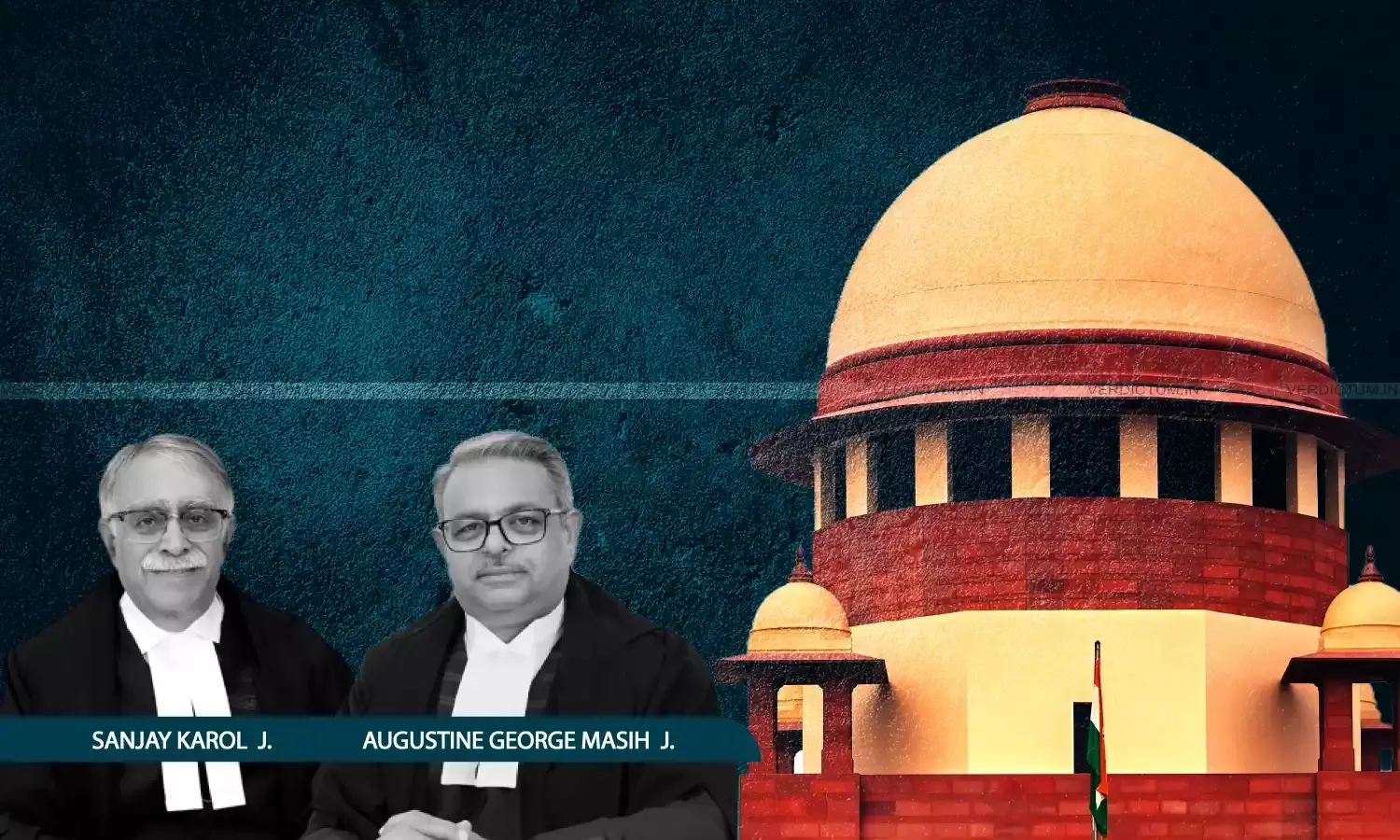
While observing that a person authorised to frame rules also carries with him the requisite authorisation to amend, alter or delete, the Supreme Court has held that the Registrar has the requisite power under Section 55 of the Chhattisgarh Cooperative Societies Act to frame the rules to regulate service conditions.
The appeal before the Apex Court was filed against the judgment passed by the Division Bench of the Chhattisgarh High Court, which affirmed the judgment of the Single Judge setting aside the appellant’s promotion order to the post of Additional Manager, and one Kishor Bagh, the original writ petitioner (fifth respondent), being promoted on a notional basis vice him.
The Division Bench of Justice Sanjay Karol and Justice Augustine George Masih held, “The stand of the Registrar, as can be understood, is that, by virtue of Section 55 (1) of the Chhattisgarh Cooperative Societies Act, 1960, he had the requisite power, as is evidenced by the above extract of the notification. The appellant, on the other hand, contends that the Registrar had no such power. We accept the stand of the Registrar as it appears. He had the requisite power. Section 55 reproduced above clearly stipulates that he has the power to frame rules to regulate service conditions. To our mind, it is quite clear that a person authorised to frame rules also carries with him the requisite authorisation to amend, alter or delete. We are supported in this view by Section 21 of the General Clauses Act, 1897 which provides that when a statute grants the power to issue notifications, orders, rules or bye-laws, or in the instant case, frame, the same would include within itself the power to amend, vary or rescind.”
Advocate Padmesh Mishra represented the Appellant while AOR Ankita Sharma represented the Respondent.
Factual Background
The appellant and the original writ petitioner, who is the fifth respondent, are both employees of the District Central Cooperative Bank Ltd, Raipur. Service in the Bank is governed by the Chhattishgarh Ke Jila Sahkari Kendriya Bank Karmachari Seva (Niyojan, Nibandhan, Tatha Unki Karya Sthiti) Niyam, 1982/ Chhattisgarh District Cooperative Central Bank Employee Service (Employment, Terms and their Working Conditions) Rules, 19822 that have been brought in by virtue of Section 55 of the Chhattisgarh Cooperative Societies Act, 1960. The dispute concerned promotion lists prepared after the Registrar, Cooperative Societies, Chhattisgarh substituted rule 5 (3) (a, b and c) with effect from 4th July 2005. In the year 2005-06, a gradation list had been prepared of the Class-I officers of the Bank, but the appellant (S.P. Chandrakar) was left out. In the subsequent year, he was included after making an application for correction, but the fifth respondent (Kishor Bagh) was aggrieved by the placement of the appellant in the gradation list.
The fifth respondent challenged such placement on the ground that the appellant’s original appointment was on a technical post (Assistant Engineer) and the post of Additional Manager was a non-technical/administrative post, and in view of Niyam 5(3)(a) of the Rules 1982, the appellant could not have been promoted. Another representation was made by technical employees, including the appellant, seeking to delete the bar in Rule 5(3)(a). The Additional Registrar issued a circular stating the rule was deleted. Despite the respondent's objections, the Registrar Cooperative Societies issued directions to the Chief Executive Officer of DCCBL to proceed as per the amendment.
The appellant was promoted to the position of Additional Manager, pursuant to the Departmental Promotion Committee recommendation. Challenging the promotion of the appellant, the fifth respondent filed the writ petition. The Single Judge quashed the promotion of the appellant, thirteen years after he was placed on the said post. The Division Bench confirmed the same. Aggrieved thereby, the appellant approached the Apex Court.
Reasoning
The Bench accepted the stand of the Registrar that, by virtue of Section 55 (1) of the Chhattisgarh Cooperative Societies Act, 1960, he had the requisite power, as was evidenced by the notification.The Bench was of the view that the communication by the Additional Registrar that was purported to be done in furtherance of the order of the Registrar could not be said to be an incorrect exercise of power since it explicitly stated, ‘ordered by Registrar’. “Still further, it is a matter of record that the State has not disputed the position that the purported amendment to the rules was done under the orders of the Registrar”, it added.
The Bench further explained that the laying procedure given in Section 95(3) is directory. “Non-compliance thereof cannot defeat the exercise of power by the Registrar. We also notice that the State of Madhya Pradesh in its Madhya Pradesh Co-operative Societies Act, 1960, from which the Chhattisgarh Act was adopted, has an identically worded provision which has been interpreted by this Court as clearly being directory and only for the purposes of information in view of Atlas Cycle supra and State of M.P. v. Hukum Chand Mills Karamchari”, it stated.
“It is trite in law that executive instructions cannot override statutory requirements. The original writ petitioner (Respondent No. 5, Kishor Bagh) alleges that the order of the Registrar sidesteps the statute. We don’t accept this argument because the Act itself provides the Registrar with the power to regulate service conditions. Once the power exists and it is clear that this particular power has been exercised, the style under which it was exercised would not denude or weaken the authority enabling it to exercise such power”, it held while also adding, “As such, given the statutory power of the Registrar, the notification being termed as ‘circular’ or something else, would not affect the sanctity thereof.”
The Bench was of the view that there was no basis for the promotion of the appellant to be set aside, given that it was granted based on a valid exercise of power. “It is a position of law that a person should be entitled to sit back, considering that his promotion, effected a long time ago, would not be disturbed after passage of considerable time”, it added.
Thus, allowing the appeal, the Bench held that the appellant should be placed on the said position and status from which he was removed, his seniority should be protected, and he should be entitled to 50% back wages.
Cause Title: S. P. Chandrakar v. State of Chhattisgarh (Neutral Citation: 2026 INSC 769)
Appearance
Appellant: Advocates Padmesh Mishra, Shivam Shukla, Sameer Singh, Shipra Singh Mishra, AOR Neelam Singh
Respondent: AOR Ankita Sharma, Advocates Arjun D Singh, Ishika Neogi, Additional Advocate General Bishwajit Dubey, Standing Counsel Vinayak Sharma, AOR Ravinder Kumar Yadav, Advocates Yashvardhan Shah, Vivek Sharma, Akshit Awasthi, AOR Vikrant Singh Bais, Advocate Neema Singh, AOR Shubham Gupta, Advocates Prerna Gupta, Praween Gupta