

No Privity Of Contract: Supreme Court Quashes Criminal Case Against Property Purchaser
The Supreme Court was considering an appeal challenging an order of the Madras High Court dismissing a petition preferred under Section 482 of the CrPC.

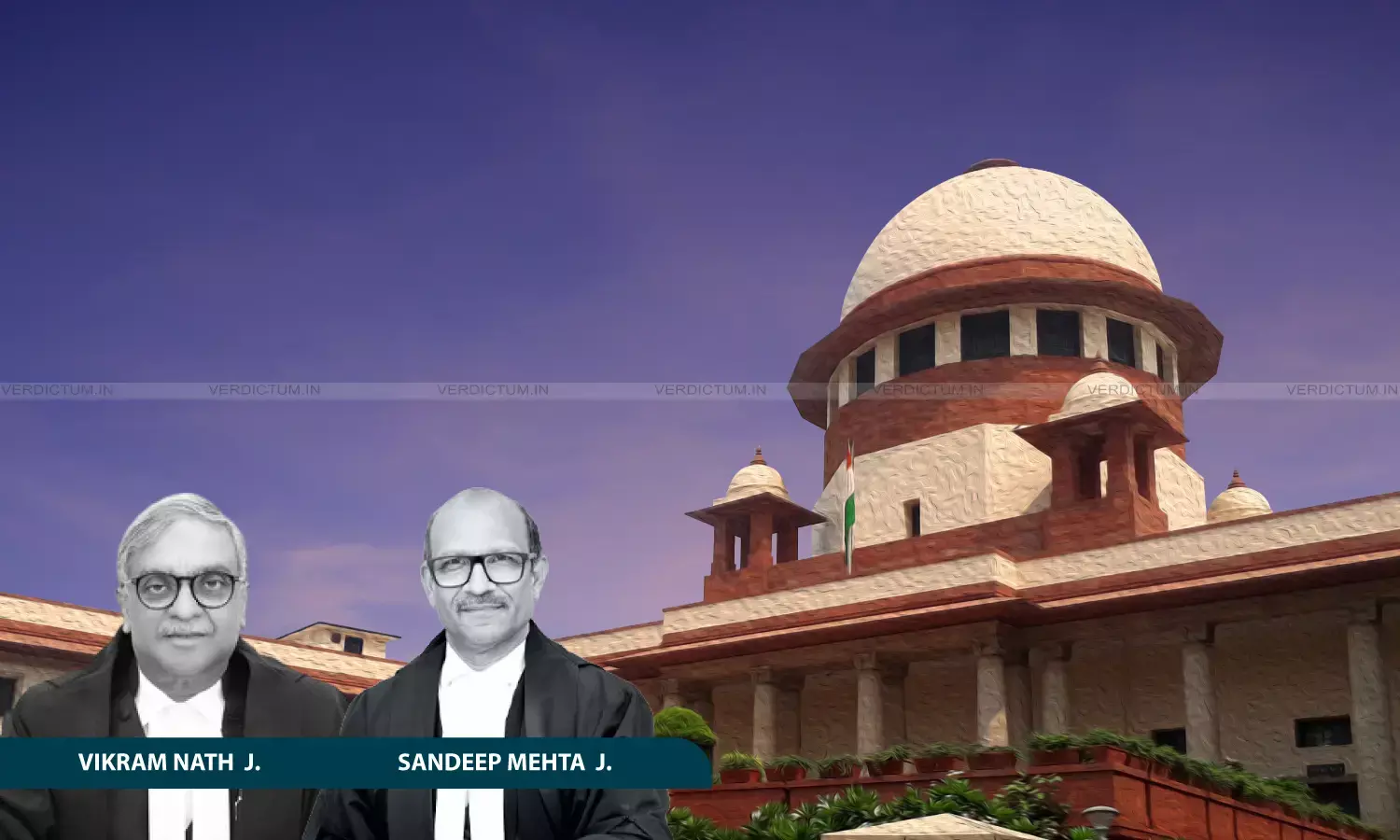
Justice Vikram Nath, Justice Sandeep Mehta, Supreme Court
While finding no tangible material to substantiate the allegation that the accused purchaser had conspired in the preparation of the alleged forged Will, or that the registered sale deed was executed by him with knowledge that the signatures on the Will were forged, the Supreme Court has quashed the criminal proceedings registered against him. However, the Court clarified that the proceedings against other accused persons would continue.
The Apex Court was considering an appeal challenging an order of the Madras High Court whereby his petition, preferred under Section 482 of the Code of Criminal Procedure, 1973, was dismissed. By way of the said petition, the appellant had sought quashing of a criminal case pending on the file of the Judicial MagistrateNo.II, Karur.
The Division Bench of Justice Vikram Nath and Justice Sandeep Mehta stated, “Admittedly, there is no privity of contract between the appellant and respondent No.2- complainant. Neither the FIR nor the impugned order discloses availability of any tangible material to substantiate the allegation that the appellant had conspired in the preparation of the alleged forged Will, or that the registered sale deed dated 18th December, 1998 was executed by him with knowledge that the signatures on the Will were forged.”
Factual Background
The second Respondent complainant lodged a complaint to the Superintendent of Police alleging that his father, Ayyasamy Nadar, died in 1988 and his elder brother, Balakrishnan, had died about one year prior thereto. It was alleged that Ayyasamy had executed a partition deed under which the ‘A’ Schedule property was allotted to the respondent complainant and, after his death, the same was to devolve upon his legal heirs. It was further alleged that his mother raised objections before the Revenue Divisional Officer, Karur. During the course of inquiry, the complainant was apprised of a Will purportedly executed by his father. However, according to the complainant, no such Will could have been executed on that date, since his father had been in a comatose condition for about one month before his death.
It was further alleged that around six years before the filing of the complaint, four accused persons had approached the complainant and his family with an offer to purchase the property at a very low price, which was outrightly rejected. Thereafter, the first accused, being the brother of the complainant, allegedly joined hands with the other four accused and the attesting witnesses to create the fabricated Will and sold the property to the accused persons by sale deeds. A case came to be registered for the offences punishable under Sections 465, 468, 420 and 120-B of the Indian Penal Code, 1860, and an investigation was commenced. Accused 3 to 6 approached the High Court by filing separate petitions under Section 482 CrPC seeking quashing of the proceedings pending before the trial Court. They claimed to be bona fide purchasers.
The High Court held that the issues raised in the petition involved disputed questions of fact and that the extreme step of quashing the criminal proceedings was not warranted. Accordingly, the quashing petition filed under Section 482 CrPC was dismissed by the High Court, and this became the subject matter of challenge in the appeal by special leave before the Apex Court.
Reasoning
On a perusal of the facts of the case, the Bench noted that Accused 2 to 6 (A-6 being the appellant), purchased the property in question by way of registered sale deeds. The sale deeds demonstrated that the sale was made for valuable consideration.
“There is not even an iota of evidence on record to show that the appellant had any role to play in the alleged fabrication of the Will dated 12th September, 1988. The earlier agreement dated 13th July, 1995 was with A-2 to A-5”, the Bench stated while also adding, “The FSL report, on which heavy reliance was placed by learned counsel appearing for respondent No.2-complainant as well as learned counsel appearing for the State, indicates that the comparison of the disputed signatures was made on the basis of a xerox copy of the allegedly forged Will. Thus, there exists a serious issue regarding the evidentiary value and persuasive worth of the said FSL report.”
The Bench noted that the appellant, being a purchaser of the subject property for valuable consideration, could not, be considered to be the person who offered fraudulent inducement to the respondent complainant or made him to deliver some property or part with valuable security so as to bring his acts within the purview of fraudulent inducement and cheating to gain property punishable under Section 420 IPC.
The Bench was of the view that even if the allegation of the respondent complainant, that the Will was forged, was found to be substantiated, the purchasers of the property would be the persons aggrieved as in such circumstances, their title over the property in question would land in dispute having been acquired from the vendor who used the alleged fabricated will to execute the registered sale deeds. Reference was made to the judgment in Mohammed Ibrahim and Others v. State of Bihar and Another (2009) wherein it has been held that a third party who is not the purchaser under the deed may not be able to make such a complaint.
Thus, allowing the appeal, the Bench quashed the proceedings in question. “However, it is made clear that the proceedings shall continue against the other accused”, it clarified.
Cause Title: S. Anand v. State of Tamil Nadu Represented by Its Inspector of Police (Neutral Citation: 2026 INSC 418