

"Temporary Status" After State-Led Administrative Exercise Not Empty Label: Supreme Court Directs Regularisation Of Goa PWD Labour Society Workers
The Court held that State of Karnataka v. Umadevi (2006) cannot be mechanically invoked to deny relief where long-serving workers were not backdoor entrants, but were continued through a State-created arrangement for essential and perennial work.
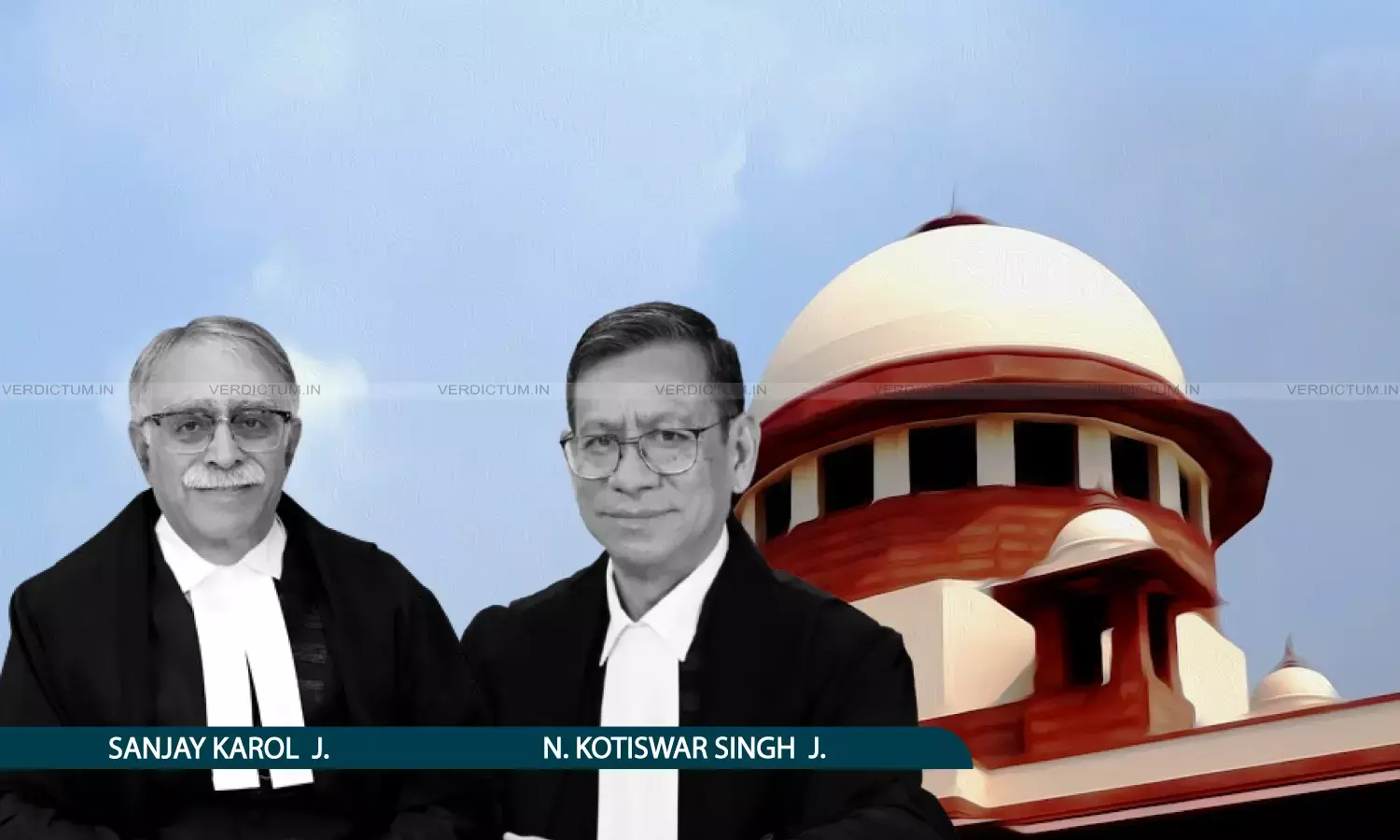
Justice Sanjay Karol, Justice N. Kotiswar Singh, Supreme Court
The Supreme Court has held that a temporary status conferred on workers after a structured administrative exercise involving Cabinet decisions, categorisation and assessment of suitability carries legal consequences, and reflects the State’s considered intention to absorb such workers in service.
The Court was hearing an appeal filed by members of the PWD Labour Supply Society against the Bombay High Court at Goa’s decision refusing to give effect to the PWD order that had granted them temporary status and recognised their entitlement to absorption in the Public Works Department as and when vacancies arose.
A Bench of Justice Sanjay Karol and Justice Nongmeikapam Kotiswar Singh, while observing that “Temporary status, so conferred after a structured administrative exercise involving Cabinet decisions, categorisation, and assessment of suitability, is not to be treated as an empty administrative label devoid of legal consequence. It is the outward manifestation of the State’s own considered intention to absorb the workers”, directed regularisation of members of the PWD Labour Supply Society in the establishment of the Public Works Department, Government of Goa.
Senior Advocate Huzefa Ahmadi appeared for the appellants, while Advocate Ninad Laud appeared for the State.
Background
The Court was hearing an appeal by members of the PWD Labour Supply Society, who challenged the Bombay High Court at Goa’s refusal to give effect to an order granting them temporary status and recognising their entitlement to absorption in the PWD as and when vacancies arose.
The workers had originally been engaged between 1967 and 2003 through private contractors executing PWD works. The State later constituted the PWD Labour Supply Society, headed by the Principal Chief Engineer of the PWD, with the object of ending exploitation of contract labour and ensuring eventual regularisation of their services.
The State had initiated steps for absorption, including categorisation of workers into posts such as Meter Readers, Work Assistants, Pump Attendants, Watchmen, Helper-Plumbers and Electricians. A proposal granting temporary status to 1,399 members who had completed eight years of service was approved by the PWD Minister and the Chief Minister. The order granting temporary status was also placed before the High Court in earlier proceedings, where the State made a statement that the workers would be absorbed as vacancies arose.
However, the State later resisted regularisation on the ground that the order lacked necessary concurrence, that the workers were members of a society and not government employees, that no sanctioned posts were available, and that State of Karnataka v. Umadevi (2006) barred such relief.
Court’s Observations
The Court rejected the State’s attempt to treat the Society as an independent labour arrangement unconnected with the Government.
The Bench observed: “At the very outset, it is necessary to observe that the PWD Labour Supply Society is not an ordinary or private labour contractor’s arrangement with which the State has only an incidental or arm’s-length connection. It is a body constituted by the State itself, headed by the Principal Chief Engineer of the PWD, a senior government functionary, and was brought into being for the specific and declared purpose of ending the exploitation of contract workers and ensuring that their services would, in due course, be regularised.”
The Court said the real question was whether the State, after taking the benefit of their work over a long period and conferring temporary status on them, could deny absorption in terms of its own policy decisions.
The Bench held that the State’s intention had to be gathered from the entire course of conduct, not from one document in isolation. It referred to the decisions taken in 2012 and 2013, the categorisation exercise, the recommended freeze on direct recruitment, grant of temporary status, parity in pay and the order recognising entitlement to absorption.
The Court stated: “Viewed thus, the decisions of 27.07.2012 and 04.12.2013, the constitution of a Committee to categorise and assess the suitability of the members of the Society, the freeze recommended on direct recruitment pending regularisation, grant of temporary status with parity of pay and emoluments as on 01.04.2013, and, finally, the order dated 07.02.2014 recording the Government’s sanction and the entitlement of the members to absorption as and when vacancies arise, each of these steps, taken cumulatively, permits of only one reasonable inference that the State intended, and continues to require, the services of the appellants and also to confer benefits.”
The Court accepted that promissory estoppel cannot compel the State to act contrary to statute or constitutional discipline. However, it held that the absence of strict promissory estoppel did not end the equitable inquiry in a welfare State.
The Bench remarked: “This is a welfare State, and a welfare State that has, for decades, in some cases since the 1960s, and at the very least since the grant of temporary status in 2014 taken the benefit of the labour, skill, and continuous attendance of the appellants, cannot in fairness and good conscience now cast them aside on the strength of an internal file infirmity of its own creation, an infirmity that was never disclosed to the appellants at the time the order dated 07.02.2014 was passed, acted upon, and placed before the High Court itself.”
The Court added that it would be inconsistent with the State’s role as a model employer to accept the benefit of long service while disowning the commitment that sustained it.
The Court noted that many of the workers belonged to unskilled, semi-skilled and skilled categories and had rendered long service, in some cases for decades.
The Bench observed: “They are workers drawn predominantly from the unskilled, semi-skilled and skilled categories, engaged on a contractual basis by the State’s own instrumentality, who have rendered long and continuous service, several of them for well over a decade and a half, and some for periods extending over decades. To deny regularisation to such workers, after having taken the benefit of their labour for so long, is itself symptomatic of the very exploitation that the Society was constituted to prevent, and cannot be countenanced by a constitutional court.”
The Court held that Umadevi (2006) was meant to curb illegal backdoor appointments, but later decisions had cautioned against using it mechanically to defeat claims of long-serving employees doing essential and perennial work.
Referring to State of J&K v. Distt. Bar Assn., Bandipora (2017), Sheo Narain Nagar v. State of U.P. (2018), Jaggo v. Union of India (2024), Vinod Kumar v. Union of India (2024), and Shripal v. Nagar Nigam, Ghaziabad (2025), the Court held that the appellants’ case fell within the one-time regularisation measure contemplated in Umadevi itself.
The Bench held: “Tested on the touchstone of this line of authority, the present is manifestly a case falling within, and not outside, the one-time measure contemplated by paragraph 53 of Umadevi (supra) itself, which recognises that irregular, as distinct from illegal appointments of duly qualified persons, continued for ten years or more without the intervention of any court order, may be regularised on a one-time basis.”
The Court further stated: “The appellants' engagement was not the product of a clandestine or illegal backdoor entry; it was the outcome of a structured process, constitution of a Society by the State, a Cabinet-approved categorisation exercise, and the grant of temporary status undertaken by the State itself, with full knowledge and active participation of its highest executive authorities, including the Chief Minister and the concerned Minister.”
The Court found fault with the High Court for treating the workers’ engagement as illegal while also recognising that they had been treated at par with regular employees except for regularisation.
The Bench observed: “These two findings sit uneasily with one another. The grant of temporary status was preceded by a process of scrutiny and categorisation undertaken at the instance of the State itself, and reflects a conscious governmental decision that the appellants should continue to discharge the functions assigned to the respective posts. It also demonstrates that the State did not regard the appellants as lacking the requisite eligibility to continue in service.”
The Court held that the principal irregularity, if any, lay in the initial mode of engagement, not in the State’s later recognition of the workers’ utility and eligibility.
The State’s argument that the temporary status order lacked Finance Department concurrence and necessary approvals was also rejected.
The Court stated: “In these circumstances, the State cannot now be permitted to rely upon its own alleged procedural deficiency to defeat the legitimate expectation generated by its consistent conduct over a prolonged period. Such a course is inconsistent with the obligation of the State to act as a model employer, a principle repeatedly emphasised by this Court.”
The Court also held that the Advocate General’s earlier statement before the High Court was not a mere wrong concession on law, but a statement based on an executive order that had emerged from a structured process.
The State’s apprehension that regularising these workers would open similar claims across the State was rejected because the relief was confined to identified workers before the Court.
The Bench held: “The floodgates concern in Umadevi (supra) was addressed to the indiscriminate regularisation of illegal appointments at large; it was never intended to shut the door on a case-specific, one-time measure confined to identified and named claimants whose facts have been fully examined by the Court.”
Conclusion
The Supreme Court allowed the appeal and set aside the Bombay High Court at Goa judgment declining regularisation.
It held the appellants entitled to regularisation in the Public Works Department, Government of Goa, in the posts or categories assigned to them pursuant to the State’s 2013 categorisation exercise and temporary status order.
The State was directed to frame an appropriate regularisation scheme within four months, limited to the workers who were members of the Society when the writ petition was instituted. If sufficient sanctioned vacant posts are unavailable, the State must create supernumerary posts on a one-to-one basis, personal to the concerned workers and to lapse upon retirement, resignation, death or cessation of service.
The workers will be deemed regularised from the date they first approached the High Court in their own right and will be entitled to consequential benefits, including seniority, pensionary and retiral benefits, from that date. However, arrears of pay and allowances will not be payable for any period before the Supreme Court’s judgment.
Cause Title: Rupesh R. Gaonkar & Ors. v. State of Goa & Ors. (Neutral Citation: 2026 INSC 792)
Appearances
Appellants: Senior Advocate Huzefa Ahmadi with Advocates Karan Mathur, Sailee Kenny, Rashmi Singh, Guruprasad Naik, Gajendra Singh Negi and Dcosta Ivo Manuel Simon, AOR
Respondents: Advocates Ninad Laud, Surjendu Sankar Das, AOR, Annie Mittal, Zubin Dash, Ishani Shekhar and Swarnendu Das
