

Heinousness Of Crime Cannot Be Sole Ground To Deny Remission: Supreme Court
The Court held that remission cannot be denied solely on the ground that the offence was heinous, observing that premature release must be assessed based on reformation, conduct in custody, and prospects of reintegration into society.
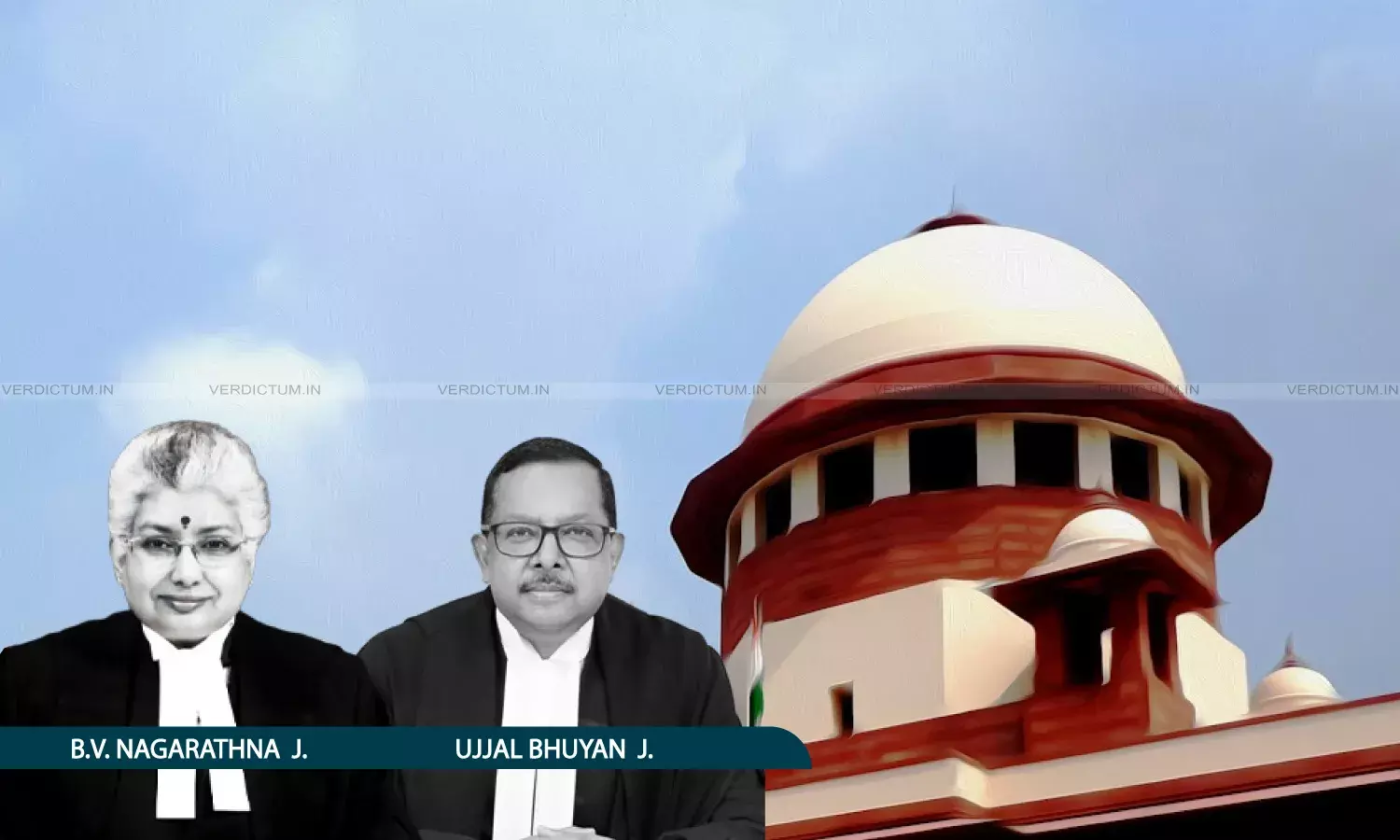
Justice B.V. Nagarathna, Justice Ujjal Bhuyan, Supreme Court
The Supreme Court has held that the heinous nature of an offence cannot, by itself, constitute the sole basis for denying premature release or remission to a convict, observing that remission is a distinct executive function rooted in reformative justice and not a continuation of the sentencing process.
The Court was hearing a writ petition filed by a life convict challenging a decision of the Ministry of Home Affairs rejecting the recommendation of the State of Uttarakhand for his premature release after more than twenty-two years of incarceration.
A Bench of Justice B.V. Nagarathna and Justice Ujjal Bhuyan observed: “… remission is not an extension of the sentencing process, but a distinct executive function concerned with the present and future, namely, the prisoner’s conduct, evidence of reformation, and prospects of reintegration into society. To predicate its denial only on the heinous nature of the offence is to collapse this distinction and to reconvert remission into a retrospective reaffirmation of guilt, which the criminal justice system has already adjudicated upon”.
Senior Advocate N. Hariharan appeared for the petitioner. Additional Solicitor General Vikramjit Banerjee appeared for the Union of India.
Background
The petitioner was convicted along with other co-accused for offences under Sections 120B and 302 IPC in connection with a murder case investigated by the CBI. He was sentenced to life imprisonment by the Special Judge, Dehradun, and his conviction was subsequently affirmed by the Uttarakhand High Court as well as the Supreme Court.
After undergoing more than twenty-two years of incarceration, the petitioner sought premature release. The State of Uttarakhand recommended his premature release after evaluating his conduct and incarceration history. However, the Ministry of Home Affairs rejected the proposal by communication dated July 9, 2025.
Before the Supreme Court, the Union of India defended the rejection primarily on the ground that the offence committed by the petitioner was grave and heinous in nature.
Court’s Observation
The Supreme Court first found that the impugned communication issued by the Ministry of Home Affairs was ex facie non-speaking and failed to disclose any reasons for disagreeing with the recommendation made by the State Government.
The Court observed that any decision affecting personal liberty must be reasoned, transparent and founded on relevant considerations. Referring to Laxman Naskar v. State of W.B. (2000), the Bench reiterated that remission decisions must consider factors such as the possibility of recurrence of crime, conduct in custody, usefulness of continued incarceration and socio-economic circumstances of the convict’s family.
The Court then extensively discussed the distinction between pardon, reprieve, respite, remission and commutation, referring to State (NCT of Delhi) v. Prem Raj (2003), Sarat Chandra Rabha v. Khagendranath Nath (1961), State of Haryana v. Mahender Singh (2007) and Satish v. State of U.P. (2021).
The Bench reiterated that remission does not alter the conviction or sentence imposed by the court, but merely shortens the duration of actual imprisonment as an exercise of executive clemency.
Dealing specifically with the Union Government’s justification based on the seriousness of the offence, the Court held that remission jurisprudence under Indian constitutional law is founded upon reformative principles and not retributive outrage.
The Bench remarked: "... the faint ground invoked by the respondent-Union of India in support of rejection of the petitioner’s plea for premature release is that the crime committed by the petitioner was a heinous one. We wish to make it clear that in a constitutional polity governed by the rule of law, the denial of remission cannot rest solely on the ground of heinousness of the crime".
The Bench further observed that “to predicate its denial only on the heinous nature of the offence is to collapse this distinction and to reconvert remission into a retrospective reaffirmation of guilt, which the criminal justice system has already adjudicated upon.”
The Bench observed that a criminal justice system refusing to recognise the possibility of transformation and rehabilitation would undermine the reformative ideals underlying remission policies, stating that “Justice does not permit permanent incarceration of an individual in the shadow of their worst act.”
The Court also cautioned against allowing emotional or retributive considerations to dominate remission decisions. The Bench observed: “Emotive retribution is a course, incompatible with constitutional values.”
Referring to Plato’s writings on punishment and reformation, the Court observed that punishment must ultimately serve prevention and rehabilitation rather than vengeance. The Bench further observed that continued incarceration becomes unjustified once the reformative objective underlying punishment stands substantially achieved.
The Court also relied upon the petitioner’s satisfactory prison conduct, the recommendation made by the State Government, the prolonged incarceration already undergone by him, and the fact that a co-accused had already been granted premature release after a lesser period of custody.
Conclusion
The Supreme Court held that the rejection of the petitioner’s premature release solely based on the heinous nature of the offence was legally unsustainable and contrary to the reformative principles governing remission jurisprudence.
The Court further held that the impugned communication issued by the Ministry of Home Affairs was arbitrary, non-speaking and violative of principles governing executive discretion in remission matters.
Accordingly, the Court quashed the rejection order and directed that the petitioner be treated as prematurely released/remitted in terms of the judgment.
Cause Title: Rohit Chaturvedi v. State of Uttarakhand & Ors. (Neutral Citation: 2026 INSC 490)
Appearances
Petitioner: N. Hariharan, Senior Advocate; Pradeep Misra, AOR; Advocates Aditya Vaibhav Singh, Vanya Gupta, Aarushi Singh, Aman Akhtar, Rekha, Riya Parihar, Arjan Singh Mandla, Shivendra Singh, Sanjukta Das
Respondents: Vikramjit Banerjee, ASG; Mukesh Kumar Maroria, AOR; Advocates S.N. Terdal, Raman Yadav, Siddhartha Sinha, Sonali Jain, Bharat Sood, Srishti Mishra, Arvind Kumar Sharma & Others
