Equating Presiding Officers Of Central Government Industrial Tribunals Cum Labour Courts With District Judges Reasonable: Supreme Court
The Apex Court also held that re-employed officers form a separate class for pay fixation, and that their claim to 6th Pay Commission scales could not be asserted as a matter of fundamental right.
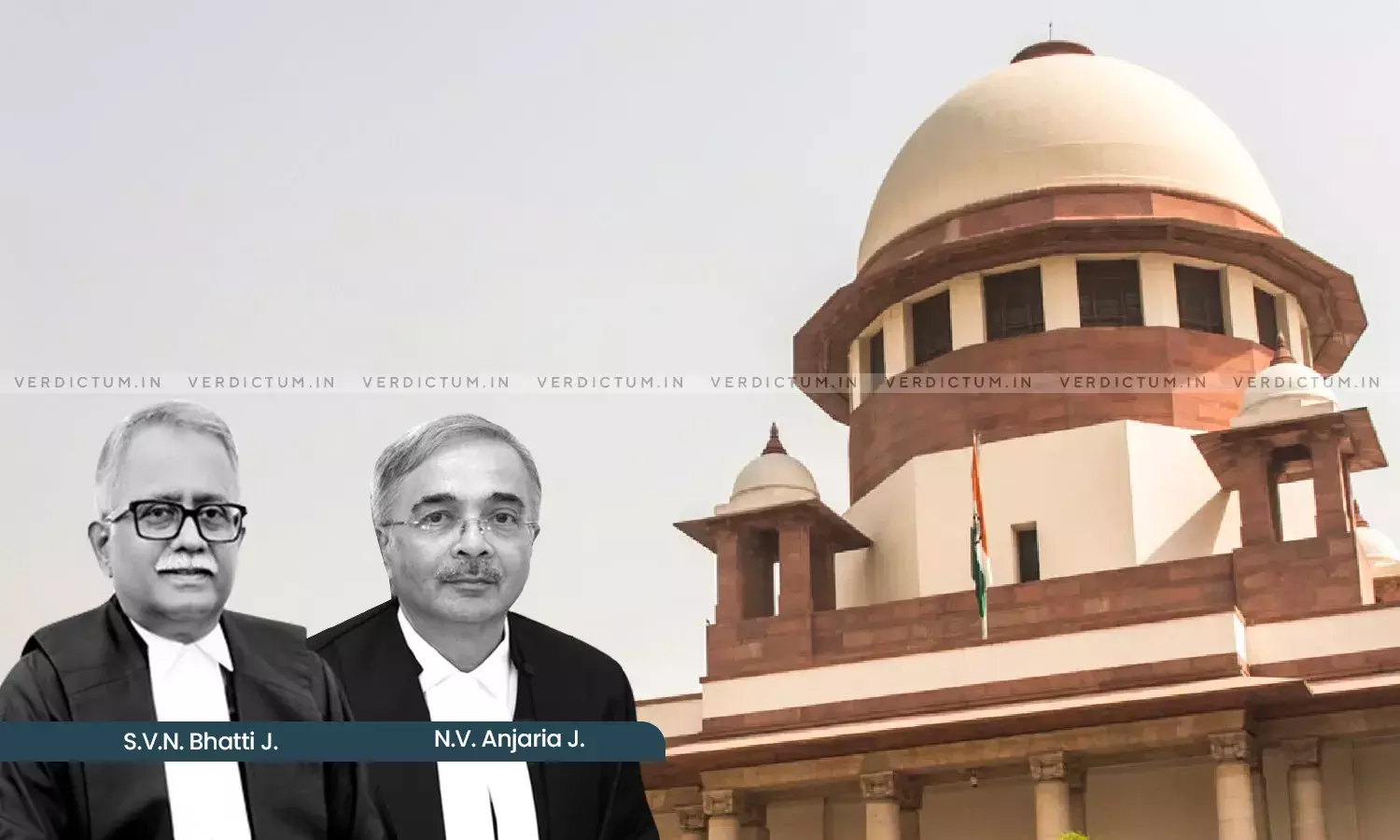
Justice S.V.N. Bhatti, Justice N.V. Anjaria, Supreme Court
The Supreme Court has held that equating Presiding Officers of Central Government Industrial Tribunals-cum-Labour Courts with officers of the District Judiciary for pay scales is reasonable and does not violate Articles 14 or 16 of the Constitution, except in the case of Presiding Officers of National Tribunals functioning at Mumbai and Calcutta.
The Court was hearing a writ petition filed under Article 32 by two Presiding Officers of Central Government Industrial Tribunals-cum-Labour Courts, who sought implementation of the 6th Pay Commission recommendations on par with other tribunals and challenged the order dated January 16, 2012, concerning the fixation of their pay scales.
A Bench of Justice S.V.N. Bhatti and Justice N.V. Anjaria held: “The contention that the presiding officers in CGITcum-LCs have been wrongly equated with the officers in the District Judiciary and that the same scales are extended to both has no legs to stand. The industrial tribunals or labour courts in which persons like the petitioners are appointed as presiding officers are established within the State, and equating such presiding officers with the District Judiciary, excepting the presiding officers of National Tribunals functioning at Mumbai and Calcutta, is reasonable and does not book any arbitrariness.
The Bench further added: “Grouping them separately with those regularly working and equating them with District Judiciary cannot be said to offend either the tenets of Article 14 or the requisites of Article 16 of the Constitution.”
Advocate Nishant Krishan Yadav appeared for the petitioners, while Additional Solicitor General Archana Pathak Dave appeared for the Union of India and its authorities.
Background
The petitioners were appointed as Presiding Officers of Central Government Industrial Tribunals-cum-Labour Courts functioning at New Delhi and Hyderabad. They contended that the tribunals presided over by them were Union Courts/Tribunals within the meaning of Article 247 read with Article 323-B of the Constitution.
Their case was that the Central Government Industrial Tribunals-cum-Labour Courts stood on the same pedestal as tribunals such as the Central Administrative Tribunal, the Income Tax Appellate Tribunal, the Railway Claims Tribunal, the Debt Recovery Tribunal, the Foreign Exchange Maintenance Authority, and the Company Law Board.
They argued that while the Government of India accepted the 6th Pay Commission recommendations for officers of other tribunals, the Presiding Officers of Central Government Industrial Tribunals-cum-Labour Courts were grouped with the District Judiciary and given pay scales recommended by the Justice E. Padmanabhan Committee.
The petitioners alleged that the Union had treated unequals as equals by applying District Judiciary scales to them, thereby denying them 6th Pay Commission pay scales and violating Articles 14 and 16.
The Union opposed the plea, pointing out that the petitioners were re-employed persons and that the pay fixation of re-employed pensioners was governed by the Central Civil Services (Fixation of Pay of Re-employed Pensioners) Orders, 1986. It was also stated that pay scales of Presiding Officers had earlier been revised in accordance with the Shetty Commission recommendations, bringing them at par with District Judges in the State Judiciary, and were later revised on the basis of Justice E. Padmanabhan Committee’s recommendations.
Court’s Observations
The Court noted the chronological development of pay and allowances applicable to Presiding Officers of Central Government Industrial Tribunals-cum-Labour Courts. It recorded that the pay scales prescribed by Justice E. Padmanabhan Commission were implemented by order dated January 16, 2012, and that later statutory rules continued to prescribe pay for such officers.
The Court observed: “In other words, statutory rules have been framed from time to time to prescribe and revise pay scales for the officers belonging to the class of petitioners holding the post of presiding officer in the CGIT-cum-LCs.”
The Court also referred to the statutory framework under the Industrial Disputes Act, 1947, including Sections 7, 7A and 7B, dealing respectively with Labour Courts, Industrial Tribunals and National Tribunals.
The Court found that the petitioners themselves were re-employed Presiding Officers. It referred to the CCS (Fixation of Pay of Re-employed Pensioners) Orders, 1986, and held that pay scales and fixation for re-employed persons were governed by a special scheme.
The Court observed: “The fact is not in dispute, rather it is the case of the petitioners themselves, that they are in re-employment holding the post of presiding officer in CGIT-cum-LCs. While working on the re-employed post, they have been seeking for themselves the grant of 6th Pay Commission pay scales. What becomes evident is that the fixation of pay scales and the manner of pay structure available to the class of re-employed officers such as the petitioners, are governed by the Central Civil Services (Fixation of Pay of Re-employed Pensioners) Orders, 1986.”
The Court said the petitioners, despite being governed by a different statutory order in their re-employed capacity, were seeking 6th Pay Commission scales while also contending that they could not be placed at par with the District Judiciary.
The Supreme Court reiterated that pay fixation is an executive function and that courts ordinarily defer to expert bodies in such matters unless mala fides or apparent anomalies are shown.
Referring to State of U.P. v. J.P. Chaurasia (1989), the Court stated that courts are not suited to evaluate and compare pay-scale differentiation on affidavits and pleadings. It also referred to Union of India v. Dineshan K.K. (2008), Union of India v. Indian Navy Civilian Design Officers Association (2023), and Union of India v. T.V.L.N. Mallikarjuna Rao (2015).
The Court quoted the statement of law in T.V.L.N. Mallikarjuna Rao: “The classification of posts and determination of pay structure comes within the exclusive domain of the executive and the Tribunal cannot sit in appeal over the wisdom of the executive in prescribing certain pay structure and grade in a particular service. There may be more grades than one in a particular service.”
The Court held that the classification adopted for applying pay scales was based on rational and intelligible differentia. It said re-employed persons could be classified separately for the purpose of pay structure and fixation.
The Court observed: “It is well-settled that Article 14 prohibits class legislation, but does not prohibit reasonable classification for the purposes of legislation. The classification brought out in the instant case for the purpose of applying the pay scales is based on rational and intelligible differentia which distinguishes persons grouped together from those left out of the group. Classifying the re-employed persons separately for the purpose of applying pay structure and pay fixation clearly satisfies the principles and tests laid down for applying the Equality Clause read with principles underlying Article 16 of the Constitution.”
Relying on Charanjit Lal Chowdhury v. Union of India (1950), the Court reiterated that Article 14 does not take away the State’s power to classify persons for legitimate purposes.
The Court further observed: “The category of re-employed officers/persons like the petitioners stand with substantial distinction against the regular officers in the employment of the government. The re-employed class could be reasonably and rationally classified separately for the purpose of applying pay scales which may not be equivalent to and on the same pedestal with the other classes. Upon re-employment, the reemployed officers/persons would cease to be homogeneous vis-à-vis class of regular officers in employment of the government.”
The Court noted that the equation with the District Judiciary was not an ad hoc exercise, but was based on recommendations of expert bodies such as the Shetty Commission and Justice E. Padmanabhan Committee.
The Court observed: “The equating exercise is undertaken by commissions like Shetty Commission and recommendations made by Justice E. Padmanabhan Committee, which are the basis for extending the pay scale to the presiding officers of CGIT-cum-LCs at par with the District Judiciary. It is trite principle that the courts refrain from adopting a different view contrary to one seasonedly taken by the expert body, which is equipped with details and has the proficiency in the subject.”
The Court reiterated that judicial review in matters of classification of posts and determination of pay scales is limited, since equation of posts and salaries is complex and better left to expert bodies and the executive.
The Court observed: “It has to be reiterated that the power of judicial review in matters of classification of posts and determination of pay scale was very limited inasmuch as the equation of posts and salaries is a complex matter required to be best left to an expert body. It is the domain which is exercised by the executive with the aid of bodies expert in the field.”
The Court further held that the pay structure of the petitioners had been designed on the basis of expert recommendations, and that grouping re-employed officers after superannuation with District Judges, while treating regularly employed government officers separately, was a reasonable classification for pay purposes.
Conclusion
The Supreme Court held that the petitioners, being re-employed officers, belonged to a separate class after retirement and had no basis to claim 6th Pay Commission pay scales as a matter of fundamental right. It dismissed the writ petition as devoid of merit and disposed of pending applications.
Cause Title: R.K. Yadav & Anr. v. Union of India and Others (Neutral Citation: 2026 INSC 848)
Appearances
Petitioners: Ranbir Singh Yadav, AOR
Respondents: Shreekant Neelappa Terdal, AOR; Archana Pathak Dave, A.S.G.; with Advocates Arvind Kumar Sharma, Kamal Rattan Digpaul, Bhuvan Kapoor, Harshita Choubey, Parthvi Ahuja and Sweksha