

Supreme Court Reserves Verdict On Review Petitions Challenging Mandatory 3-Year Practice Rule For Entry-Level Judicial Officers
The Court heard extensive arguments on whether a mandatory three-year practice rule deters meritorious law graduates, women, and persons with disabilities from joining the judiciary.

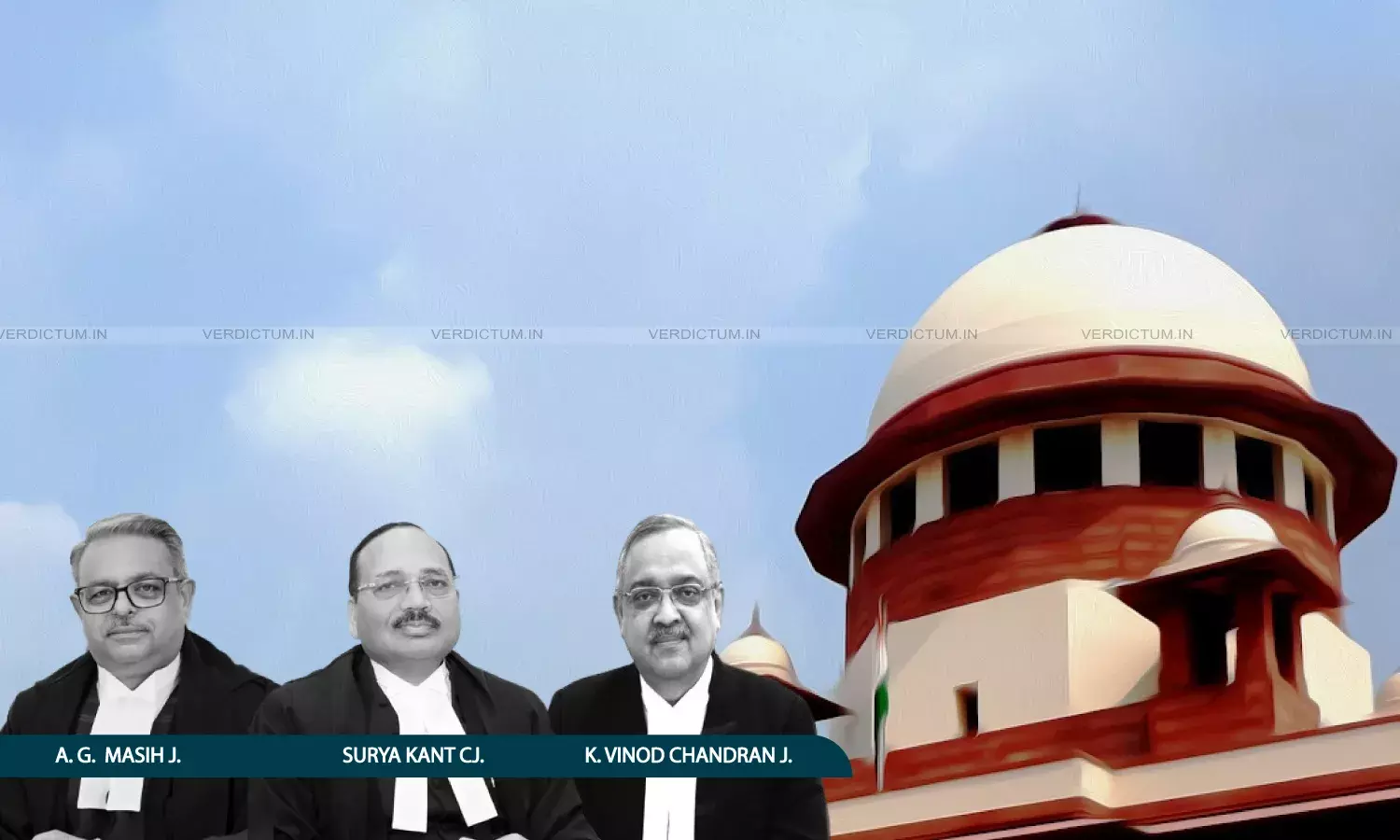
The Supreme Court reserved its verdict on a batch of review petitions that challenged its earlier judgment mandating three years of legal practice for candidates seeking direct recruitment as Civil Judges (Junior Division).
Simultaneously, the Court heard a writ petition that sought the relaxation of this three-year mandate for persons with disabilities.
A Bench comprising Chief Justice of India Surya Kant, Justice August George Masih and Justice K. Vinod Chandran heard extensive submissions from various counsel, intervenors, and the Amicus Curiae before reserving the judgment.
The review petitions sought reconsideration of the Court's May 2025 decision which restored the three-year practice requirement, contending that the rule deterred bright law graduates from joining the lower judiciary immediately after completing their education.
During the proceedings, counsel appearing against the practice requirement argued that the mandatory waiting period severely discouraged young graduates from opting for judicial service.
Counsel submitted before the Bench that a three-year delay deterred aspiring legal professionals from entering the field, noting that women and persons with disabilities suffered a disproportionately higher impact. Earlier in the proceedings, Chief Justice Surya Kant also orally remarked that the rule disproportionately affected women candidates.
Senior Advocate Pinky Anand argued that the judicial system should focus on strengthening post-recruitment training rather than imposing entry barriers. She advocated for a nationwide, standardized continuing legal education framework to replace the varying training standards across different State Judicial Academies.
Senior Advocate Colin Gonsalves urged the Bench to consider experiential learning models, including legal aid work, judicial clerkships, and structured internships. He brought to the Court’s notice that National Law Universities (NLUs) and premier law institutions across the country unanimously opposed the three-year litigation mandate.
Gonsalves emphasized that rigid practice requirements deterred top law graduates from entering judicial service, citing data showing that only 20% of NLSIU graduates joined active litigation. He also questioned the procedural validity of the May 2025 judgment, submitting that a three-judge Bench could not have completely reversed an earlier three-judge Bench ruling without making a reference to a larger Bench.
He said, "The suggestion made here is experimental learning—some things that are interesting because they were missing in the learned Amicus’s presentation. So, experiential learning—judges who are taken from day one through legal aid, clerkship, and internship-based models, continuous evaluation and accountable mechanisms, and holistic, evolving judicial training...I give you the status as far as the NLUs are concerned. What did they tell you? Because I think the presentation of the learned Amicus may not have been comprehensive. There seem to be very emphatic interventions by the NLUs and the leading law colleges..The NLUs seem to be telling you that you should not have the three-year rule...When the examinations are held for the Higher Judicial Services, there are a significant number of vacancies in the country. So you are having a sort of problem filling the vacancies for judges. Only 20% of the graduates from NLSIU are entering law practice."
One Counsel submitted a phased transition framework to ensure institutional stability while mitigating hardship for aspirants. He suggested a transitional cooling period up to 2029 during which the three-year requirement would remain in abeyance.
Under his proposed model, Phase One (up to 2029) would focus on institutional preparation, expanding post-selection training and district-level clerkships; Phase Two (from 2029) would introduce mandatory legal aid and mediation training; Phase Three (from 2030) would integrate a structured one-year court internship into the final year of LL.B. degree programs; and Phase Four (from 2031) would reintroduce a pre-selection practice requirement.
He also suggested, "Alternative Framework (if the phased model is not accepted): Without prejudice, a two-year composite model may be adopted—one year of post-selection training (mandatory Judicial Academy training with structured modules and supervised attachments) and a one-year structured mandatory internship integrated with legal education (where the final year of LL.B. / B.A. LL.B., three-year or five-year, includes a structured one-year internship comprising six months at the District Courts and six months at the High Courts)..."
"Special Provisions for Persons with Disabilities: It is respectfully submitted that persons with disabilities may be required to undergo only one year of mandatory practice, preferably post-selection. Such a requirement may continue only until accessible judicial infrastructure is fully operational. Alternative pathways such as clerkship and research roles may be recognized", he added.
Amicus Curiae Senior Advocate Siddharth Bhatnagar submitted that if the Court chose to retain the three-year eligibility threshold, it should adopt a staggered implementation roadmap.
He suggested allowing fresh law graduates to take the judicial examinations in 2026, while gradually scaling the practice requirement from zero years in 2026, to one year in 2027, two years in 2028, and full implementation by 2029. Taking note of additional applications regarding upper-age relaxations due to delayed recruitment cycles, Chief Justice Surya Kant indicated that age-bar relief might be considered necessary before reserving the matter for judgment.
He submitted that concessions such as lower qualifying marks could apply to women and persons with disabilities, and further suggested that judicial clerkships ought to count toward the requisite legal experience.
Various intervenors further advocated for staggered, experience-proportional training modules modeled after the frameworks adopted by the Assam and Punjab & Haryana High Courts, arguing that rigid entry barriers violated Article 14 of the Constitution.
Arguments were also advanced highlighting European judicial models, specifically the civil law frameworks in France and Denmark, where direct recruitment is paired with extensive institutional training and judicial assistance roles prior to full appointment.
Additionally, law officers from Public Sector Undertakings (PSUs) sought parity with judicial law clerks to count their corporate and advisory experience toward the three-year eligibility threshold.
Cause Title: All India Judges Association v. Union of India (W.P. (C) No. 1110/2025)
Appearances:
Petitioners: Senior Advocate Colin Gonsalves and Senior Advocate Pinky Anand
Respondents: Additional Solicitor General Aishwarya Bhati and Senior Advocate Maninder Acharya
Amicus Curiae: Senior Advocate Siddharth Bhatnagar
Click here to read/download the Order