

Multiplier For Assessing Motor Accident Compensation For Bachelor’s Death Must Be Based On Deceased’s Age, Not Parents': Supreme Court
The Court also declined to revisit the concurrent finding that the claimant had not established her status as the deceased’s legally wedded wife and upheld the apportionment of compensation.
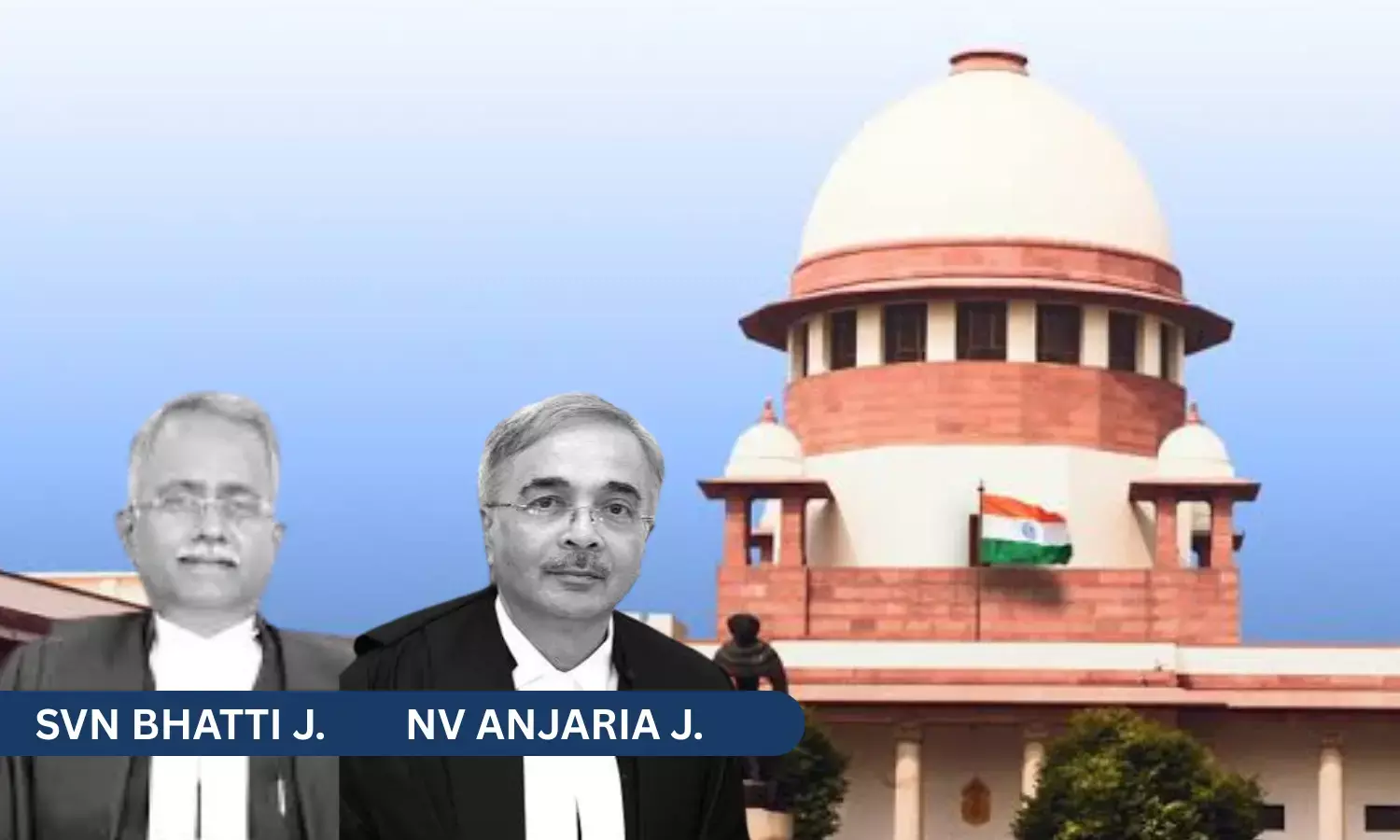
The Supreme Court has held that the multiplier for assessing compensation arising from the motor accident death of a bachelor must be determined according to the deceased’s age and not the age of his dependent parents.
Upholding the multiplier of 16 applied for a 33-year-old deceased, the Court dismissed the appeals filed by the insurer and the claimant against the compensation award and its apportionment.
The Court was hearing cross-appeals against a judgment of the Punjab and Haryana High Court, which had substantially affirmed the compensation awarded by the Motor Accident Claims Tribunal while increasing the claimant’s share from ₹5 lakh to ₹7.5 lakh.
A Bench of Justice S.V.N. Bhatti and Justice N.V. Anjaria observed: “To ensure consistent calculations across the country, this Court introduced a standardised multiplier matrix in Sarla Verma (supra). This matrix was validated by a Five-Judge Bench in Pranay Sethi. Addressing the specific legal question of which multiplier method would apply to the bachelors, a Three-Judge Bench of this Court in Munna Lal Jain (supra) held that the multiplier must be determined by the age of the deceased, not by the age of the dependents. This was later confirmed by a subsequent ruling of this Court in Sube Singh (supra), which held that this rule is no longer res integra. The deceased, Shushant Prabhakaran, was 33 years old at the time of the accident. According to the standardised matrix established in Sarla Verma (supra) and approved in Pranay Sethi (supra), the age bracket of 31 to 35 corresponds directly to a multiplier of 16. Therefore, the MACT and the High Court correctly applied a multiplier of 16 in determining the compensation.”
Senior Advocate Prashanto Chandra Sen appeared for the claimant, and Advocate Prabhat Ranjan Raj appeared for the respondents.
Background
The claim arose from an accident in which a heavy goods vehicle struck a motorcycle. The rider died at the scene, while the pillion rider sustained grievous injuries. The deceased was 33 years old and employed as a manager with a private company. The claimant asserted that she was his widow, while his parents were also joined in the compensation proceedings.
The Tribunal found that the accident had occurred due to the truck driver’s rash and negligent driving and rejected the insurer’s defence that the vehicle lacked a valid fitness certificate. Based on the deceased’s income, the Tribunal added 50% towards future prospects, deducted 50% towards personal expenses and applied a multiplier of 16. After deducting the amount received under a personal accident term policy, it awarded compensation of ₹82,56,152.
The Tribunal did not accept the claimant’s assertion that she was the deceased’s legally wedded wife, observing that the documentary evidence described him as her fiancé. It also found that she was independently employed and was not financially dependent upon him. The Tribunal apportioned ₹5 lakh to her, ₹50,000 to the deceased’s father and the remaining amount to his mother.
Both the insurer and the claimant approached the High Court. The High Court increased the claimant’s share to ₹7.5 lakh but otherwise maintained the award. Before the Supreme Court, the insurer contended that the multiplier should have been selected according to the parents’ age, while the claimant challenged the refusal to recognise her as the legally wedded wife and the consequent apportionment.
Court’s Observations
The Supreme Court noted that the insurer had not seriously challenged the Tribunal’s factual findings on negligence. The claimant had testified as an eyewitness, while the truck driver admitted that his licence and vehicle had been impounded and that he had not complained to any authority that he had been falsely implicated.
The Court found that the registration of the criminal case and the filing of the charge sheet discharged the primary burden and strengthened the conclusion that the accident resulted from the truck driver’s rash and negligent driving.
The Court rejected the insurer’s argument that the multiplier should correspond to the age of the deceased’s parents because they were the principal beneficiaries of the compensation.
The Bench observed: “The MACT and the High Court rejected the Insurer’s argument, holding that the legal position has evolved and is now settled in favour of using the deceased’s age.”
The Court traced the governing position to Sarla Verma v. Delhi Transport Corporation (2009), which standardised the multiplier matrix, and National Insurance Co. Ltd. v. Pranay Sethi (2017), in which a Constitution Bench approved that matrix.
It further relied upon Munna Lal Jain v. Vipin Kumar Sharma (2015), which held that the multiplier in the case of a deceased bachelor must be selected according to the deceased’s age rather than the age of the dependent parents. The principle was subsequently affirmed in Sube Singh v. Shyam Singh (2018).
Since the deceased was 33 years old, he fell within the 31-to-35 age bracket, for which the standardised matrix prescribed a multiplier of 16. The Court accordingly found no error in the multiplier applied by the Tribunal and affirmed by the High Court.
On the claimant’s asserted marital status, the Supreme Court noted that the burden of proof rested upon her even though proceedings before a Motor Accident Claims Tribunal are summary in nature.
The Bench observed: “The Tribunal and the High Court have appreciated the oral and documentary evidence pleaded to confirm the finding of fact that Priyanka Das was not his legally wedded wife. We are not reappreciating the evidence to record a different finding, nor to express our concurrence with the view taken by the Tribunal and the High Court.”
The claimant submitted that although the courts had correctly relied upon Manjuri Bera v. Oriental Insurance Co. Ltd. (2007), the share apportioned to her remained inadequate. The Supreme Court, however, declined to interfere with the High Court’s determination.
The Court underscored: “In matters such as the present, mathematical precision is not always sought or applied by the Courts and the Tribunals, but the claimants are awarded just and fair compensation and in the process, what is due is not denied; what is undeserving is not awarded.”
Conclusion
The Supreme Court dismissed the insurer’s appeal challenging the quantum and multiplier and the claimant’s appeal concerning her marital status and the apportionment of compensation. The High Court’s judgment, including the application of multiplier 16, the compensation of ₹82,56,152 and the claimant’s enhanced share of ₹7.5 lakh, was left undisturbed. Pending applications were disposed of, with no order as to costs.
Cause Title: Reliance General Insurance Company Limited v. Priyanka Das and Others (Neutral Citation: 2026 INSC 950)
Appearances
Claimant: Senior Advocate Prashanto Chandra Sen
Respondents: Advocates Syed Jafar Alam, Prerna Mehta and Shantanu Sagar, Prabhat Ranjan Raj, Anil Kumar, Gunjesh Ranjan, Abhishek Kumar Gupta, Manoneet Dwivedi and Prakash Kumar Mangalam
