

Advocate Cannot Use Confidential Information Against Client Merely Because She Became Adversary: Supreme Court
The Court held that an advocate who considers himself falsely accused may place his version before the investigating agency or pursue defamation, but cannot disclose privileged communications on television.
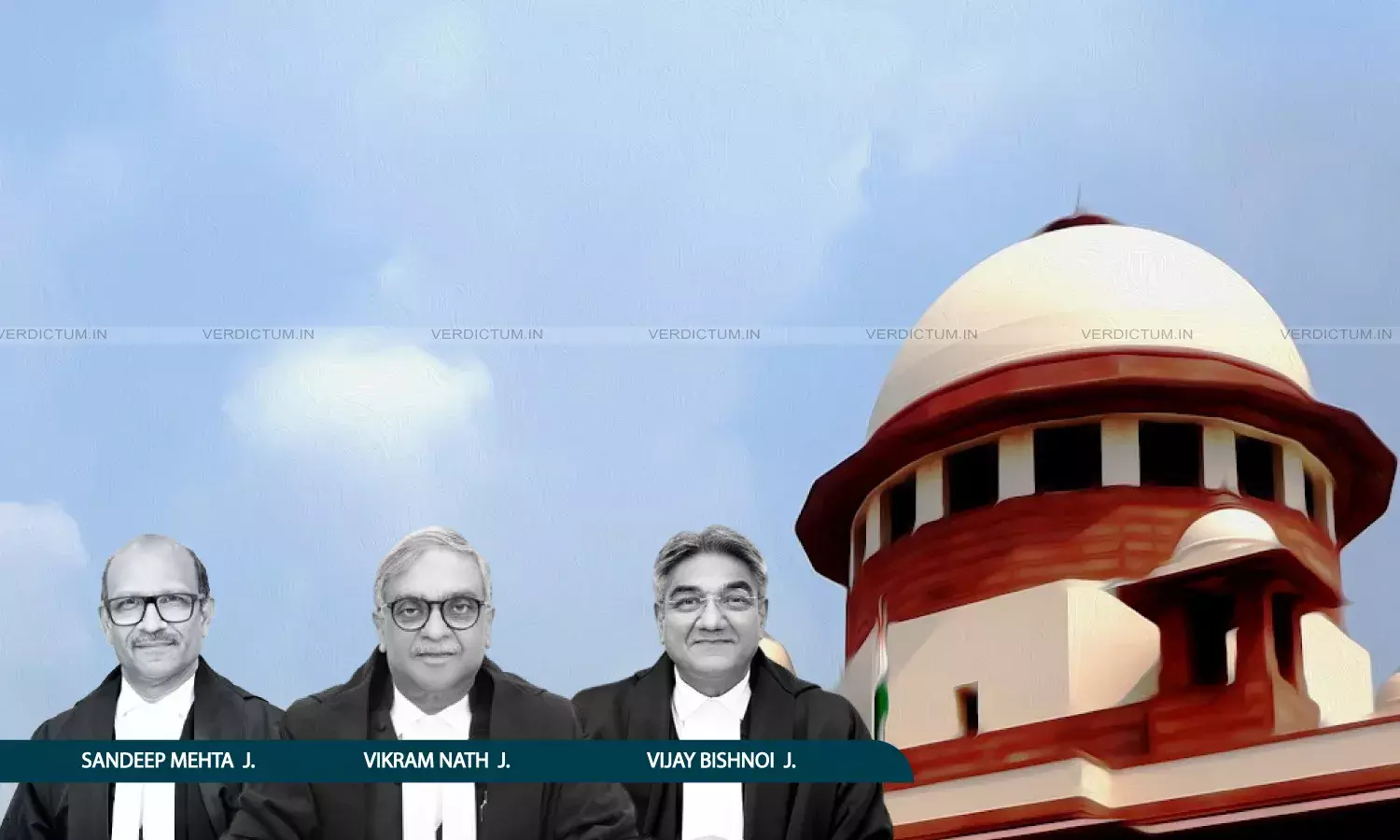
The Supreme Court has held that an advocate’s duty to protect confidential information received from a client does not depend on the client’s continued conduct towards the advocate, and the fact that the client later becomes an adversary makes no difference.
The Supreme Court accordingly upheld the Bar Council of India’s order directing removal of the advocate’s name from the roll of advocates for two years, while dismissing the client’s plea for enhancement and imposing costs of ₹5 lakh each on both sides.
The Court was hearing cross proceedings arising from the Bar Council of India’s disciplinary order holding an advocate guilty of professional misconduct under Section 35 of the Advocates Act, 1961, in connection with media disclosures concerning a former client.
A Bench of Justice Vikram Nath, Justice Sandeep Mehta and Justice Vijay Bishnoi observed: “The justification offered is that the appellant had by then named the respondent in the FIR of 24th July 2014, that he was no longer her counsel, that he was being pursued by the media, and that he spoke only to answer the accusations made against him. This justification does not suffice. An advocate’s duty is not conditional upon the client's continued good behaviour towards the advocate. An advocate cannot use information received in confidence against his client, and the fact that she has since become his adversary makes no difference.”
Advocate Adit S. Pujari appeared for the respondent; Advocate P.V. Yogeswaran appeared for the Bar Council of India.
Background
The appellant had engaged the respondent as her counsel during part of 2013 and 2014. Her case before the disciplinary authority was that she had shared confidential details of her personal life and material concerning allegations against a senior police official while seeking legal assistance.
A legal notice was sent through the respondent’s office. The appellant alleged that it was issued without authority, while the respondent maintained that it was based on a draft supplied by her and sent on her instructions. The appellant later lodged an FIR against the police official, in which the respondent was also named as a person acting under the influence of that official.
The controversy then moved into the media. The judgment records that the appellant appeared before electronic media with her face covered, while the respondent later gave interviews broadcast on television channels. Footage of conversations between the appellant and respondent, and material said to be messaging exchanges between them, were also broadcast.
The appellant filed a complaint under Section 35 of the Advocates Act, 1961 alleging professional misconduct. The Bar Council of India held that unauthorised issuance of the notice, disclosure of confidential information leading to identification of the complainant in the media, and derogatory public remarks concerning her constituted professional misconduct. It ordered removal of the respondent’s name from the roll of advocates for two years, imposed ₹3 lakh payable to the appellant and directed ₹2 lakh to be deposited in the Bar Council of India Welfare Fund.
Both sides approached the Supreme Court. The appellant sought enhancement of punishment, including permanent removal and compensation. The respondent challenged the finding of misconduct and contended that he had been denied a fair hearing before the Disciplinary Committee.
Court’s Observations
The Court first rejected the respondent’s contention that the Bar Council of India’s order was vitiated for want of notice of final hearing at his correct address.
The Court noted that the respondent had entered appearance, filed a written statement, was represented by counsel and participated in recording of evidence. It observed: “It is clear that he knew, from the institution of the disciplinary case, down to the passing of the impugned order in August 2025, that proceedings were pending against him and what those proceedings alleged.”
Rejecting the plea as an afterthought, the Court added: “A party who has been present throughout cannot be heard to say that he was absent, especially one who is himself an advocate. The ground is flimsy and is, in our view, an afterthought, taken because no better one was available.”
On the substance of misconduct, the Court held that whatever uncertainty existed about the legal notice, one material fact was not in dispute: the respondent gave a television interview.
The Court recorded: “On 5th August 2014 the respondent went on television. He gave an interview which was broadcast on 'Aaj Tak' and 'Zee News'. In that interview he spoke of his relationship with the appellant, of what she had told him and of what had passed between them.”
It further noted that conversations between the two were played alongside the broadcast and messaging material was also aired. Since the complaint expressly referred to the press interview and the respondent’s written statement did not deny giving it, the Court held that the Disciplinary Committee was bound to proceed on that footing.
The Court held that the respondent’s claim of responding to public accusations could not justify disclosure of confidential communications.
It observed that an advocate who believes he has been falsely accused is not remediless. The Court stated: “He may place his version before the investigating agency, as indeed the respondent did on 4th August 2014 or he may sue in defamation. What he may not do is take his grievance to a television channel and there disclose privileged communications, play recorded conversations with his former client, and describe her complaint as a false case of rape while accusing her of seeking publicity.”
On this count, the Court held that the finding of professional misconduct was “unassailable” and sufficient to sustain the punishment imposed by the Bar Council of India.
While upholding the finding against the advocate, the Court refused to enhance the punishment at the appellant’s instance.
The Court said that a person seeking enhancement of punishment in her favour must approach with clean hands. It found that the material on record, including exchanges relied upon by the appellant, showed that while the engagement subsisted, she and the respondent were discussing means by which the police official might be trapped.
The Court observed: “Nor is her account of what followed complete. She appeared before the electronic media on 28th July 2014 of her own volition and spoke of her case, though her grievance before us is that her case was made public.”
Recording its disapproval of both sides, the Court said: “Each of these parties has come to us complaining of a wrong, and each has been the author of a good part of it. Between them they have occupied the time of the Bar Council of India, a High Court and this Court for eleven years.”
Conclusion
The Supreme Court upheld the Bar Council of India’s order removing the respondent’s name from the roll of advocates maintained by the Bar Council of Maharashtra and Goa for two years and sustaining the monetary directions made by the disciplinary authority.
The Court dismissed the appellant’s appeal seeking enhancement of punishment, the respondent’s civil appeal, and the transferred case arising from his writ petition. It also directed both the appellant and the respondent to pay costs of ₹5 lakh each to the Supreme Court Legal Services Committee within four weeks, failing which the amount shall be recovered in accordance with law. Pending applications were disposed of.
Cause Title: Rehana Khan v. Rizwan Siddhiquee (Neutral Citation: 2026 INSC 907)
Appearances
Appellant: Petitioner-in-person
Respondents: Advocate Adit S. Pujari with Advocate Karishma Maria, AOR, Advocate Manvendra Singh Shekhawat, Advocate Harshwardhan Pushkin Sharma and Advocate Bhavesh Seth, Advocate P.V. Yogeswaran
