

Cannot Fetter State From Choosing Particular Policy Course: Supreme Court Refuses To Lay Down Uniform Policy For Demolition Drives
The Court disposed of a PIL seeking a uniform regularization policy and a Court-Empowered Committee, directing the petitioner to submit representations to the Union and State governments.

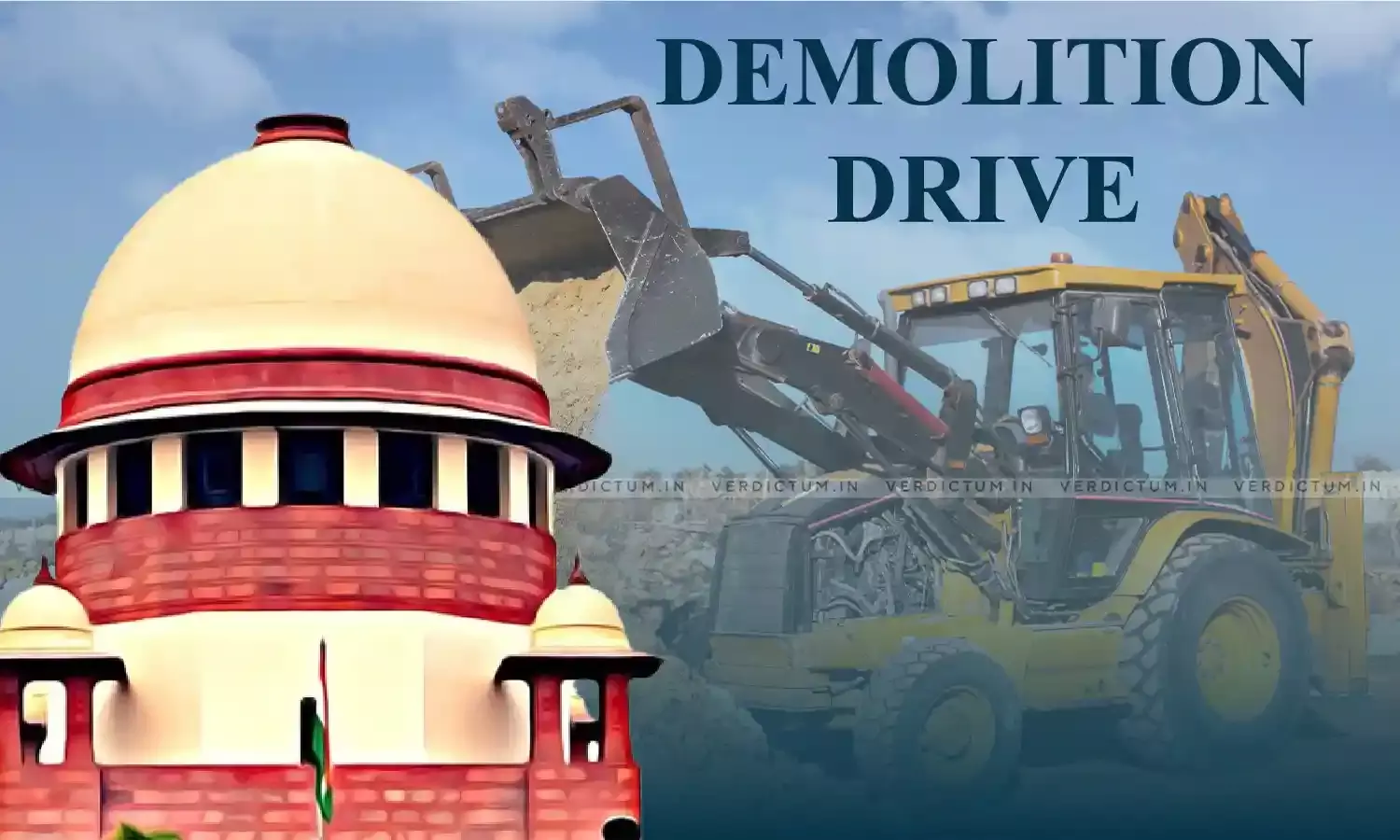
The Supreme Court disposed of a writ petition filed under Article 32 of the Constitution that sought the formulation of a uniform national policy on the regularization and demolition of long-standing unauthorized constructions, as well as the appointment of a Court-Empowered Committee.
While acknowledging the petitioner’s concerns regarding the right to shelter and the rehabilitation of affected families under Article 21, the Bench held that such matters fall strictly within the policy domain of individual States and Union Territories due to varying local factual scenarios.
Observing that existing judicial guardrails already protect against arbitrary dispossession, the Court granted liberty to the petitioner—Centre For Law and Good Governance—to forward its proposals directly to the Union of India, State Governments, and Union Territories for their consideration.
The Bench of Chief Justice Surya Kant, Justice Joymalya Bagchi and Justice V Mohana ordered, "While we appreciate the concern of the petitioner organisation regarding the rehabilitation of those who are affected and whose right to shelter is adversely impacted as a result of demolition, etc., we are also of the view that such issues essentially fall within the policy domain. The factual matrix may vary from State to State, and it may, therefore, warrant variations in their policy decisions as well. It would be difficult, and may not be prudent, for this Court to lay down a uniform policy framework to be applied across all States...Ordinarily, we deem it appropriate to dispose of this petition with liberty to the petitioner to forward a copy of this petition to the Union of India, all State Governments, and the Union Territories, to consider the issues raised therein for the purpose of formulating or revisiting their existing policies...We are hopeful that due consideration shall be given to all such issues by the competent authorities."
A writ petition under Article 32 of the Constitution was filed seeking directions to the Union of India, State Governments, and Union Territories to formulate a uniform policy regarding the regularisation and demolition of long-standing unauthorised constructions. The petition also sought the appointment of an expert committee by this Court to monitor and supervise the formulation and implementation of such policies.
It was pointed out that State Governments across the country have, for decades, not only allowed unauthorised colonies and constructions to stand unchallenged, but have, in fact, been facilitating their regularisation by assessing municipal taxes, sanctioning electricity and water connections—thereby implying regularisation—and converting leasehold properties into freehold.
The Petitioner stated that at the same time, similar policies are in vogue in the States of Andhra Pradesh, Telangana, NCT of Delhi, etc. However, there are other States where decade-old unauthorised structures are suddenly ordered to be demolished, with or without notice, but without any welfare scheme for the rehabilitation of the affected families.
It was in this backdrop that the petitioner contended that demolition, being an extreme and irreversible measure, cannot be carried out without a policy that reconciles the enforcement of planning laws with the rights to shelter, livelihood, and dignity as guaranteed under Article 21 of the Constitution.
The Counsel for the Petitioner submitted, "some jurisprudence of human rights has to inform this entire area of demolition, which is executed in a very hurried, erratic, and unsystematic manner. I am requesting that this Honourable Court constitute a Court-Empowered Committee to lay down such guidelines so that—while I am certainly not supporting unauthorized construction or unauthorized colonies—the plight of 30, 40, or 50-year-old residents, helpless women and crying children, is addressed. Something needs to be done by this Honourable Court."
To which Justice Bagchi replied, "Already, against illegal or unauthorized demolition, comprehensive directions have been issued."
The Counsel submitted, "Those directions exist, but kindly see that those directions, with great respect, are contradictory. For example, in the case of Rachna Sharma / Chitra Sharma, at paragraph 25, the Honourable Court holds that the right to shelter should be considered an integral part of the right to life with human dignity. On the other hand, as recently as 14 July 2026, another Division Bench of this Honourable Court at paragraph 21 holds that the long standing of colonies does not mean anything; you must obey the law, and even where it is compoundable, we will disregard it...So, totally contradictory directions exist. That is why I am submitting that even within the Honourable Supreme Court, on the one hand, assurance is given, and on the other hand, it is held that time will not create any right whatsoever. Kindly see the strong language used in that criminal case."
Justice Bagchi then replied, "You cannot substitute the powers vested in a State or a municipality to enforce the rule of law by delegating them to a Court-Empowered Committee. It would be completely contrary to the Constitution. As you rightly said, humanistic jurisprudence has been worked out by this Court starting from Olga Tellis onwards, holding that a person in settled possession cannot be dispossessed without due process of law. Until recently, where this Court gave certain directions that at least a 15-day notice has to be given even to a rank unauthorized occupant, these guardrails had already been put in place...The implementation of those guardrails on a case-to-case basis is something we would require to examine individually, not on a collective policy basis."
The Petitioner then submitted that there is a negative guarantee of liberty—meaning non-interference. He referred to the positive aspect of liberty, as Professor Roscoe Pound and other jurists have expounded, i.e. unless there is a meaningful guarantee, merely having a guarantee on a piece of paper is not enough.
Justice Bagchi then said, "That is exactly what we are trying to indicate to you. There are cases and cases. There are rank illegal constructions that have been undertaken for commercial or profit motives. Then there are situations, as you are pointing out, where a large number of economically marginalized people occupy tracts of land and require alternate accommodation. These are policy decision calls. We cannot fetter the State from choosing a particular policy course. Once it takes such a recourse, we can step in through judicial review if that policy is arbitrary, unreasonable, or fails to accord due process. This petition is too widely worded and encroaches upon the policy domain."
After hearing the Petitioner at considerable length, the Court disposed of the matter with the liberty to approach the authorities.
Cause Title: Centre For Law and Good Governance v. Union of India & Ors. [W.P.(C) No. 984/2026]