

Supreme Court: Sale Deed Executed With Knowledge Of Part Consideration Can’t Be Rendered Void On Non-Payment Of Balance Consideration
The legal heirs of the original sole defendant had approached the Supreme Court challenging the reversal of the findings of the Trial Court.

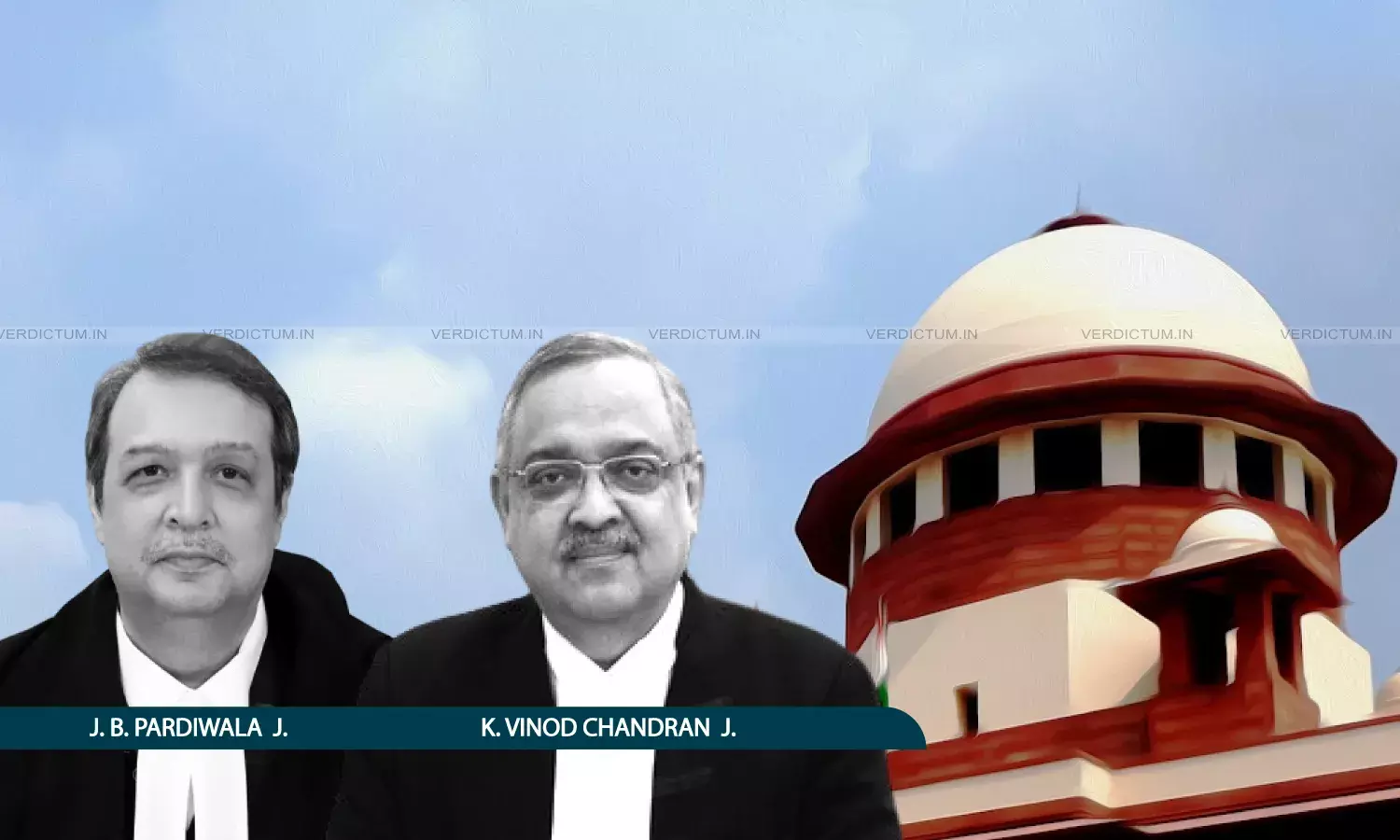
Justice J. B. Pardiwala, Justice K. Vinod Chandran, Supreme Court
While asking the litigants to pay the balance sale consideration in a property dispute matter, the Supreme Court has held that a sale deed executed with full knowledge of the part consideration alone having been passed cannot be rendered void or inoperative merely because the balance consideration promised to be paid, which promise was incorporated in the sale deed, had not been complied with.
The legal heirs of the original sole defendant had approached the Apex Court challenging the reversal of the concurrent findings of the Trial Court and the Appellate Court by the High Court in a second appeal.
The Division Bench of Justice J. B. Pardiwala and Justice K. Vinod Chandran held, “Even if we understand the High Court having not entered into a reappreciation of facts, it is clear that the conclusion on the available facts was wrong. The sale deed executed with full knowledge of the part consideration alone having been passed, cannot be rendered void or inoperative merely because the balance consideration promised to be paid, which promise was incorporated in the sale deed, had not been complied with. The right of the plaintiffs was to file for recovery of balance sale consideration and not to seek declaration that the sale deeds were null and void; which they are not.”
Advocate Satyajit A. Desai represented the Appellant while AOR Farrukh Rasheed represented the Respondent.
Factual Background
The respondents are the legal heirs of the original plaintiffs, a son and his mother. The plaintiffs filed a suit for declaration of two sale deeds as void and inoperative, to cancel these deeds and declare the plaintiffs as the absolute owners of the properties covered by the sale deeds. They also prayed for a permanent injunction against the sole original defendant. The plaint averments were that the two sale deeds were executed in the wake of debts accrued in the name of the plaintiffs in various financial institutions and government departments. The original defendant brought a purchaser, who left at the last minute, when the original defendant agreed to purchase their lands. The entire consideration was not available with the defendant, and he persuaded the plaintiffs to execute the sale deeds with respect to both the properties, handing over only part of the consideration.
The Trial Court found that the agreements related to a concluded sale and, though there was only part payment of the sale consideration, even as per the agreement, there was no condition incorporated in the sale deed that refusal to pay the balance sale consideration would result in the cancellation of the sale deed. The plaintiffs’ suit was dismissed with the finding that the plaintiffs were not entitled to cancellation of the sale deeds, declaration of ownership or the injunction as prayed for. The Trial Court dismissed the suit, and the First Appellate Court affirmed it. In the second appeal, the High Court decreed the suit, declaring the plaintiffs to be the owners of the lands covered by the sale deeds.
Reasoning
The Bench referred to the judgment in Dahiben v. Arvindbhai Kalyanji Bhanusali (Gajra) Dead through Legal Representatives & Ors. (2020) where, while interpreting Section 54 of the Transfer of Property Act, 1882, it was held that actual payment of the entire sale price at the time of execution of the sale deed is not an essential condition for completion of sale. It was also observed therein that when a sale deed is registered, even upon part payment of the sale price, title would pass to the transferee. The nonpayment of the remaining part of the sale price would not invalidate it, and the remedy would be to recover the balance sale consideration, but not cancellation of the sale deed for non-payment of balance sale consideration.
Holding that Section 54 squarely applied to the case, the Bench noted that the sale deeds indicated that the defendant had retained Rs 4,500 for clearing the dues of the plaintiffs. The same was not paid, and later, by two agreements, the defendant agreed to pay the full consideration and repay all the government loans.
“The plaintiffs, without filing a suit for recovery of money; i.e., for balance sale consideration, attempted cancellation of the sale deeds, after executing it on receipt of part consideration, agreeing for the retention of balance consideration with the defendant to satisfy the dues of the plaintiffs. The sale, hence, has become final”, it added.
The Bench was of the view that the right of the plaintiffs was to file for recovery of balance sale consideration and not to seek a declaration that the sale deeds were null and void. Thus, allowing the appeal and restoring the judgment of the Trial Court as affirmed by the First Appellate Court, the Bench held that the appellants would have to pay the balance sale consideration with interest from March 10, 1975, at the rate of interest charged on the plaintiffs by their creditors and seek possession of the property, if at all they so desire.
Cause Title: Raziya Begum & Ors. v. Nafisa Begum Abdul Hamid (Neutral Citation: 2026 INSC 814)
Appearance
Appellant: Advocates Satyajit A. Desai, Sachin Patil, Pratik Kumar Singh, Sachin Singh, Shashank Upadhyay, Vishwesh S, Gadage, AOR Anagha S. Desai
Respondent: AOR Farrukh Rasheed, Advocates Harshita Singhal, Seraj Ahmed, Sayed M. Hurmul