Supreme Court Upholds Husband’s Conviction For Wife’s Murde; Rejects Defence Theory Of Death Due To Epileptic Fit During Sexual Act
The Court also upheld the convictions for cruelty and dowry death, finding that the accused had failed to rebut the statutory presumption under Section 113-B of the Evidence Act.
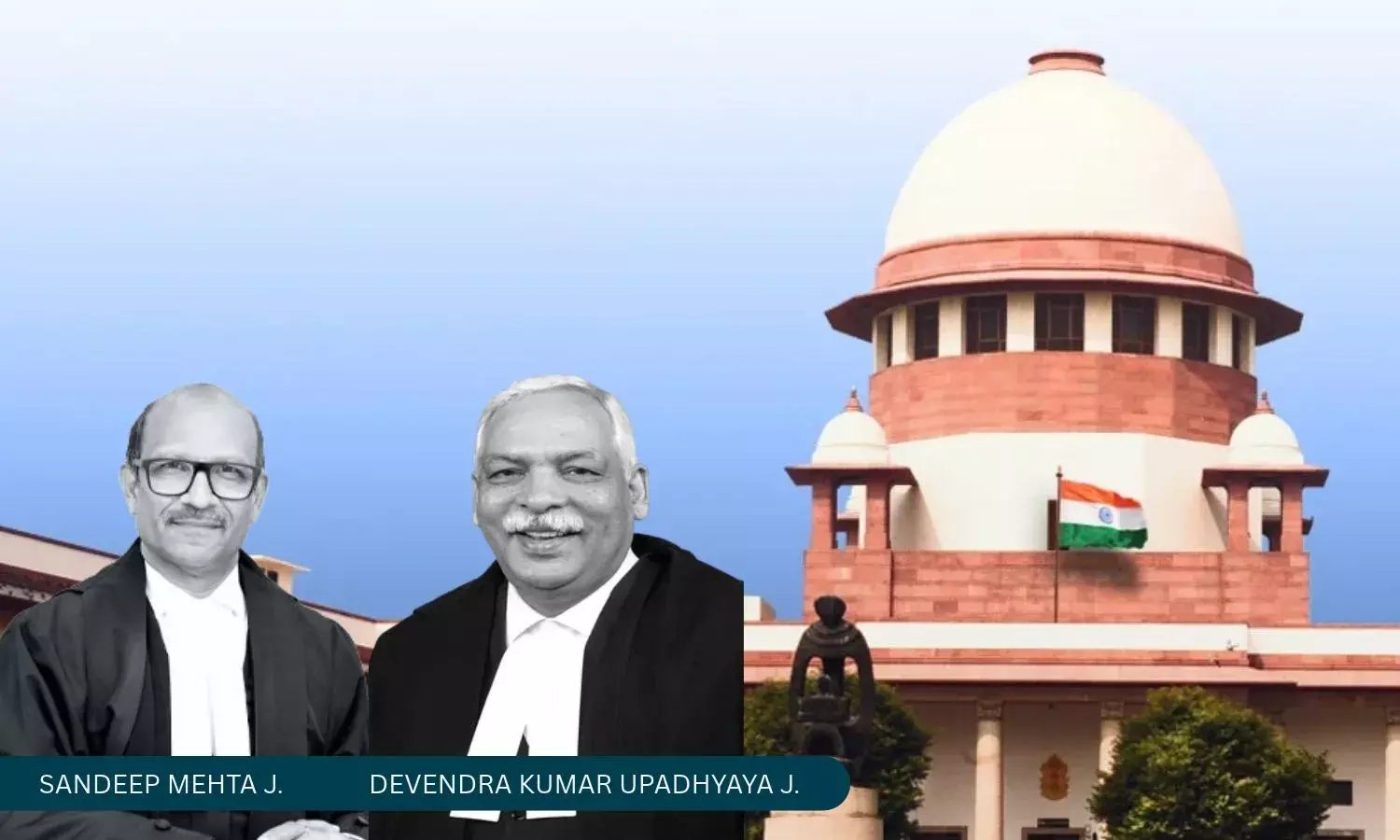
The Supreme Court has upheld a husband’s conviction for murdering his wife inside their matrimonial home, holding that his false accidental-death defence provided an additional incriminating link completing the chain of circumstantial evidence.
The Court was hearing connected appeals against a Bombay High Court judgment that reversed the husband’s acquittal for murder and sentenced him to life imprisonment. The High Court had also affirmed the convictions of the husband and two relatives under Sections 498-A and 304-B read with Section 34 IPC.
A Bench of Justice Sandeep Mehta and Justice Devendra Kumar Upadhyaya held: “The failure of the appellant-Ramkishan to furnish a plausible explanation and in discharging the burden cast upon him by virtue of Section 106 of the Evidence Act coupled with the introduction of a false defence, provides an additional incriminating link that completes the chain of circumstantial evidence, and thereby establishing his guilt for the offence of murder punishable under Section 302 of the IPC.”
Advocate Shivaji M. Jadhav appeared for the appellants. Advocate Varad Kilor appeared for the State.
Background
The deceased died inside her matrimonial home within nine months of marriage. The prosecution alleged that she had been subjected to physical and mental cruelty over demands for ₹50,000, a television set, a tape deck and transfer of a plot of land.
The husband informed the police that, while they were having sexual intercourse, his wife experienced sudden giddiness, her jaws became locked and she died. During the trial, he claimed that she had suffered an epileptic seizure. The post-mortem examination, however, attributed her death to asphyxia caused by throttling and disclosed injuries to the neck, including a fractured hyoid bone.
The Trial Court convicted the husband and two relatives of cruelty and dowry death but acquitted all the accused of murder. On the State’s appeal, the High Court reversed the husband’s acquittal for murder while maintaining the other accused persons’ acquittal on that charge.
Before the Supreme Court, the appellants argued that the prosecution had failed to establish a complete chain of circumstantial evidence. The State submitted that the wife died while in the husband’s exclusive company and that his false explanation failed to discharge the burden concerning facts especially within his knowledge.
Court’s Observations
Medical Evidence Ruled Out Accidental Death
The Court found that the medical evidence conclusively established a homicidal death by throttling. The internal neck injuries could not have been caused by an epileptic seizure, as suggested by the defence.
The Bench observed: “However, the medical jurist emphatically denied this suggestion noting that there was no lock-jaw or displacement of the tongue, and that the internal neck injuries could not be caused by an epileptic fit. Consequently, the defence theory of death as a result of an epileptic fit suffered during a sexual act was found to be false and concocted by both the trial Court and the High Court.”
The Court also noted that the husband did not dispute his presence with the deceased when she suffered the fatal injuries. Instead, he had positively asserted that she experienced a seizure while they were together.
Section 106 Required Husband To Explain Circumstances Of Wife’s Death
The Court noted that the medical evidence established a homicidal death and that the deceased was in her husband’s exclusive company at the matrimonial home when she died. In these circumstances, the Court held that Section 106 of the Evidence Act placed a heavy burden on the husband to offer a cogent, credible and satisfactory explanation for the circumstances culminating in his wife’s death.
Relying on Trimukh Maroti Kirkan v. State of Maharashtra (2006), the Bench reiterated that the prosecution continues to bear the initial burden in a murder case. However, where an offence is committed in secrecy inside a house, an inmate possessing special knowledge of the circumstances must offer a cogent explanation.
The Court quoted the precedent: “Where an offence like murder is committed in secrecy inside a house, the initial burden to establish the case would undoubtedly be upon the prosecution, but the nature and amount of evidence to be led by it to establish the charge cannot be of the same degree as is required in other cases of circumstantial evidence. The burden would be of a comparatively lighter character. In view of Section 106 of the Evidence Act there will be a corresponding burden on the inmates of the house to give a cogent explanation as to how the crime was committed. The inmates of the house cannot get away by simply keeping quiet and offering no explanation on the supposed premise that the burden to establish its case lies entirely upon the prosecution and there is no duty at all on an accused to offer any explanation.”
The Bench found that, instead of giving a credible account of how his wife suffered fatal throttling injuries, the husband introduced a version expressly refuted by the post-mortem findings. The Court held that his failure to furnish a plausible explanation, coupled with the false defence, provided an additional incriminating link completing the chain of circumstantial evidence.
Cruelty And Dowry-Death Convictions Upheld
The Court also upheld the convictions under Sections 498-A and 304-B read with Section 34 IPC. It found consistent and corroborative evidence that the deceased had faced physical cruelty, mental torture and starvation over unlawful dowry demands.
The Bench held: “There is clear, consistent, and mutually corroborative evidence establishing that the deceased-Vimalbai was subjected to persistent physical cruelty, mental torture and even starvation at her matrimonial home over unlawful demands for dowry, specifically comprising Rs. 50,000/- in cash (to secure employment/service for her husband), a television set, a tape deck, and the transfer of a plot in the MIDC area at village Ghungrala.”
The Court found that the evidence concerning dowry-related cruelty came not only from the deceased’s family but was also supported by the marriage mediator and independent neighbours. It consequently held that the accused had failed to rebut the presumption under Section 113-B of the Evidence Act.
Conclusion
The Supreme Court dismissed the appeals and upheld the husband’s conviction and life sentence for murder, along with the convictions for cruelty and dowry death. It also affirmed the surviving co-convict’s conviction under Sections 498-A and 304-B read with Section 34 IPC. The appeal concerning another co-convict stood abated because of his death during its pendency.
The Court cancelled the appellants’ bail bonds and directed them to surrender before the Trial Court within four weeks to serve their remaining sentences. In case of failure, the Trial Court was directed to take the necessary steps, including issuing non-bailable warrants, to secure their custody. Pending applications were disposed of.
Cause Title: Ramkishan Digambar Jadhav v. The State of Maharashtra (Neutral Citation: 2026 INSC 1187)
Appearances
Appellants: Advocate-on-Record Shivaji M. Jadhav; Advocates Aditya S. Jadhav, Brij Kishor Sah, Apurva, Vignesh Singh, Shivali Chaudhary, Amit Kumar Gupta and Dere Kishor Shankar
Respondent: Advocates Varad Kilor, Siddharth Dharmadhikari and Shrirang B. Varma; Advocate-on-Record Aaditya Aniruddha Pande