

Supreme Court Explains Difference Between Transfer & Change In Cadre; Imposes ₹1L Cost On UP Govt For Delay In Dealing With Reallocation Dispute
The appeal before the Supreme Court was filed by an employee who sought a change of cadre from Uttar Pradesh to Uttarakhand.

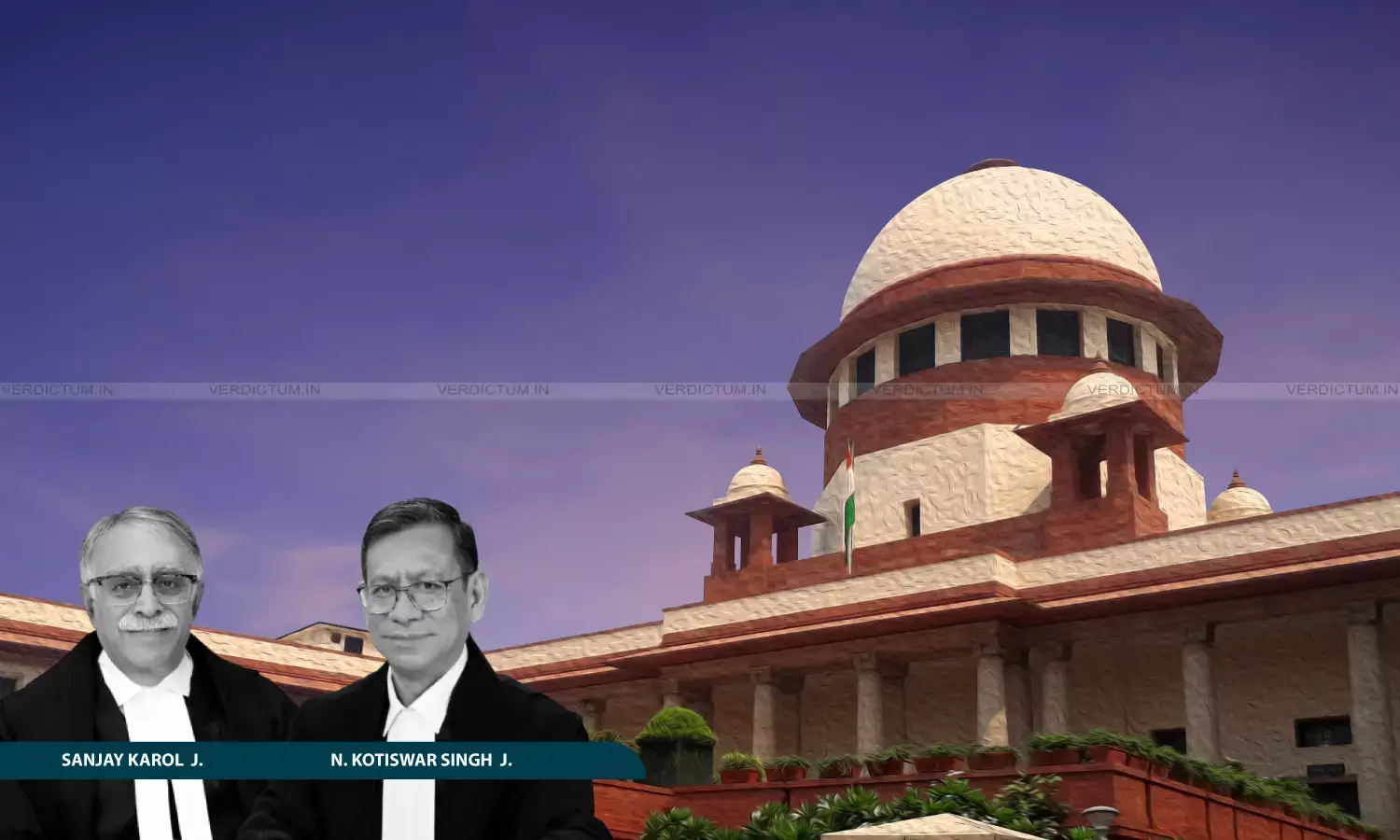
Justice Sanjay Karol, Justice Nongmeikapam Kotiswar Singh, Supreme Court
While observing that the distinction between a transfer and a change in cadre operates in entirely different domains, the Supreme Court has imposed a cost of Rs 1 Lakh on the Uttar Pradesh Government for the delay shown in fructifying a government employee’s request for being posted in his home State.
The appeal before the Apex Court was filed by an employee challenging a decision of the Allahabad High Court whereby he had sought a direction to issue a mandamus to the States of Uttar Pradesh and Uttaranchal, thereby effecting his change of cadre from Uttar Pradesh to Uttarakhand, on account of the fact that when he appeared for the Combined Lower Subordinate Service Examinations in 1995, he had opted for ‘hill region’ posting, which was rejected.
The Division Bench of Justice Sanjay Karol and Justice Nongmeikapam Kotiswar Singh explained, “A change in cadre, by contrast, involves a shift from one cadre to another and, therefore, alters the very framework within which the employee’s service is regulated. It is not a mere relocation but a structural change that may affect seniority, promotional avenues, and applicable service conditions. Such a change is exceptional in nature and typically requires specific statutory authority or higher-level approval given its far-reaching implications. The difference, therefore, is clear and substantive. A transfer is a matter of administrative convenience within the same service, whereas a change in cadre entails a reconfiguration of the employee’s service identity itself.”
The Bench further stated, “The person was appointed with effect from June 1997 and today we are in April of 2026. Only now will he get something that he had opted for right from the start. Even if we exclude the initial few years till his appointment was confirmed by the High Court in the first writ petition which was in February 2004, even from that point onwards 22 years have passed. The entire time that being close to family would have been a great sense of support in raising his son, he has spent away from family at least since 2011. In the attending facts and circumstances as discussed above, we award cost to the appellant, to be paid by the respondent State of Uttar Pradesh, to the tune of Rs.1,00,000/- (Rupees One lakh only).”
AOR Ravindra S. Garia represented the Appellant, while AOR Abhishek Atrey represented the Respondent.
Factual Background
The appellant cleared the competitive exam conducted by the Uttar Pradesh Subordinate Services Selection Commission, Lucknow, with 672 marks out of 900. While opting for Sub-Deputy Inspector of Schools, his preference was the ‘hill area of Uttar Pradesh’. Despite such a situation, the appellant was not appointed because he had only submitted his B.Ed (Bachelor of Education) marksheet at the time of the interview without the application form. Those below him in the merit list were appointed. Aggrieved thereby, the appellant approached the High Court. The Single Judge allowed the petition, and given the remote area from where the appellant hailed, the Court allowed the appellant to be appointed from the same date as the other candidates, along with consequential benefits except for arrears and salary.
The State of Uttar Pradesh appealed against these findings, but the same came to be dismissed. He was finally appointed by the Director (Basic) Uttar Pradesh, Allahabad, to the position of Sub Deputy Inspector of Schools, notionally from June 11, 1997. He joined the said service in 2011 in Kashi Ram Nagar, Uttar Pradesh. He submitted representations requesting that he be granted the ‘hill cadre’ as originally requested. The respondent State of Uttar Pradesh did not respond to the representations made by the appellant. It was in such circumstances that the appellant approached the Apex Court.
Reasoning
The Bench made it clear that the distinction between a transfer and a change in cadre is plain, and the two operate in entirely different domains while carrying different legal and administrative consequences. The Bench found that the appellant had been granted a notional appointment from June 11, 1997 and he had also submitted, in various representations, that he is a resident of present-day Uttarakhand. “On both these counts the request for reallocation of cadre ought to have been acceded to, if at all it can be called as such”, it stated.
The Bench further took note of the fact that his son had been declared to be cognitively challenged with little or no scope for improvement/betterment in his condition. The Medical Certificate testifying to such a position was placed on record. “The above extracted exceptions to the allocation policy have an exception for persons with ‘mental illness’ which does include the family members also. When such an exception applies, the allocation to be made is as per the option exercised by the employee. On this count also, the appellant’s appointment in the hill cadre taken from the original date, should have been translated into an appointment with the successor State”, it held.
Thus, allowing the appeal, the Bench directed the Chief Secretary, State of Uttar Pradesh, to facilitate the reallocation of the appellant to the State of Uttarakhand. Imposing cost on the State, the Bench stated, “It is difficult to think that there are not many other cases where on account of long pendency of service dispute the party in question would be approaching superannuation as the case may also be here. As such, it is requested that the learned Chief Justice of the High Court, ascertain the number of such cases long pending and endeavour to have them decided expeditiously by possibly by distributing them across benches which would ensure that they are taken up and decided within a comparatively shorter span of time.”`
Cause Title: Rajendra Singh Bora v. Union of India & Ors. (Neutral Citation: 2026 INSC 404)
Appearance
Appellant: AOR Ravindra S. Garia, Advocates Shashank Singh, Vinit Raj
Respondent: AOR Abhishek Atrey