

Plea Of Limitation Not Raised Before Arbitral Tribunal Ought Not To Be Considered By Court U/S 34 A&C Act Challenge: Supreme Court
Dismissing RVUNL’s petition against arbitral awards in favour of Parsa Kente Collieries, the Court held that the Additional Award of ₹66.70 crore could not be said to be vitiated by patent illegality merely because it was silent on limitation.

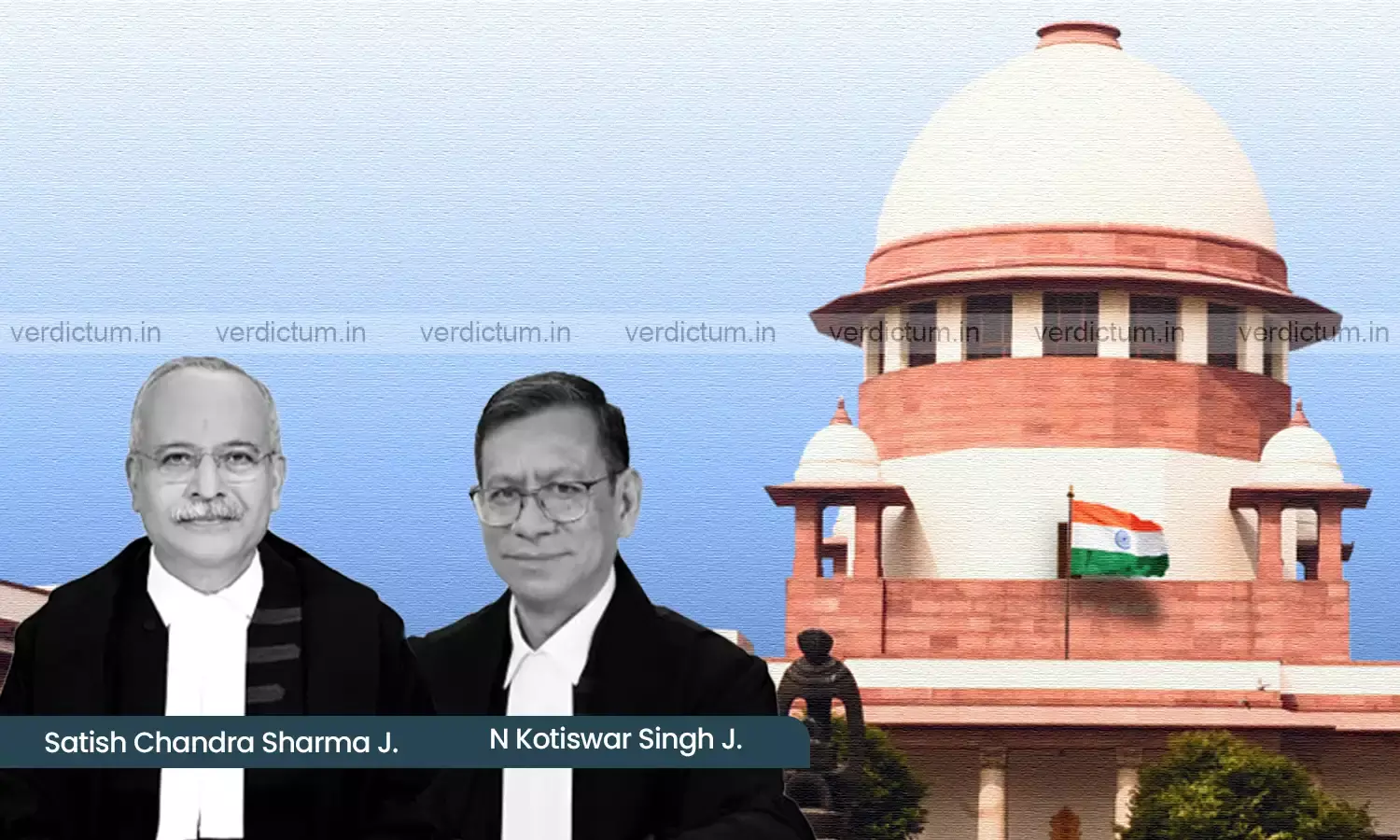
The Supreme Court has held that a plea of limitation not raised before the Arbitral Tribunal ought not to have been considered by the Commercial Court in a challenge under Section 34 of the Arbitration and Conciliation Act, 1996. The Court said such a plea is a mixed question of fact and law, and that in the absence of appropriate facts and pleadings it could not be decided afresh at the Section 34 stage.
Dismissing the Special Leave Petition of Rajasthan Rajya Vidyut Utpadan Nigam Ltd. (RVUNL), the Court held that the Additional Award of July 5, 2021, allowing ₹66.70 crore for four villages with interest, “cannot be said to be vitiated by patent illegality merely because it is silent on limitation”. It held that the Commercial Court’s reason for setting the award aside, namely that the Tribunal had not examined limitation, was not “proper in law and within the scope of Section 34 of the Act”.
A Division Bench of Justice Satish Chandra Sharma and Justice Nongmeikapam Kotiswar Singh observed, “…The Arbitral Tribunal is the final arbiter of the facts, and the construction of the contractual terms is primarily its domain…In the present case, the plea of limitation was not raised before the Tribunal and, having not been raised, it was not examined by the Tribunal. Hence, in absence of appropriate facts and pleadings, it could not have been considered by the Commercial Court, and proceed to set aside the Tribunal’s award on the ground that the Tribunal had not considered the issue of limitation. Further, a plea not raised before the Tribunal ought not to have been considered by the Commercial Court in the challenge under Section 34 of the Act. We are thus of the view that the Additional Award cannot be said to be vitiated by patent illegality merely because it is silent on limitation, a plea which was not raised before the Arbitral Tribunal. The reason given by the Commercial Court in setting aside the Additional Award on the ground that the Tribunal did not go into the question of the limitation cannot be said to be proper in law and within the scope of Section 34 of the Act”.
Senior Advocate Shyam Divan appeared for the petitioner while Senior Advocate Dr. Abhishek Manu Singhvi appeared for the respondent.
“…Where the interpretation adopted is a possible and plausible one, the court cannot substitute its own interpretation, however persuasive the alternative reading may be. The Section 37 court is, moreover, confined to the grounds available under Section 34 of the Act and cannot undertake an independent assessment of the merits of the award…”, the Bench further noted.
RVUNL, a Government of Rajasthan undertaking, and Parsa Kente Collieries Limited (PKCL), a joint venture company, were parties to a Coal Mining and Delivery Agreement of July 16, 2008 for the Parsa East and Kanta Basan coal block.
The block’s allocation was cancelled in 2014 in Manohar Lal Sharma v. Principal Secretary & Others, thereafter, it was re-allotted to RVUNL in 2015, and a Supplementary Agreement of July 29, 2016 continued the agreement under Section 11(1) of the Coal Mines (Special Provisions) Act, 2015. PKCL then raised nine claims, including ₹83,47,64,575 paid as stamp duty and other charges on the fresh mining lease.
A sole arbitrator allowed Claim Nos. 1, 2, 3, 4, 6 and 7, allowed Claim No. 5 in part, and rejected the fifth-village part of Claim No. 8 as premature. An Additional Award under Section 33(4) later allowed ₹66.70 crore for four villages under Claim No. 8.
The Commercial Court, Jaipur upheld the findings on Claim Nos. 1, 3, 5 and 9, but set aside those on Claim Nos. 2, 4, 6, 7 and 8, and set aside both awards entirely on May 20, 2023. The High Court, under Section 37, restored both awards on May 21, 2026.
The Court first recalled that Article 136 is a discretionary power, and that interference with an award at this third stage would be “an exception rather than the norm.” It examined each claim separately. On Claim No. 2, it said the question was not whether the Arbitrator’s reading of Clause 7.1 was the only possible construction, “but whether it is a construction that no fair-minded person could take.”
The Commercial Court had therefore exceeded its jurisdiction in substituting its own construction. On Claim No. 4, it held that the Arbitrator’s view of limitation was neither perverse nor patently illegal. On Claim Nos. 6 and 7, it held that the Arbitrator’s findings on the scope of work were “possible views.”
On the Additional Award, the Court held that a plea of limitation not raised before the Tribunal “ought not to have been considered by the Commercial Court.” The Additional Award could not be called patently illegal merely because it was silent on limitation.
The Court added that some findings “may admit of another plausible view,” or may appear to rest on an incorrect appreciation of facts, but that this “is not the test” under Sections 34 and 37. Since no part of the awards was found invalid, the questions of severability and remand did not arise.
Cause Title: Rajasthan Rajya Vidyut Utpadan Nigam Ltd. v. Parsa Kente Collieries Limited (Neutral Citation: 2026 INSC 1234)
Appearances:
Petitioner: Shyam Divan, Sr. Adv., Kartik Seth, Shilpa Saini, Pranjal Jaiswal, Ujjwal Kumar, K.M.Abish, Ratakshi Sarvaria, Advocates M/s Chambers of Kartik Seth- 2839, AOR.
Respondent: Dr. Abhishek Manu Singhvi, Sr. Adv., Abhisaar Bairaagi, Milind Sharma, Ausaf Ayyub, Advocates M/S. Khaitan & Co.- 1509, AOR.