120-Day Limit U/S 74 Of RFCTLARR Act Is Inflexible; Even One-Day Delay Bars Land Acquisition Appeal: Supreme Court
The Court held that Section 5 of the Limitation Act is excluded by necessary implication because Section 74 of the 2013 land-acquisition law contains an in-built condonation provision capped at an additional 60 days.
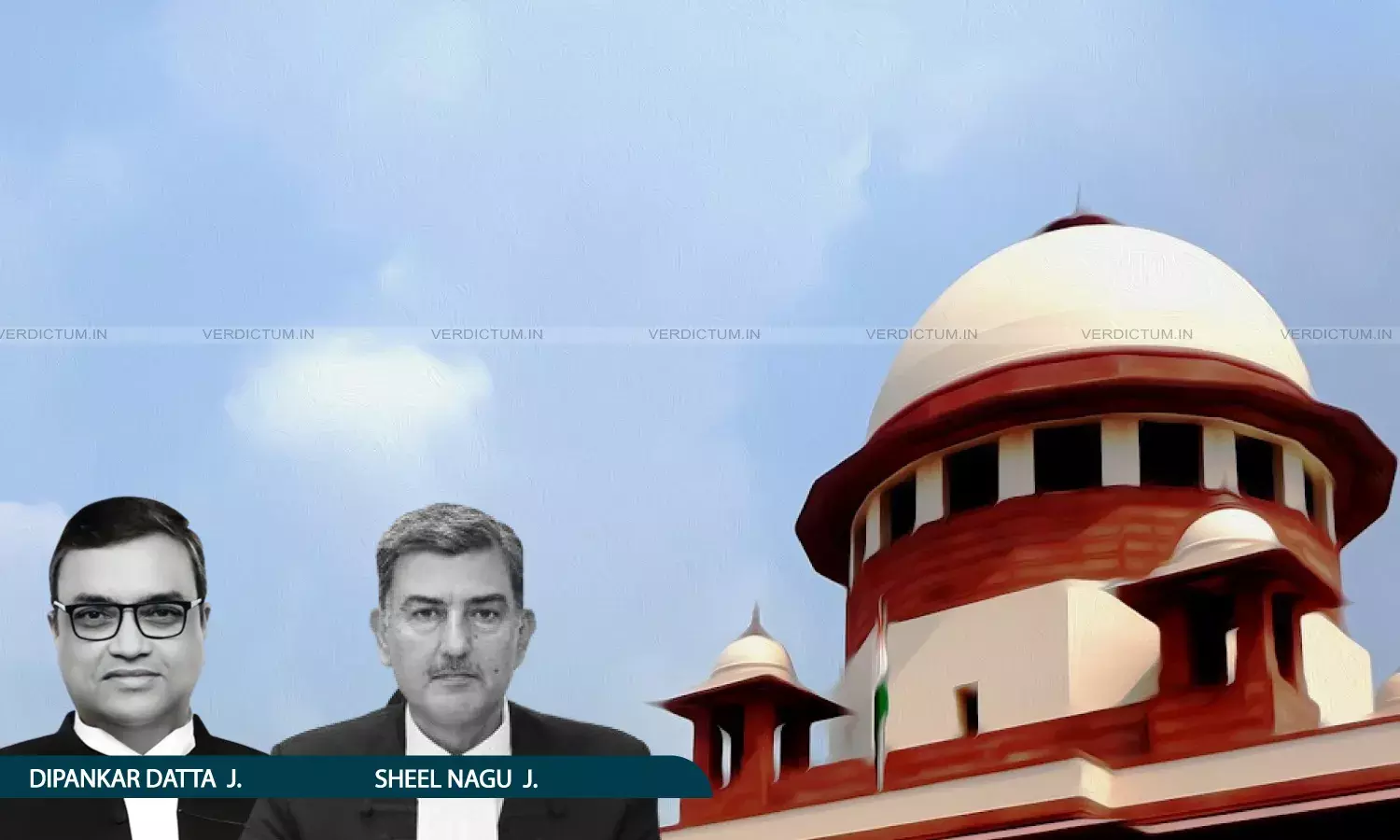
Justice Dipankar Datta, Justice Sheel Nagu, Supreme Court
The Supreme Court has held that an appeal under Section 74 of the Right to Fair Compensation and Transparency in Land Acquisition, Rehabilitation and Resettlement Act, 2013 cannot be entertained after the maximum period of 120 days, even if the delay is only by a single day.
The Court dismissed the Rajasthan Housing Board’s special leave petition against the Rajasthan High Court’s refusal to entertain its challenge to orders passed by the Land Acquisition Rehabilitation and Resettlement Authority.
The Court was hearing the Board’s special leave petition against the Rajasthan High Court’s refusal to entertain its Article 227 challenge. The Board relied on Deputy Commissioner and Special Land Acquisition Officer v. S.V. Global Mill Limited (2026), which had held that the Limitation Act, 1963 was not excluded and that a High Court could condone delay beyond the additional 60-day period under Section 74.
A Bench of Justice Dipankar Datta and Justice Sheel Nagu held: “Reading Section 74 of the 2013 in juxtaposition with Section 54 of the erstwhile Land Acquisition Act, 1894 and also having regard to the scheme of the 2013 Act, we have no hesitation in holding that the period of 120 days in Section 74 is inflexible and rigid and cannot be read in a manner so as to permit any aggrieved person to approach the relevant high court with an appeal which is barred even by a single day’s delay”.
“Even this Court in exercise of its power under Article 142 cannot condone the delay although, in a fit and proper case, a party may seek exemption from application of the laws of limitation”, the Bench added.
Advocate Anuj Bhandari appeared for the Rajasthan Housing Board.
Background
The Land Acquisition Rehabilitation and Resettlement Authority allowed a reference made by the private respondent under Section 64 of the 2013 Act on May 26, 2025. It subsequently made a minor modification in the respondent’s favour while allowing a review petition on September 12, 2025.
The Rajasthan Housing Board, the State Government and the Special Officer of the Urban Development and Housing Department challenged both orders through a petition under Article 227 of the Constitution.
The High Court held that the petition was not maintainable because Section 74 provided an appellate remedy. It further held that the petition could not be treated as an appeal since Section 74 prescribed 60 days for filing an appeal and permitted condonation only for a further period of 60 days.
Before the Supreme Court, the Board relied on S.V. Global Mill Limited (2026) and sought liberty to approach the appellate forum with an application for condonation of delay. When the Court expressed reservations about the correctness of S.V. Global Mill Limited, counsel submitted that a reference to a larger Bench would be the proper course.
Court’s Observations
Section 74 Creates An Absolute 120-Day Ceiling
The Court observed that the proviso to Section 74(1) functions as a special, in-built condonation provision similar to Section 5 of the Limitation Act, but subject to a statutory ceiling. Applying Section 5 independently would deprive the 120-day outer limit of its meaning.
The Bench held: “The proviso to sub-section (1) of Section 74 of the 2013 Act is in the nature of a special in-built provision akin to Section 5 of the Limitation Act, permitting condonation of delay subject, however, to a statutory cap. Sub-section (1) of Section 74, though part of the 2013 Act which is a special law, admits of no ambiguity and is incapable of two constructions. Application of Sections 4 to 24 is not available in view of such an unambiguous provision and, therefore, no further condonation outside the second phase of time-limit of 60 days is permissible in case of a time-barred appeal under Section 74 of the 2013 Act. The question of application of Section 5 of the Limitation Act to such an appeal, thus, does not arise.”
The Court referred to decisions interpreting comparable limitation provisions under the Arbitration and Conciliation Act, 1996, the Foreign Exchange Management Act, 1999, the Electricity Act, 2003, the Companies Act, 2013 and the Insolvency and Bankruptcy Code, 2016.
These included CCE v. Hongo India (P) Ltd. (2009), Singh Enterprises v. CCE, Jamshedpur (2008), Union of India v. Popular Construction Co. (2001), ONGC v. GETCO Ltd. (2017), Bengal Chemists and Druggists Association v. Kalyan Chowdhury (2018) and V. Nagarajan v. SKS Ispat & Power Ltd. (2022). The Court observed that such provisions had uniformly been construed as barring condonation beyond the prescribed outer limit.
Exclusion Of Limitation Act May Be Implied
Referring to the three-Judge Bench ruling in Hukumdev Narain Yadav v. Lal Narain Mishra (1974), the Court observed that Sections 4 to 24 of the Limitation Act may be excluded by the nature, subject matter and scheme of a special law even without an express exclusion.
The Bench stated: “The test would be, whether in the absence of express exclusion, application of the provisions of Sections 4 to 24 of the Limitation Act can be excluded by necessary implication or not? To construe sub-section (2) of Section 29 of the Limitation Act only if there is an express exclusion would run contrary to the view taken by the larger Bench. Also, one other aspect seems to have escaped the attention of the coordinate Bench. Applying Section 5 of the Limitation Act to a time-barred appeal under sub-section (1) of Section 74 of the 2013 Act, on the premise that the 2013 Act is a beneficial legislation, would occasion reverse prejudice.”
The Court added that such an interpretation would also permit the State and acquiring bodies to seek condonation of inordinate delay, to the prejudice of landowners.
Contrary Two-Judge Ruling Not Referred To Larger Bench
The Court reasoned that S.V. Global Mill Limited had departed from the consistent interpretation of comparable limitation provisions and the binding three-Judge ruling in Hukumdev Narain Yadav.
The Bench observed: “Given the uniform interpretation of pari materia provisions as to limitation placed by several Benches of this Court in a long line of decisions and in keeping with the doctrine of stare decisis, the two-Judge Bench in S.V. Global Mill Limited (supra) ought not to have placed a discordant construction on sub-section (1) of Section 74 of the 2013 Act; instead, since such consistent views of this Court as well as the long standing and well accepted ratio of Hukumdev Narain Yadav (supra) were being departed from, it could have itself referred the matter for consideration by a larger Bench. Being bound by the doctrine of precedents, laid down by larger Benches, we decline a reference.”
The Court further held that S.V. Global Mill Limited was inapplicable because the Board had not filed a delayed statutory appeal under Section 74. It had instead invoked the High Court’s supervisory jurisdiction under Article 227 after failing to avail the appellate remedy within the maximum condonable period or thereafter.
Conclusion
The Supreme Court dismissed the special leave petition, finding no ground to interfere with the High Court’s reasoned decision. It also declined to refer S.V. Global Mill Limited to a larger Bench.
The Court clarified that pending time-barred appeals under Section 74 may be decided by the relevant High Courts in accordance with law. Connected applications were disposed of.
Cause Title: Rajasthan Housing Board v. M/s Hariyali Rural Ventures Ltd. & Others (Neutral Citation: 2026 INSC 1168)