FIR Against Wife For ‘Giving Dowry’ Cannot Be Based On Her Own Statement; Proceedings Maintainable Only On Independent Evidence: Supreme Court
The Court held that statements made by the wife and her family alleging payment of dowry cannot be used to prosecute them, as they are protected under Section 7(3) of the Dowry Prohibition Act, unless supported by independent evidence.
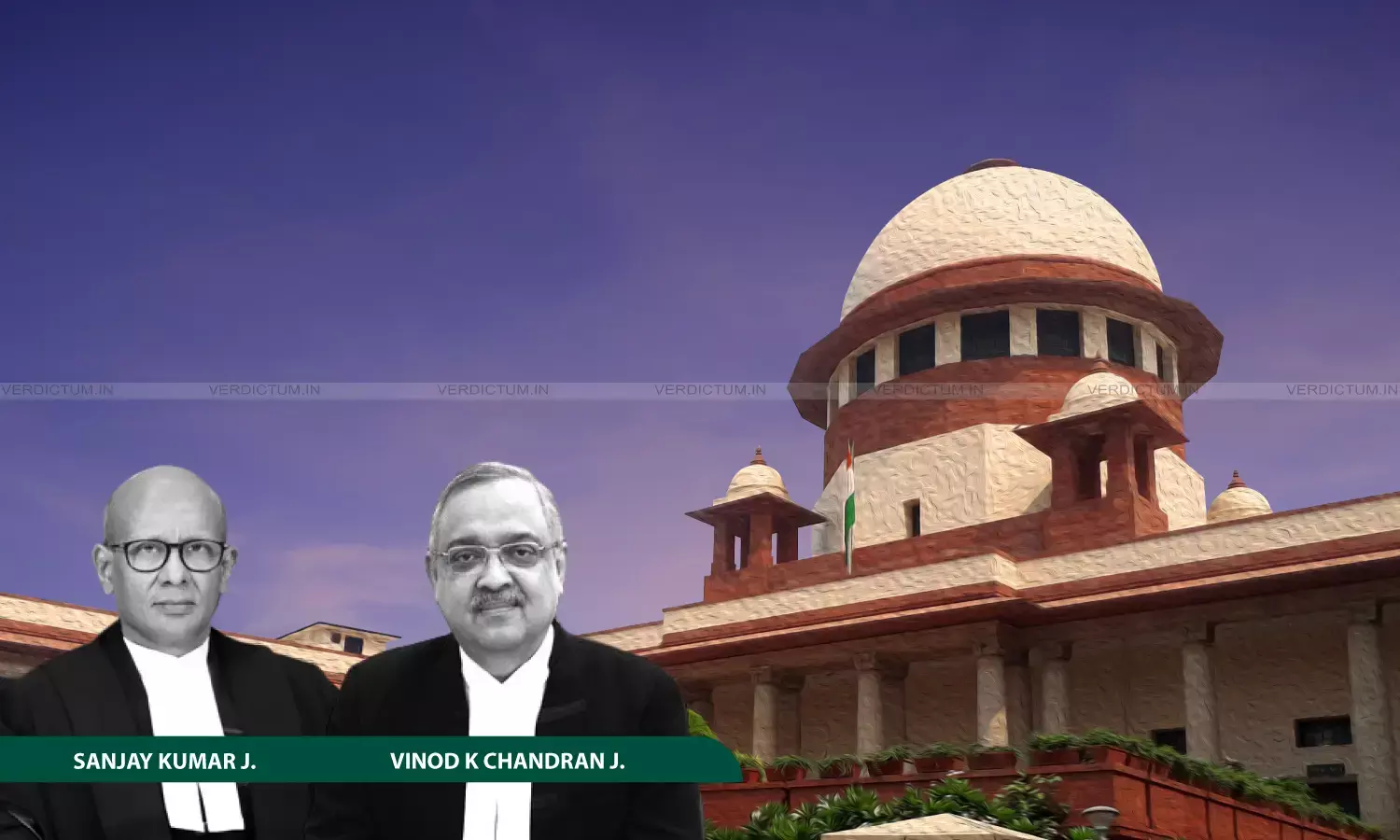
The Supreme Court held that an FIR for the offence of ‘giving dowry’ under Section 3 of the Dowry Prohibition Act, 1961, cannot be founded solely on the complaint or statements made by the wife and her family members.
The Court clarified that such proceedings would be maintainable only where independent evidence exists, as statements of the ‘persons aggrieved’ are protected by statutory immunity under Section 7(3) of the Act.
The Court was hearing a Special Leave Petition filed by the husband seeking registration of an FIR against his wife and her family members, relying upon their statements made during the investigation in an earlier FIR lodged for offences under Section 498A of the Indian Penal Code, 1860 and Section 3 of the Dowry Prohibition Act.
A Bench of Justice Sanjay Kumar and Justice K. Vinod Chandran observed: “if in a given case all that is projected to establish the offence of ‘giving’ dowry… is the complaint and/or the statements made by the wife and her family members… they… would be fully covered by the shield of immunity… and would not be liable to be prosecuted on the strength thereof.”
“Had it been a case where independent evidence was presented with regard to the ‘giving’ of dowry and reliance was not placed only upon the complaint and statements made by the persons aggrieved, i.e., the wife and her family members, it would have been possible to register an FIR for the offence of ‘giving’ dowry under Section 3 of the DP Act as, in such a situation, the protection afforded to the ‘persons aggrieved’, under Section 7(3) of the DP Act, would not be available to them”, the Bench added.
The petitioner appeared in person, while Senior Advocate Pradeep Kumar Rai and other counsel appeared for the respondents, and Advocate Dhananjaya Mishra assisted the Court as amicus curiae.
Background
The dispute arose out of matrimonial discord between the parties. An FIR was registered at the instance of the wife alleging cruelty and dowry harassment against the husband and his family members. During the course of the investigation, the wife and her family members made statements stating that dowry had been discussed and given at the time of marriage.
Relying upon these statements, the husband sought registration of a separate FIR against the wife and her family members for the offence of ‘giving dowry’ under Section 3 of the Dowry Prohibition Act. His application under Section 156(3) of the Code of Criminal Procedure, 1973 was dismissed by the Magistrate, and the rejection was upheld in revision as well as by the High Court.
Court’s Observation
The Court examined the statutory scheme of the Dowry Prohibition Act, particularly the interplay between Section 3, which criminalises ‘giving’ and ‘taking’ of dowry, and Section 7(3), which protects the ‘persons aggrieved’.
It noted that Section 7(3) was introduced to ensure that victims of dowry-related offences are not deterred from making complaints due to fear of prosecution. The Court observed: “a statement made by the person aggrieved by the offence shall not subject such person to a prosecution under this Act.”
Tracing the legislative history, the Court referred to the recommendations of the Joint Parliamentary Committee, which recognised that the givers of dowry are often compelled by social circumstances and should not be treated on par with those who demand or receive dowry.
“The objections of the members of the Committee to the same were broadly on the ground that the parents of the bride, who submit a complaint in relation to dowry, would then be open to prosecution; that the giver of dowry is usually compelled to do so, as girls would remain unmarried otherwise; that the giver of the dowry should not be dealt with on equal footing as the taker, being the aggrieved party; and that the giver of dowry is forced to do so by societal and customary norms”, the Bench highlighted.
At the same time, the Court clarified that the immunity under Section 7(3) is not absolute. It observed that where there is independent evidence establishing the act of giving dowry, and the case is not based solely on the complaint or statements of the wife and her family members, an FIR for the offence under Section 3 of the Dowry Prohibition Act can be registered, and in such situations, the protection under Section 7(3) would not be available to them.
The Court thus drew a clear distinction between cases based solely on statements of the wife and her family, and cases supported by independent evidence. In the former, prosecution is barred; in the latter, it may proceed.
On the facts, the Court found that the petitioner’s entire case was founded only on the complaint and statements made by the wife and her family members, without any independent material to substantiate the alleged offence.
Conclusion
The Court held that in the absence of independent evidence and in view of the statutory immunity under Section 7(3) of the Dowry Prohibition Act, no case was made out for registration of an FIR against the wife and her family members for the offence of ‘giving dowry’.
Accordingly, the Special Leave Petition was dismissed, and the orders passed by the courts below were upheld.
Cause Title: Rahul Gupta v. Station House Officer & Ors. (Neutral Citation: 2026 INSC 374)
Appearances
Petitioner: Appeared in person.
Respondents: Senior Advocate Pradeep Kumar Rai; Advocates N. Pradeep Sharma, Modoyia Kayina, Abhishek Gupta, Vidhi Gupta, Vivek Mangla, Saif Rizvi, Vinay Kumar Rai, Rajshree Rai; Advocates Dhananjaya Mishra, AOR; S. Debabrata Reddy; Bhargav Verma (Amicus Curiae).