

Statutory Presumption U/S.20 Prevention Of Corruption Act Would Come Into Play Only After Initial Demand Is Proved Beyond Reasonable Doubt: Supreme Court
The Apex Court was considering the appeals challenging the judgment of the Gujarat High Court upholding the conviction under the Prevention of Corruption Act.

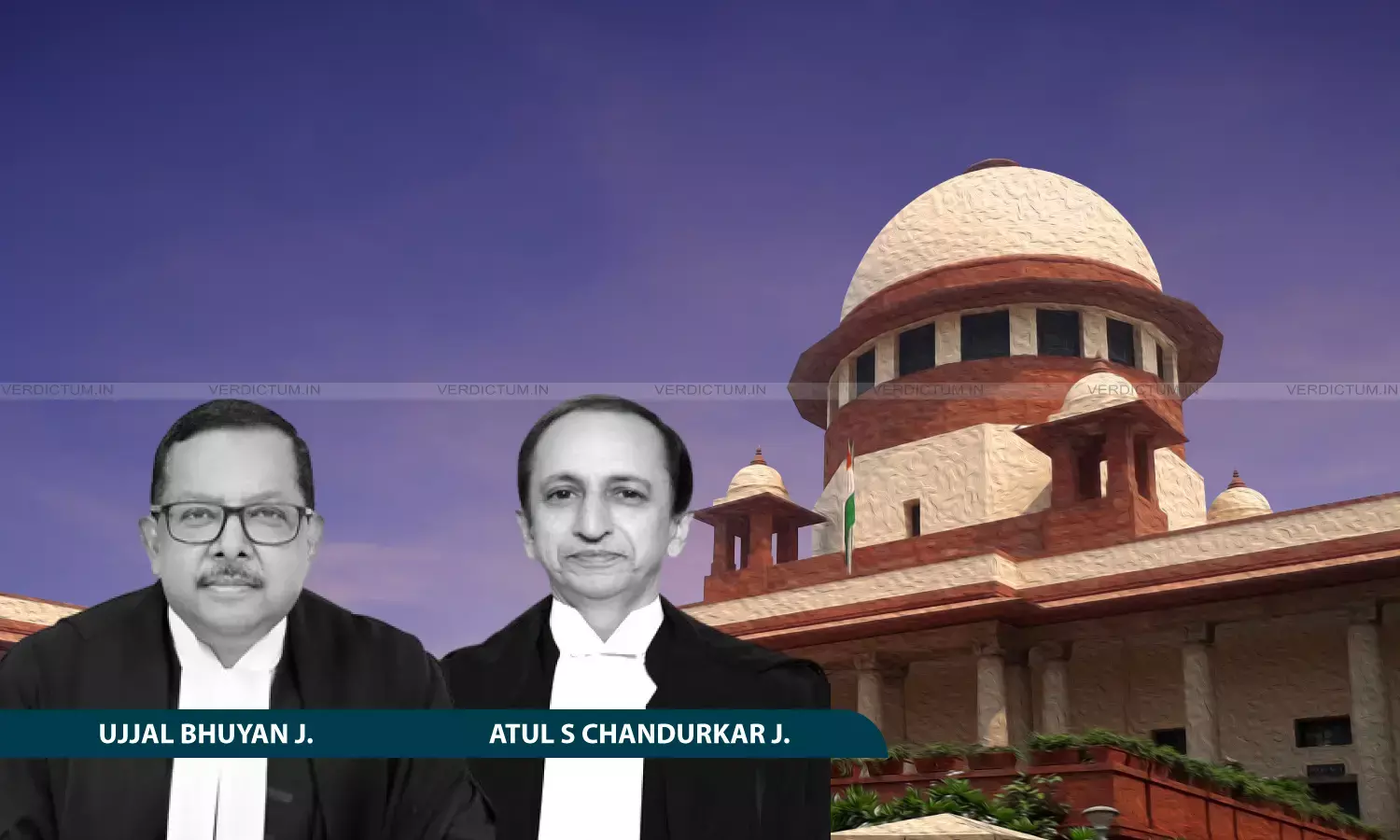
While granting an order of acquittal in a corruption case, the Supreme Court has held that the statutory presumption under Section 20 of the Prevention of Corruption Act, 1988 would come into play only after the initial demand is proved by the prosecution beyond reasonable doubt.
The Apex Court was considering the appeals challenging the judgment of the Gujarat High Court whereby the conviction of the appellants for the offence punishable under Sections 7, 12 and 13(1)(d) of the Prevention of Corruption Act, 1988 was upheld.
The Division Bench of Justice Ujjal Bhuyan and Justice Atul S. Chandurkar held, “It was sought to be urged on behalf of the prosecution that the presumption under Section 20 of the Act of 1988 would arise once it was proved that the bribe amount of ₹20/- was received by A2. This contention cannot be accepted for the reason that the statutory presumption under Section 20 of the Act of 1988 would come into play only after the initial demand is proved by the prosecution beyond reasonable doubt. If the initial demand itself is not proved, mere recovery of the amount of ₹20/- from A2 would not resurrect the case of the prosecution to enable the Court to hold that the charge was proved.”
AOR Divyesh Pratap Singh represented the Appellant while Advocate Prashant Bhagwati represented the Respondent.
Factual Background
One Hasmukhbhai Maganbhai Chauhan was pursuing his education and was required to produce an Income Certificate for being entitled to certain concessions. For obtaining the Income Certificate, he approached the Mamlatdar and made an application in that regard. The complainant went to the Bechri Grampanchayat and met the Talati-cum-Mantri. On perusing the said application, the first accused(A1) allegedly demanded an amount of ₹120 from the complainant. The first accused stated that ₹100 was to be given to him and ₹20 was to be given to the Peon. The complainant, thereafter, returned back stating that he would get the money afterwards. The complainant went to the office of the first accused who demanded a copy of his father’s income certificate along with the amount of ₹120.
The complainant along with the raiding party visited the office of the first accused for collecting the concerned certificate. According to the prosecution, on receiving such certificate the complainant gave a note of ₹20 to the second accused (A2) who put it in his pocket. On giving the pre-determined signal, the raiding party appeared. After completing all the formalities, an offence was registered against both the accused. The charge was framed against A1 and A2 alleging commission of offence under Sections 7, 12 and 13(1)(d) of the Act of 1988. In addition, charge for the offence punishable under Section 120B of the Indian Penal Code, 1860 was also framed.
The accused persons were held guilty of having committed the offence punishable under Section 7 read with Section 13(1)(d). A1 and A2 being aggrieved by their conviction preferred appeals while the State of Gujarat preferred an appeal seeking enhancement in the quantum of punishment. A Single Judge of the High Court maintained the onviction of A1 and A2. It was also held that since A1 and A2 were dismissed from service after their conviction, there was no necessity to enhance the sentence. Accordingly, the appeal preferred by the State of Gujarat was also dismissed. Being aggrieved, the accused appellants approached the Apex Court.
Reasoning
On a perusal of the evidence of the complainant, the Bench noted that though he was instructed to give the entire amount of ₹120 on demand being made, he gave ₹20 only to A2. It was also noticed that, according to the complainant, an amount of ₹120 was demanded from him after receiving the certificate, and A2 was standing at a distance of one to two feet from A1.
“However, A2 did not inquire from the complainant as to why only ₹20/- was being given though A1 had told him to give an amount of ₹120/-. This again raises a doubt as regards demand of ₹120/- by A1 in the backdrop of the complainant giving ₹20/- to A2 despite being instructed to give the entire amount of ₹120/- whenever the demand was made. When this conduct of the complainant is considered along with his admission in the cross-examination that A2 did not make any demand, the entire episode gives rise to serious suspicion. There is no explanation as to why the instructions given to the complainant at the Anti-Corruption Bureau office of giving the entire amount of ₹120/- on demand were not followed”, the Bench added.
The Bench noted that the complainant in his cross-examination volunteered to demonstrate as to how he took out the currency note of ₹20 from his pocket for being given to A2. According to him, he held the said currency note with his first two fingers and thumb. However, PW-3, who acted as Panch, denied the suggestion that the complainant took out the money using his three fingers, his thumb and two other fingers.
“Though the aforesaid could be termed as a discrepancy when considered in isolation, the same would have some bearing while considering the entire evidence, especially as regards demand and giving of the amount of bribe. In our view, the prosecution evidence is insufficient to hold that demand of ₹120/- by A1 was proved beyond reasonable doubt”, it added.
Considering that the charge of demand of bribe amount had not been proved against A1 and both the Courts had recorded a finding that no demand was made by A2, the Bench held that the case of the prosecution must fail.“As noted, mere possession of a currency note of ₹20/- with A2 by itself would not be sufficient to uphold the conviction of A1 and A2 for the offence punishable under Sections 7, 12 and 13(1)(d) of the Act of 1988”, it stated.
Thus, allowing the appeals and setting aside the judgment of the Trial Court as affirmed by the High Court, the Bench acquitted the appellants.
Cause Title: Rafikmiya Ahmedmiya Malek v. State of Gujarat (Neutral Citation: 2026 INSC 890)
Appearance
Appellant: AOR Divyesh Pratap Singh, Advocates Amit Sangwan, Shivangi Singh, Vikram Pratap Singh, Chandan Kumar Singh, AOR Sudhansu Palo
Respondent: Advocate Prashant Bhagwati, AOR Swati Ghildiyal, Advocates Neha Singh, AOR Deepanwita Priyanka