

Can’t Blithely Ignore Bank Accounting System: Supreme Court Holds PNB Entitled To Claim Interest Maintained In Separate Suspense Account
The appeal before the Supreme Court was filed by the Punjab National Bank, challenging the orders passed by a Division Bench of the Orissa High Court.

While observing that a trust and its trustees cannot blithely ignore the accounting system followed by banks and come up with different calculations at different points of time to suit their own interests, the Supreme Court has held Punjab National Bank entitled to claim the interest due, which was calculated and maintained in a separate suspense account.
The appeal before the Apex Court was filed by the Punjab National Bank, challenging the orders passed by a Division Bench of the Orissa High Court on January 11, 2024, directing the Bank to receive a sum of ₹29,55,678.02 from a charitable trust M/s. Shree Jyoti Education and Management Trust World and its managing trustee, Tara Prasad Satpathy (respondents) in full and final settlement of their dues so as to close their loan account.
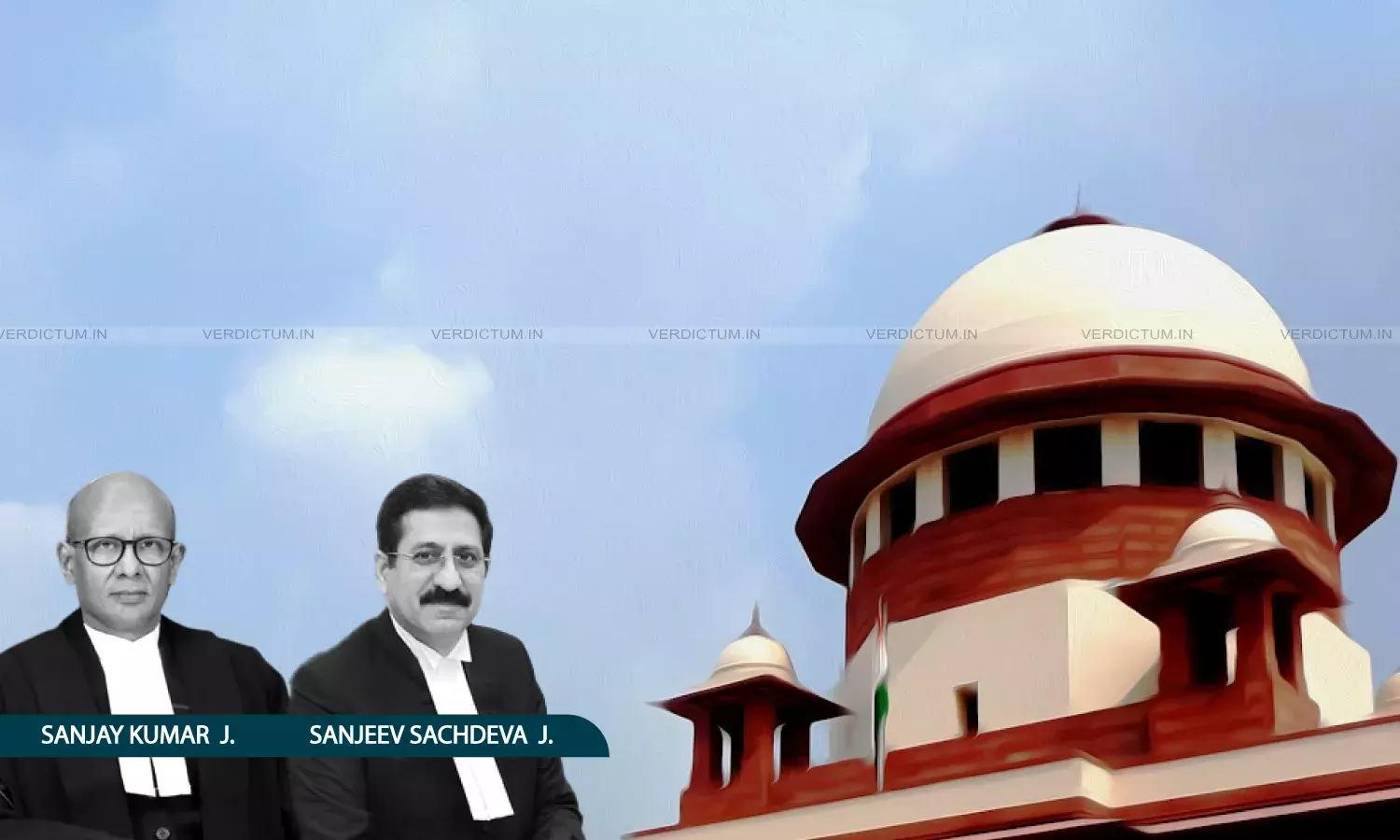
The Division Bench of Justice Sanjay Kumar and Justice Sanjeev Sachdeva held, “Oversimplification of calculation by the High Court with respect to the amount payable, ignoring the existence of the suspense account for the interest component since the date of classification of the loan account as a non-performing asset, and giving effect only to the figure mentioned in the PNB’s certificate dated 24.12.2020, viz., ₹31,99,000/-, thereby accepting the plea of the Trust that the sum of ₹2,43,321.98 paisa paid by it needed to be deducted therefrom reducing its dues to ₹29,55,678.02 paisa, is therefore clearly unsustainable. The Trust and its trustees cannot blithely ignore the accounting system followed by banks and come up with different calculations at different points of time to suit their own interests.”
“PNB is entitled to claim the interest due, which was calculated and maintained in a separate suspense account, in addition to the outstanding principal loan amount and, therefore, the calculation in that regard by the Appellate Tribunal, in its order dated 01.09.2023 in Appeal No. 16 of 2021, would have to be acted upon. In terms of the said order, which was accepted without demur by PNB, the rate of pendente lite and future simple interest chargeable by PNB would have to be scaled down to 9% per annum on the decretal amount of ₹54,90,413/- from 05.02.2018 till the date of realization”, it ordered.
AOR Ekta Choudhary represented the Appellant while Senior Advocate Bharat Sangal represented the Respondent.
Factual Background
The United Bank of India, the predecessor-in-interest of PNB, sanctioned a loan of ₹5 crore to the Trust for the construction of a college building. Tara Prasad Satpathy, its managing trustee, and other trustees (respondents) stood as guarantors for the loan. The loan amount was disbursed over a period of two years. The United Bank of India issued a confirmation letter to the Trust informing it that, as on that day, the balance loan amount due and payable by it stood at ₹1,27,33,669. The loan account of the Trust was, however, classified as a non-performing asset. United Bank of India filed an application before the Debts Recovery Tribunal, Cuttack, Odisha, for recovery of its outstanding dues, amounting to ₹75,56,680 along with future interest.
During the pendency of the proceedings before the DRT, United Bank of India was amalgamated with PNB, which issued a certificate titled ‘To Whom It May Concern’, stating that the Trust had paid ₹93,31,842/- since the date its loan account became a non-performing asset, and as on October 13, 2020, the outstanding amount of the loan was ₹31,99,000. The DRT allowed the application only to the extent of permitting PNB to recover a sum of ₹1,83,268, along with interest. A recovery certificate was directed to be issued under Section 19(2) of the Recovery of Debts due to Banks and and Financial Institutions Act, 19934 (renamed as the Recovery of Debts and Bankruptcy Act, 1993).
The Appellate Tribunal partly allowed the appeal and determined that the Trust and the trustees were liable to pay ₹54,90,413 along with interest. The Trust and Tara Prasad Satpathy, its managing trustee, approached the High Court challenging the said order by way of a Writ Petition. The Division Bench directed the Trust and Tara Prasad Satpathy, its managing trustee, to pay the said amount within four weeks. Thereupon, PNB filed an application seeking recall/modification of the order dated January 11, 2024. However, by its later order dated May 14, 2024, the Division Bench opined that there was no error apparent in its earlier order and dismissed the application. The Bank thus approached the Apex Court by filing the appeal.
Reasoning
On a perusal of the facts of the case, the Bench noted that the statement of account filed by the Trust and its trustees claiming that the principal amount due as on June 29, 2017 was ₹64.25,915, was contrary to their running account statement, produced by the bank, which showed that the principal amount along with interest calculated upto that date, stood at ₹1,25,30,842.
The Bench also noticed that their stand before the DRT was that the rate of interest charged was on the higher side and that they were due and liable to pay ₹32,63,899.65 and not the claimed amount of ₹57,01,917.32. However, in the Writ Petition they ignored their earlier stand and relied upon the certificate to claim that only a sum of ₹29,55,678.02 was payable by them.
Considering that Section 2(g) of the Act of 1993 defines ‘debt’ to mean, amongst other things, any liability (inclusive of interest) which is claimed as due from any person by a bank or a financial institution, the Bench held that the interest component was part of the debt due to PNB. “Further, Section 19(20) of the Act of 1993 empowers a Debts Recovery Tribunal, while dealing with an application made to it by a bank or financial institution, to pass an interim or final order, which may include an order for payment of interest from the date on which payment of the amount is found due up to the date of realisation or actual payment. On a parallel, Section 21A of the Banking Regulation Act, 1949, dealing with rates of interest charged by banking companies, provides that a transaction between a banking company and its debtor shall not be re-opened by any Court on the ground that the rate of interest charged by the banking company in respect of such transaction is excessive”, it added.
The Bench thus held that the attempt on the part of the Trust and its trustees in coming up with a self-serving statement of account, showing the principal amount due as ₹64,25,915, was contrary to the record, so as to arrive at a negative balance of ₹93,981.40, whereupon they claimed that they paid in excess to the tune of ₹57,12,857. The Bench found that the claim that the said sum was liable to be refunded to them by PNB,was patently erroneous and mischievous.
Holding PNB entitled to claim the interest due, which was calculated and maintained in a separate suspense account, in addition to the outstanding principal loan amount, the Bench held that the calculation in that regard by the Appellate Tribunal, would have to be acted upon. Thus, allowing the appeal and restoring the order passed by the Debts Recovery Appellate Tribunal, Kolkata, the Bench held that the appellant, Punjab National Bank, would be entitled to seek recovery of its dues.
Cause Title: Punjab National Bank v. M/s. Shree Jyoti Education and Management Trust World and others (Neutral Citation: 2026 INSC 836)
Appearance
Appellant: AOR Ekta Choudhary, Advocate Rushali Sikand
Respondent: Senior Advocate Bharat Sangal, Advocates Snigdha Dash, Hemant Tripathi, Shreya Kasera, AOR Sahil Tagotra