

Action Contrary To Express Judicial Order Is Nullity: Supreme Court Awards ₹ 10 Lakh Each To Two School Clerks In Wrongful Termination Case
The Supreme Court was considering the appeal filed by two school clerks in a case of wrongful termination.

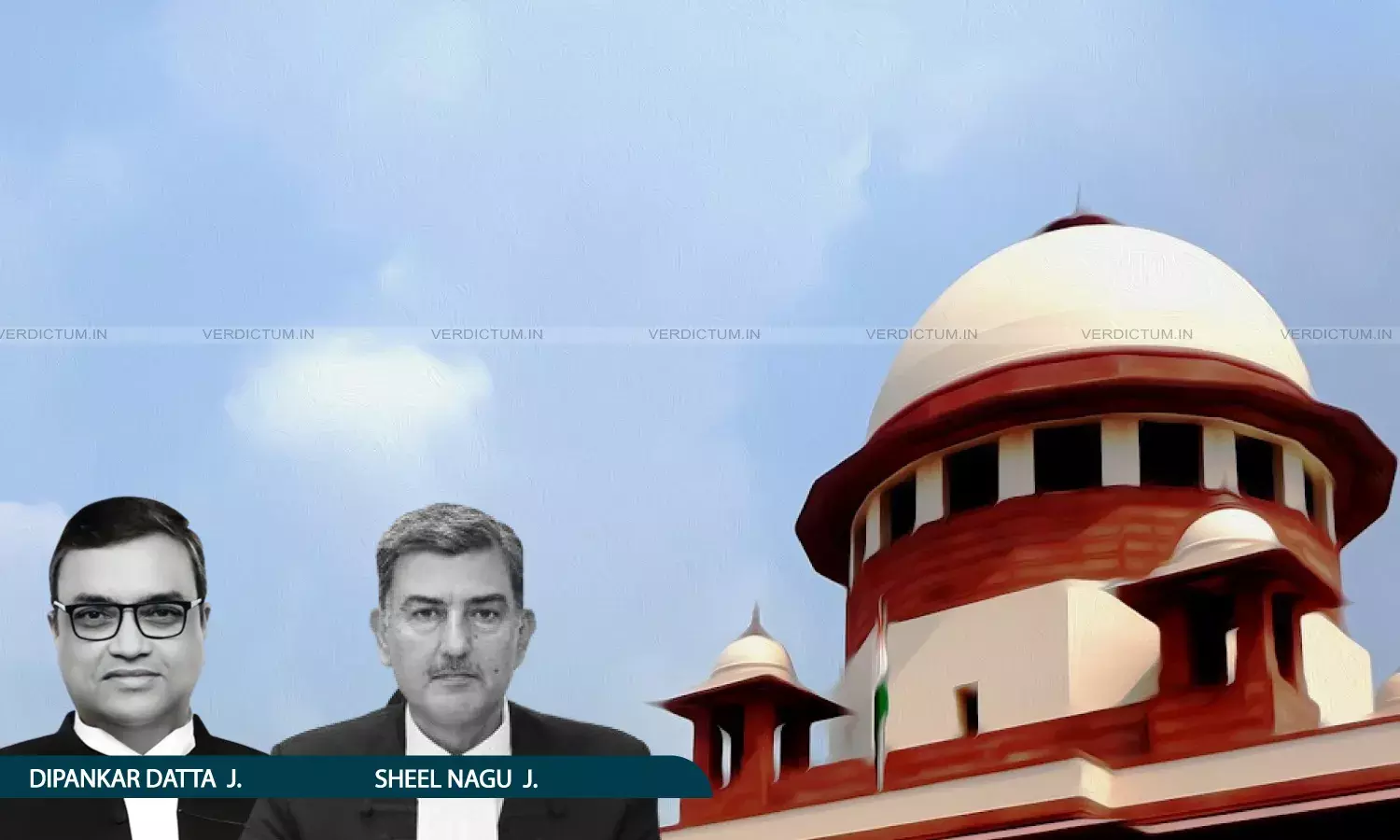
Justice Dipankar Datta, Justice Sheel Nagu, Supreme Court
While affirming the legal principle that an action/order, which is wholly contrary to an express judicial order passed in the exercise of competent jurisdiction, is a nullity and cannot be accepted, the Supreme Court has awarded Rs 10 lakh each to two wrongfully terminated school employees. The Apex Court also highlighted how a meritorious cause was earlier allowed to fail by reason of inept drafting of a writ petition.
The Apex Court was considering the appeal filed by two school clerks in a case of wrongful termination.
The Bench comprising Justice Dipankar Datta and Justice Sheel Nagu held, “Though law is well-settled that a high court cannot grant any relief under Article 226 to a litigant who has approached it without pleading an appropriate case for relief, this is a fit case where the appellants deserve to be granted some relief based on the principle that an action/order which is wholly contrary to an express judicial order passed in exercise of competent jurisdiction is a nullity and cannot be accepted.”
“Since that stage has passed, we exercise our power under Article 142 of the Constitution and direct the school to pay to each of the appellants Rs.10,00,000/- (Rupees ten lakh) only as lump sum compensation for wrongful termination of their services within three months from the date of receipt of this order from the heirs/legal representatives of late Prithviraj S. Singh and from Shivadatta R. Singh or his authorised representative”, it ordered.
Senior Advocate B H Marlapalle represented the Appellant while Senior Advocate Sudhanshu S Choudhari represented the Respondent.
Factual Background
The first and second appellants were employed as senior clerk and head clerk respectively in the respondent school. Both, along with the headmaster in charge of the school, were proceeded against departmentally for misappropriation of public money and allied charges. The school constituted an inquiry committee in terms of the provisions contained in the Maharashtra Employees of Private Schools (Conditions of Service) Rules, 1981. The Committee held that the charges against the appellants stood established. The orders of termination were carried in appeals before the School Tribunal, Mumbai, and vide interim orders, the Tribunal stayed the operation of the termination orders and directed the school to allow the appellants to resume their service and pay 50% of their salaries.
The school invoked the writ jurisdiction of the Bombay High Court, and by a Consent Order dated March 17, 2005, the Tribunal was asked to expedite the disposal of the main appeal. The school was also directed to pay an amount equivalent to the subsistence allowance to one of the teachers in accordance with law, during the pendency of the appeal. The Tribunal dismissed the appeals, observing that since the appellants had deliberately avoided participating in the inquiry proceedings and failed to nominate their nominees on the committee, they could not assail the termination on merits. The appellants’ writ petition also came to be dismissed, leading to the appeal before the Apex Court.
Reasoning
The Bench, at the outset, noted, "...what has engaged our attention and is a matter of serious concern is the circumstance arising from the High Court’s consent order dated 17th March, 2005. Why the terms thereof were not adhered to and/or complied with by the school is not forthcoming since Mr. Choudhary, in his usual fairness, did not seek to justify such omission."
On a perusal of the facts, the Bench noted that there was no evidence before the tribunal resting on which the charges against the appellants could be held to be ‘established’. According to the Bench, the fact that the appellants were not furnished the final inquiry reports by the school prior to their services being terminated constituted a serious flaw in the process of taking disciplinary action against them. The Bench also found that despite the same, the tribunal proceeded to hold that there was no infirmity in the proceedings.
The Bench was thus inclined to grant relief to the appellants, considering the principle that an action/order wholly contrary to an express judicial order passed in exercise of competent jurisdiction cannot be accepted.
The Bench further noted that the first Appellant died, while the second appellant was stated to be surviving. “Ex debito justitiae, the appellants would have been entitled to larger relief if only their writ petitions had been appropriately drafted and the right points had been argued”, the Bench stated.
The Bench thus disposed of the appeals by exercising the power under Article 142 of the Constitution and directing the school to pay to each of the appellants Rs 10 lakh only as lump sum compensation for wrongful termination of their services.
Cause Title: Prithviraj S. Singh (Deceased) Through Lrs. v. The Secretary, School Education Department, State of Maharashtra & Ors. (Neutral Citation: 2026 INSC 1241)
Appearance
Appellant: Senior Advocate B H Marlapalle, AOR Ajit Pravin Wagh, Advocates Avinish Kumar Saurabh, Nivedita Kushwaha, Ritik Ranjan
Respondent: Senior Advocate Sudhanshu S Choudhari, AOR Aaditya Aniruddha Pande, Advocates Siddharth Dharmadhikari, Shrirang B. Varma, Sourav Singh, Chitransha Singh Sikarwar, AOR Vatsalya Vigya, Advocates Aanchal Rathore, Gautami Yadav, Pranjal Chapalgaonkar, Yash Singhania, Pradeep Kumar Tripathi