

Typographical Errors In Pleadings Cannot Trigger Proceedings U/S 340 CrPC Unless They Amount To Deliberate Falsehood: Supreme Court
The Apex Court set aside proceedings initiated against a litigant and his counsel under Sections 193, 199 and 200 IPC, holding that a wrong statement caused by a typographical error cannot be equated with a false statement made with intent to deceive.
The Supreme Court has held that typographical or inadvertent errors in pleadings cannot justify initiation of proceedings under Section 340 CrPC unless the Court records a prima facie finding of deliberate falsehood and also finds that prosecution is expedient in the interests of justice.
The Court distinguished a “wrong statement” from a “false statement”, holding that the latter requires something more than mere inaccuracy and carries an intent to deceive coupled with knowledge.
The Court was hearing a criminal appeal against orders directing the filing of a complaint against a litigant and his counsel for offences under Sections 193, 199 and 200 of the Indian Penal Code, after certain statements in a memorandum of appeal and stay application were alleged to be incorrect.
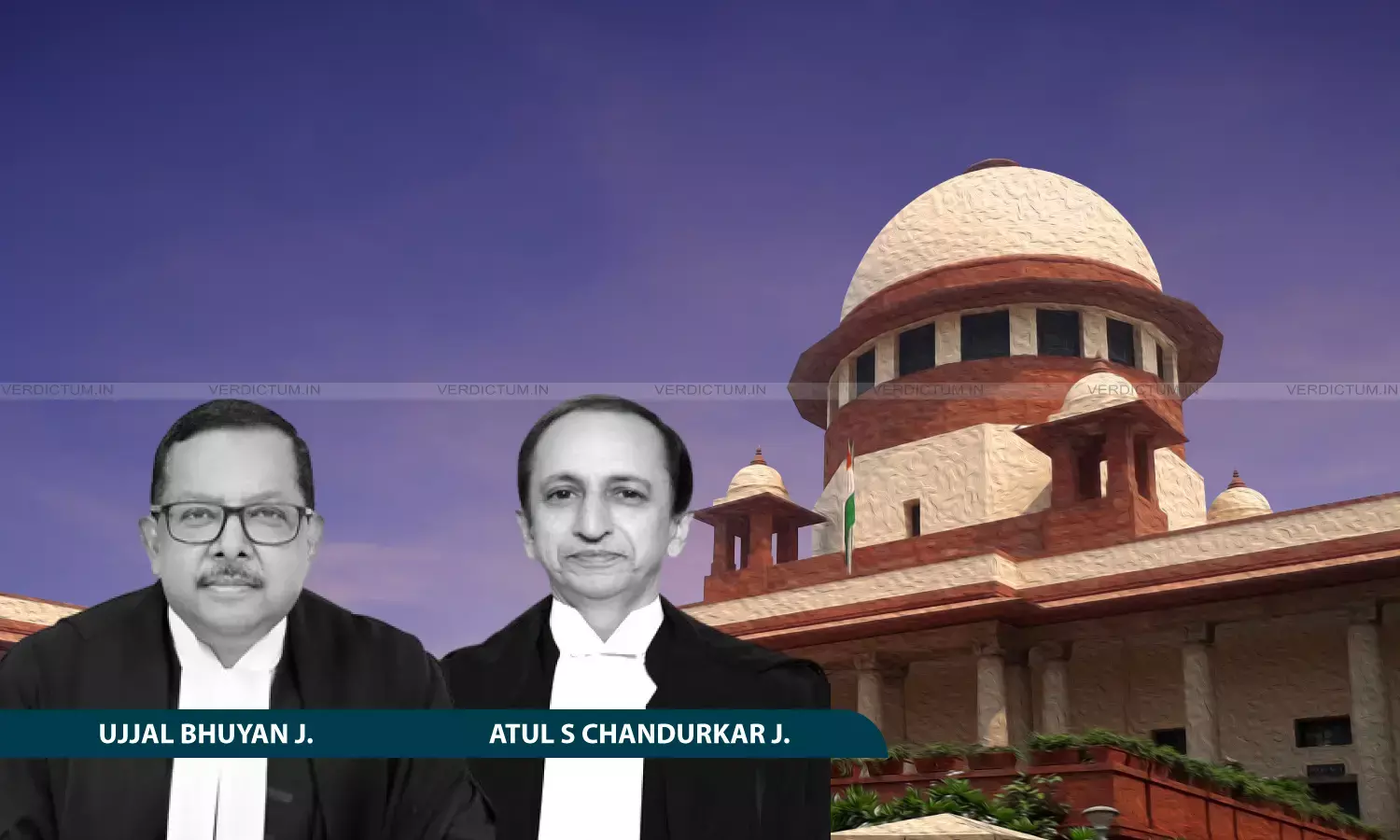
A Bench of Justice Ujjal Bhuyan and Justice Atul S. Chandurkar, while allowing the appeal, observed:
“Inadvertent errors or mistakes in a statement could be termed as a ‘wrong statement’. However, a ‘false statement’ would imply something more than a mere untruth as it carries with it an intent to deceive coupled with knowledge, actual or constructive. This perhaps explains the reason as to why the court of first instance was of the view that ‘wrong statements’ had been made in the memorandum of appeal and the application for stay instead of holding them to be ‘false statements’. It, therefore, cannot be said that the errors in the memorandum of appeal and the application for stay were of such a grave nature that it amounted to making ‘false statements’ requiring initiation of proceedings under Sections 193, 199 and 200 of the Penal Code”.
Advocate Satyajit A. Desai appeared for the appellants. Despite the service, the respondents did not oppose the appeal.
Background
The dispute arose from a civil suit in which the plaintiffs sought to restrain the defendants from obstructing the enjoyment of property. During the pendency of the suit, the trial court granted a temporary injunction. Later, on an application alleging breach of injunction under Order XXXIX Rule 2A CPC, the trial court directed restoration of the earlier position at the site and issued show cause notice.
The defendant filed a miscellaneous appeal and a stay application against that order. The appellate court stayed the effect and operation of the trial court’s order.
The plaintiffs then alleged that incorrect and false statements had been made in the appeal and stay application, leading to the stay order. They first filed a criminal contempt petition before the Bombay High Court, which declined to proceed in contempt but granted liberty to initiate Section 340 CrPC proceedings.
The plaintiffs thereafter moved an application under Section 340 CrPC before the appellate court. The appellate court held that a prima facie case was made out that “wrong statements” had been made by the defendant and his counsel, and directed the filing of a complaint for offences under Sections 193, 199 and 200 IPC. The High Court declined to interfere, leading to the appeal before the Supreme Court.
Court’s Observations
The Court began by examining Section 340 CrPC and the settled law that prosecution for offences affecting the administration of justice is not automatic. It referred to the Constitution Bench decision in Iqbal Singh Marwah v. Meenakshi Marwah (2005), which held that the Court is not bound to file a complaint in every case and must consider whether prosecution is expedient in the interests of justice.
The Court observed: “It is by now settled that while entertaining proceedings under Section 340 of the Cr.P.C., it must be borne in mind that the material produced before the Court ought to make out a prima facie case for an inquiry to be made into an offence referred to in Section 195(1)(b) of the Penal Code. Further, the Court has to also consider whether it is expedient in the interest of justice that such inquiry should be made into the alleged offence.”
The Court noted that the appellate court had proceeded only on the footing that “wrong statements” had been made, without recording satisfaction that false evidence or false statements had been made.
The Supreme Court then examined Sections 191, 193, 199 and 200 IPC. It held that what is punishable under these provisions is false evidence or a false statement, not every wrong statement.
The Court stated: “There is a material difference between making a ‘wrong statement’ and ‘false statement’ in the context of Sections 199 and 200 of the Penal Code. A ‘wrong statement’ of fact may not always have the character of a ‘false statement’. While making of a ‘wrong statement’ may not fall within the ambit of Sections 199 and 200 of the Penal Code, a ‘false statement’ would qualify as relevant material for being considered as an offence under the said provisions.”
It further held: “The threshold for initiating action for an offence punishable under Sections 199 and 200 of the Penal Code is the making of a ‘false statement’ and not the making of a ‘wrong statement’. It is so because a ‘false statement’ denotes a deliberate intention in making such statement; in other words, it is a wrongful or erroneous statement made intentionally to gain an undue advantage.”
On this basis, the Court held that the original order directing prosecution did not satisfy the required legal threshold.
The Court also found that the appellate court failed to record that it was expedient in the interests of justice to initiate an inquiry, which is a mandatory requirement under Section 340 CrPC.
The Court noted: “Section 340 (1) of the Cr.P.C. mandates that a Court before directing an inquiry to be made into any offence referred to in Section 195 (1) (b) of the Penal Code, it should form an opinion that it is expedient in the interests of justice that such inquiry is in fact necessary. This would indicate that on the mere making of a ‘wrong statement’, an inquiry cannot be ordered.”
Relying on Santokh Singh v. Izhar Hussain (1973), the Court reiterated that every incorrect or false statement does not require prosecution, and that prosecution is meant for the larger interest of administration of justice, not for private vindictiveness.
The Supreme Court also faulted the High Court for recording findings that were absent in the original Section 340 order. While the original court had referred only to “wrong statements”, the High Court recorded that a false affidavit had been filed and also supplied the missing finding on expediency.
The Court held: “The High Court has, thus, proceeded to improve the impugned order in an appeal preferred by the appellants, who were in fact aggrieved by the same. Such course is not permissible in law.”The Court found it significant that before the Section 340 application was filed, the defendant had already moved an application seeking correction of typing mistakes in the memorandum of appeal and stay application. The counsel had explained that the errors occurred while typing and tendered an apology.
The Court observed: “Perusal of the said application clearly indicates that the mistakes were typographical in nature and an explanation was duly furnished for their occurrence. The gravity of a statement that is false is definitely greater than that of a statement that is wrong.”
The Court held that the errors were not so grave as to amount to false statements warranting prosecution under Sections 193, 199 and 200 IPC.
Before parting, the Court referred again to Iqbal Singh Marwah (2005) and noted that complaints under Section 340 CrPC should normally not be directed during pendency of substantive proceedings, but after final judgment.
The Court stated: “The object is clear inasmuch as the main proceedings ought to be proceeded with and decided instead of diverting them with the aid of Section 340 of the Cr.P.C. It is noticed that at times, the aid of Section 340 of the Cr.P.C. is sought to be taken merely to delay the adjudication of the substantive proceedings, as also in the present case.”
The Court also relied on James Kunjwal v. State of Uttarakhand (2024), which held that Section 340 proceedings require deliberate falsehood on a matter of substance, a reasonable foundation for the charge, and exceptional circumstances.
Conclusion
The Supreme Court allowed the appeal and set aside the orders directing the filing of a complaint against the appellants. It dismissed the Section 340 CrPC application filed by the plaintiffs.
The Court held that no case had been made out for initiation of criminal proceedings against either the litigant or his counsel.
Cause Title: Prabhakar Yeshwant Masram And Another v. Sou Tula Namdeorao Jaipurkar And Another (Neutral Citation: 2026 INSC 724)
Appearances
Appellants: Advocates Satyajit A. Desai, Pratik Kumar Singh, Sachin Singh, Shashank Upadhyay and Anagha S. Desai, AOR
