Regulatory Lacuna Does Not Bar CERC From Imposing Reasonable Liability On Defaulting Party U/S 79 Electricity Act: Supreme Court
The Court found that PGCIL’s two LILO transmission assets were operational and used to evacuate power. It also upheld the commercial-operation dates accepted by CERC and rejected the Appellate Tribunal’s direction for their reconsideration.
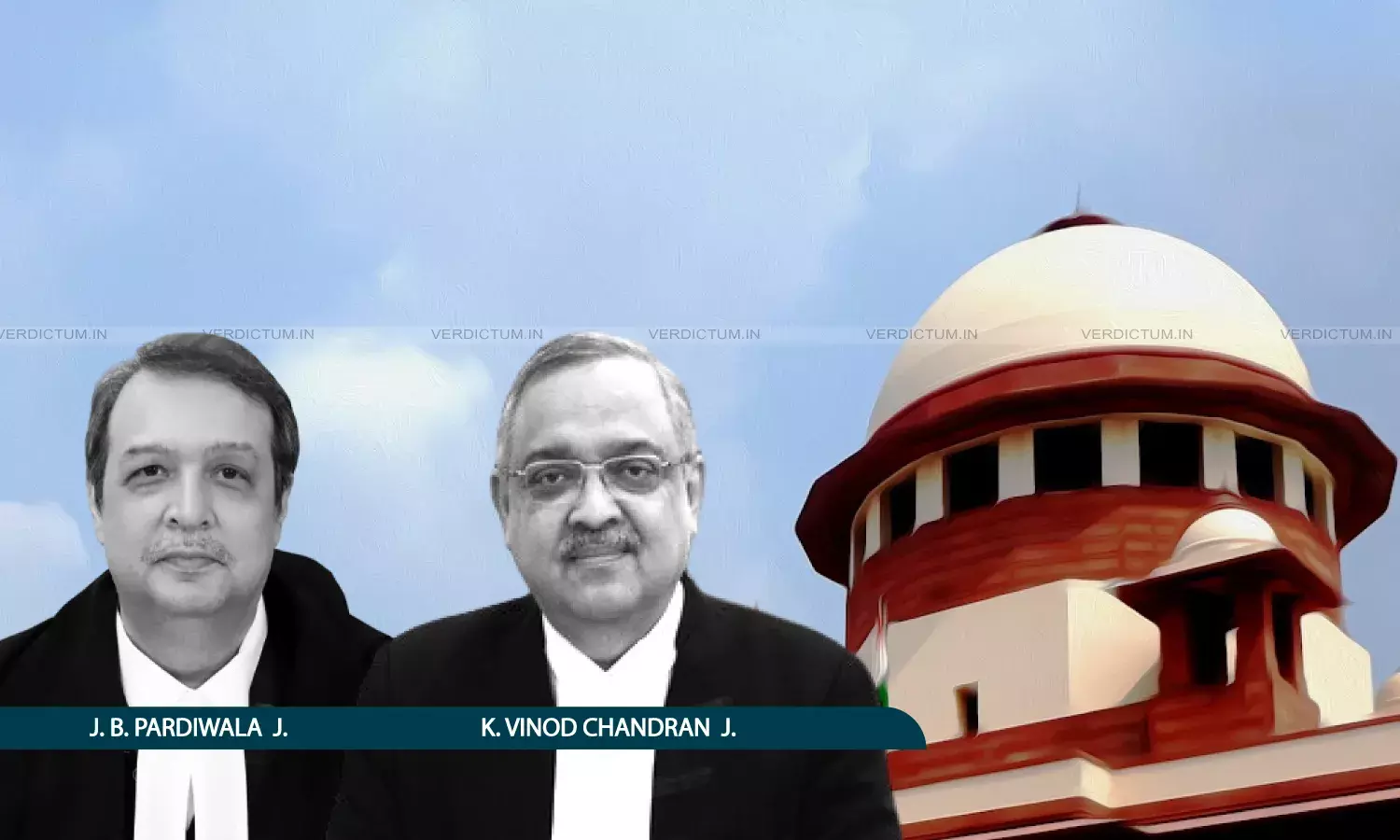
Justice J. B. Pardiwala, Justice K. Vinod Chandran, Supreme Court
The Supreme Court has held that the absence of a regulation under Section 178 of the Electricity Act, 2003, does not prevent the Central Electricity Regulatory Commission from exercising its regulatory power under Section 79 and imposing a reasonable liability on a defaulting party.
Applying that principle, the Court upheld transmission charges against a generating company that had delayed commissioning its dedicated transmission line and restored CERC’s tariff order.
The Court was hearing appeals by Power Grid Corporation of India Limited against two orders of the Appellate Tribunal for Electricity concerning tariff for two Line-In Line-Out or Loop-In Loop-Out transmission assets at the Tuticorin Pooling Station. The Tribunal had overturned CERC’s findings on their use and commercial-operation dates and remanded the matter for reconsideration.
Referring to PTC India Limited v. Central Electricity Regulatory Commission (2010), A Bench comprising Justice J.B. Pardiwala and Justice K. Vinod Chandran observed: “… making of a regulation under Section 178 is not a precondition to the Central Commission taking any steps/measures under Section 179 (1)’ (sic). While unequivocally declaring that if there is a regulation under Section 178 then the measure under Section 79(1) has to be in conformity with such regulation, it was also held that an order imposing regulatory fees could be passed even in the absence of a regulation under Section 178.”
Senior Advocate Ramji Srinivasan appeared for PGCIL; Senior Advocate Sajan Poovayya represented the generating company; and Advocate Vrinda Bhandari appeared for TANGEDCO.
Background
The dispute concerned two LILOs installed by PGCIL on the Tuticorin JV-Madurai transmission line at the Tuticorin Pooling Station. The assets were commissioned in January 2015. Although the generation, transmission and supply of electricity were admitted, the parties disputed whether the LILOs had been used.
Under the agreed transmission arrangement, the generating company was required to build a dedicated transmission line directly to the Tuticorin Pooling Station. It did not commission that line until October 2016. PGCIL claimed transmission tariff for the two LILOs from their respective commercial-operation dates until the dedicated line became operational.
CERC accepted the commercial-operation dates proposed by PGCIL after considering the Regional Load Despatch Centre’s successful trial-operation certificates, the Central Electricity Authority’s safety certificates and the agreed transmission plan. It placed liability for the relevant transmission charges on the generating company until its dedicated line became commercially operational.
The Appellate Tribunal accepted that the LILOs formed a permanent part of the transmission plan but held that they had not been put to use because the upstream transmission system from Tuticorin to Salem and Madhugiri was not operational. It also found that the prescribed procedure for approving the commercial-operation dates had not been followed and directed CERC to reconsider them.
PGCIL contended that power was routed through the LILOs and that the delay in the upstream lines did not affect their use. The generating company and TANGEDCO maintained that the assets had no beneficial use during the disputed period and that liability could not arise without commercial-operation dates declared in accordance with the Tariff Regulations.
Court’s Observations
LILOs Were Used To Transmit Power
The Court held that electricity evacuated through a temporary connection necessarily passed through PGCIL’s permanent LILOs (Line-In Line-Out/Loop-In Loop-Out), entered the Tuticorin Pooling Station and returned to the Tuticorin JV-Madurai line.
It also noted that the generating company had acknowledged before the Tribunal that it used the Tuticorin Pooling Station and the relevant transmission system. The Court observed: “Hence, the use of LILOs was admitted and the contention was only of sharing, which cannot be raised without commissioning the DTL.”
The delayed upstream line to Salem did not prevent transmission through the Tuticorin JV-Madurai line. The Court consequently found beneficial use established.
Failure To Commission Dedicated Line Created Liability
The Court held that Section 10 of the Electricity Act, 2003, placed responsibility for establishing and maintaining the dedicated transmission line on the generating company. The Bulk Power Transmission Agreement also required the line to connect the generating station directly to the Tuticorin Pooling Station.
The judgment stated: “The liability now cast on the power generating company is only by reason of the DTL having not been constructed, which would have extracted power from the generating station and transmitted it directly to the Tuticorin Pooling Station.”
Until that line became operational, the LILOs were essential to the transmission arrangement. The Court therefore upheld the generating company’s liability between the LILOs’ commercial-operation dates and commissioning of the dedicated line.
Commercial-Operation Dates Required No Reconsideration
The Court found no impediment to regular transmission after generation began. The Tariff Regulations required successful trial operation and certification by the Regional Load Despatch Centre, which PGCIL had produced with the relevant safety certificates.
After noting that CERC had accepted the two commercial-operation dates on that material, the Court held: “This calls for no-redetermination under Regulation 4(3)(ii) of the Tariff Regulations.”
The Tribunal’s interpretation of the commercial-operation requirements was therefore erroneous.
CERC Could Act Despite Regulatory Lacuna
The Court distinguished CERC’s administrative and adjudicatory powers under Section 79 of the Electricity Act, 2003, from its delegated legislative power to make generally applicable regulations under Section 178. Orders under Section 79 must conform to an existing regulation, but the absence of such a regulation does not extinguish CERC’s regulatory power.
Relying on Energy Watchdog v. Central Electricity Regulatory Commission (2017) and Power Grid Corporation of India Limited v. Madhya Pradesh Power Transmission Company Limited (2025), the Court observed: “The dictum squarely applies in the present case, where the generating company failed to establish and operationalise its DTL within the time stipulated.”
It held that CERC had reasonably imposed the liability on the defaulting generating company for the period during which PGCIL’s LILOs were used before the dedicated line was commissioned.
APTEL Misread CERC’s Order
The Court found that the Tribunal had incorrectly treated a passage recording TANGEDCO’s contention as CERC’s own finding on beneficial use. The subsequent portions of CERC’s order had considered liability and placed it on the generating company.
The Court said: “As we observed, paragraph 72 of the CERC order cannot be isolated and considered out of context.”
It also held that the Tribunal’s understanding of the network diagram was factually incorrect and inconsistent with the admitted use of the LILOs.
Conclusion
The Supreme Court held that the two LILOs were includable in the transmission tariff as non-Point of Connection charges from their respective commercial-operation dates until the dedicated transmission line became operational. It rejected the Tribunal’s interpretation of the commercial-operation requirements and upheld the liability imposed on the generating company for its delay.
The Court set aside both Appellate Tribunal orders, restored CERC’s order and allowed PGCIL’s appeals. All pending applications were disposed of.
Cause Title: Power Grid Corporation of India Limited v. Tamil Nadu Generation and Distribution Corporation Limited (TANGEDCO) & Others (Neutral Citation: 2026 INSC 1237)
Appearances
Appellant: Ramji Srinivasan, Senior Advocate; Swapna Seshadri, Nikunj Dayal, Rupinder Kaur, Namrata Saraogi, Shefali Munde, Aryansh Tripathi, Radhika Gaur and Kaushiki, Advocates; Pramod Dayal, Advocate-on-Record
Respondents: Sajan Poovayya, Senior Advocate; Mahesh Agarwal, Matrugupta Mishra, Arshit Anand, Vidisha Swarup, Siddhi Gupta, Vanshika Saraf and Nipun Dave, Advocates; E.C. Agrawala, Advocate-on-Record; Vrinda Bhandari, Advocate-on-Record; S. Vallinayagam, Bhavya Arora and Durga Vallinayagam, Advocates