

You Are Before A Conservative Bench, We Don't Jump The Gun: Apex Directs Centre To Consider Registration Of Institutions Imparting Religious Education
The Court maintained that since a representation was submitted to the Education Secretary only in February, the government must be allowed to decide before any judicial intervention.

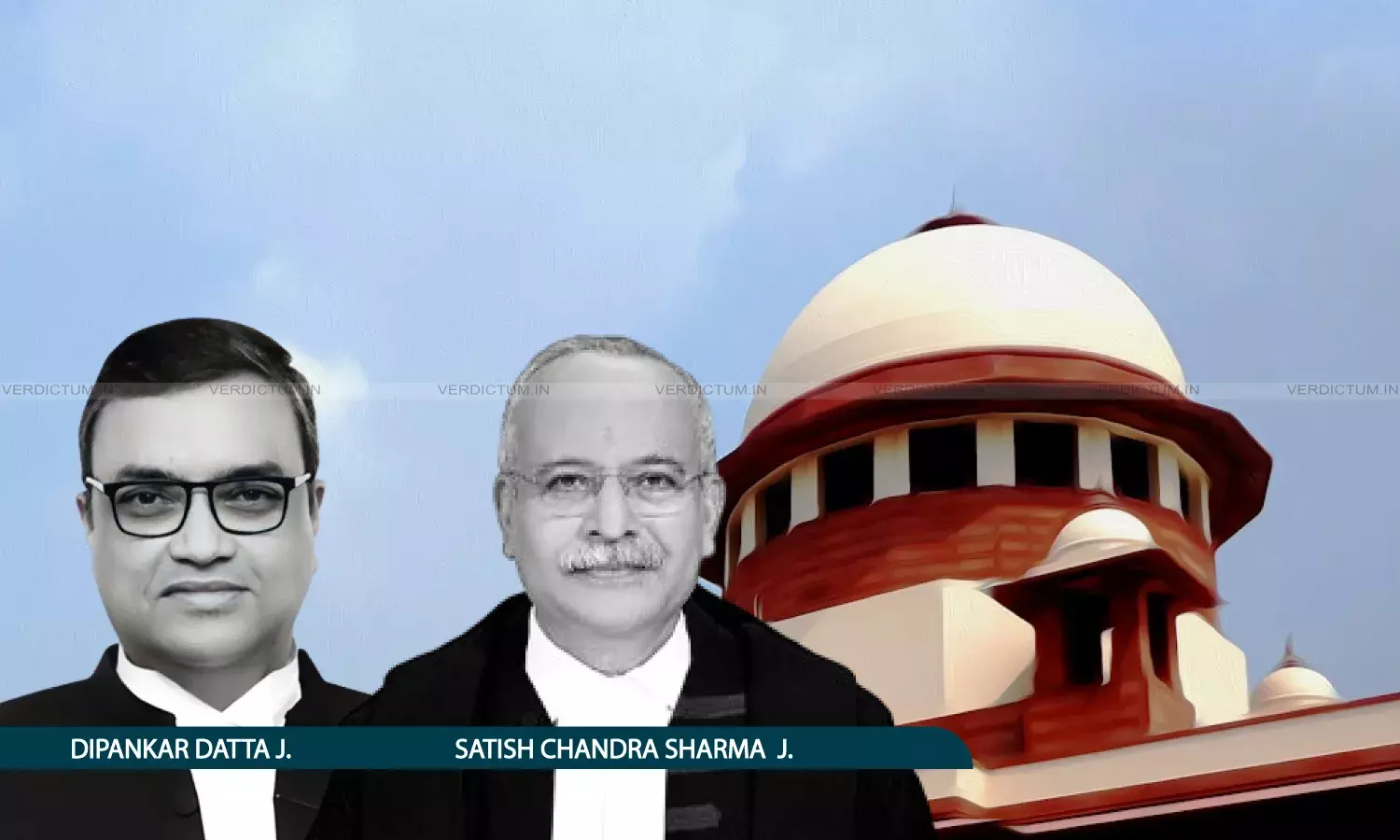
Justice Dipankar Datta, Justice Satish Chandra Sharma, Supreme Court
The Supreme Court has declined to entertain a plea seeking the mandatory registration and monitoring of all institutions imparting religious or secular education to children under 14, and directed the Ministry of Education to first decide on the petitioner's pending representation.
A plea was filed by Ashwini Kumar Upadhyay seeking registration, recognition, supervision and monitoring of all institutions imparting secular/religious education to children up to 14 years in the spirit of Article 21A, 39(f), 45 and 51-A(k).
Previously, the Court had refused to entertain the previous petition seeking directions for the Centre and States to register all institutions imparting secular or religious instruction to children under 14. After which the Petitioner i.e. Ashwini Kumar Upadhyay, approached the Secretary, Ministry of Education, vide representation dated February 10, 2026.
The Bench of Justice Dipankar Datta and Justice Satish Chandra Sharma dismissed the matter and asked the Ministry of Education to decide the representation.
Justice Dipankar Datta said, "We are not considering anything on merits. He has made a representation pursuant to our order. Notices have already been issued on that matter...Maybe, but pursuant to our order, he has made a representation, right? The Secretary has not considered it. Is he not required to consider it?"
He added, "You are before a bench having judges who are very conservative and traditional, right?...We don't jump the gun."
Upadhayay said, "I am coming for the third time."
The court said, "This is the second time. The first time you came without making any representation. We said that once you are seeking a mandamus in terms of the judgment of 1974, four judges, you are required to first go to the authority, tell your grievance. If they don't [respond], then you come back. You have not done it. Not too much time has elapsed—two months. 10th of February, you have submitted it. They will consider it within another two months. And if you don't get justice from them—look here, justice is not a one-way traffic to be given by the judiciary only. The executive also has a duty under the law...So, let the executive first consider your representation. Let them say that we don't agree with Mr. Upadhyay for X, Y, Z reason."
Upadhayay submitted, "There will be a simple answer, Milord, because there are some judgments of this Hon'ble Court where Lordships have set—said that Article 30 is the extension of Article 26. I am saying Article 25 and 26 is the most restricted provision, Milord. Article 30 is not. So Lordships have to interpret the Constitution, Milord. That's why this matter needs to be... notice to be issued."
Justice Datta, "No. Let them give a decision."
Counsel said, "Then Milord, please consider this petition as a representation. I will serve the copies to the registry."
Justice Datta said, "No, no. Let the Education Secretary at the Central Government level, let him decide. Thereafter, we'll consider."
The plea, filed by AOR Ashwani Kumar Dubey, submitted that children are the backbone of nation's growth and are also gullible & naive due to their tender age. Hence, the State has heightened responsibility towards them. Secondly, it said that this is an issue of national security as young kids form the future of the nation, can be brainwashed/manipulated in an unregistered institution. Thirdly, it was submitted that Article 21-A also guarantees quality of education, which can't be ensured in unregistered, unrecognised institutions.
"Fourthly, it is State's obligation to provide conducive environment to children upto 14 years. Fifthly, neither there are any criteria for appointment of teachers nor there is any audit of syllabus/curriculum in unregistered unrecognised institutions. Sixthly, the safety/security of children is paramount. It is the State's onus to prevent trafficking of children by non-registered non recognised institutions by preventing it at the threshold", it said.
It also said that the institutions which impart religious instruction directly fall under Article 26, but presently, they are being covered under Article 30, which is not permissible under the Constitution. If a non-minority institution imparting religious instruction can not be covered under Article 19, then minority institutions imparting religious instruction also can't be covered under Article 30, as Article 30 is a reiteration of Article 19, it said.
Petitioner submitted that semi-religious minority educational institutions are being covered under Article 30, which is a wrong interpretation.
"Thousands of non-registered institutions are radicalising gullible young children under the garb of imparting religious instruction as they are not supervised by the State. It has serious implications not only for internal security but also fraternity, unity and national integration, as one can easily brainwash young children in the name of religion", it added.
The Petitioner also submitted that Imparting Religious Instruction amounts to ‘Propagating’ Religion and shall be covered under Article 25. Any Institution which imparts such Religious Instruction falls squarely under the ‘Institutions for Religious and Charitable Purposes’ under Article 26. It said that the magnitude of Religious Instruction being imparted or if Secular Education was being imparted, would be no ground to not categorise such an institution under Article 26.
It was prayed, "direct the Centre and States to take appropriate steps to Register all the Schools / Institutions, imparting Education and/or Religious Instruction to Children upto the age of 14 years in spirit of Article 21A, Article 39 (f), Article 45 and Article 51-A(k)...direct and declare that Article 30 is Specific Reiteration of the Article 19(1)(g) and doesn’t confer any Additional Rights/Benefits/Privileges than the Rights guaranteed to the citizens under Article 19(1)(g)".
Accordingly, the matter was dismissed.
Cause Title: Ashwini Kumar Upadhyay v. Union of India and Ors. [Diary No. 27230 of 2026]