

Proof Of Thumb Impression & Handwriting Does Not Conclude Enquiry Into Validity Of Will: Supreme Court
The Bench noted that Section 69 of Evidence Act only substitutes formal mode of proof, and does not create presumption of free agency or absence of suspicious circumstances.

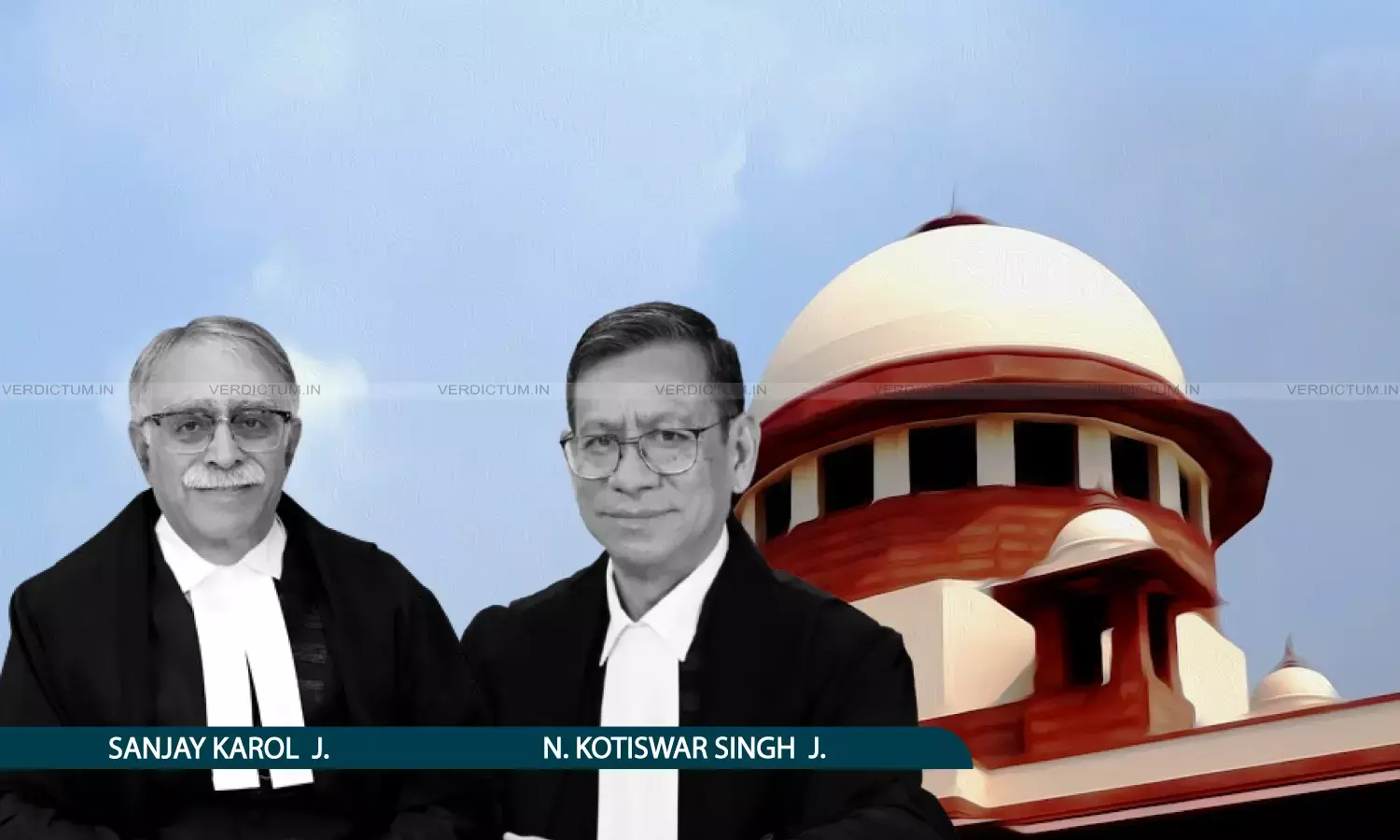
Justice Sanjay Karol, Justice N. Kotiswar Singh, Supreme Court
The Supreme Court has held that establishing the thumb impression of a testator and the handwriting of an attesting witness under Section 69 of the Indian Evidence Act, 1872 does not conclude the entire enquiry into the legal validity of a Will. The Court clarified that while Section 69 provides a substituted mode of formal proof when attesting witnesses cannot be produced, it does not create any legal presumption that the testator understood the recitals, freely adopted the testamentary scheme, or acted without suspicious circumstances.
The Apex Court further emphasized that the statutory gateway between Sections 68 and 69 of the Evidence Act cannot be bypassed without cogent proof regarding the death or unavailability of all named attesting witnesses. Where the propounders fail to satisfactorily establish the unavailability of a witness or remove cumulative suspicious circumstances, such as incorrect recitals, exclusion of natural heirs without explanation, and withholding key witnesses, the document fails as a valid testamentary disposition.
A Bench comprising Justice Sanjay Karol and Justice Nongmeikapam Kotiswar Singh while setting aside a Madras High Court judgment and restoring the Trial Court’s partition decree in a long-standing family property dispute, observed, “…proof of the handwriting and thumb impression does not conclude the entire enquiry into the validity of the Will. Section 69 of the Evidence Act, substitutes a mode of formal proof where attesting witnesses are unavailable. It does not create a presumption that the testatrix understood every recital, freely adopted the testamentary scheme, possessed the requisite capacity, or acted free from suspicious circumstances. Those questions remain governed by the substantive principles relating to proof of Wills”.
Senior Advocate S Nagamuthu appeared for the appellant and Senior Advocate Sathyanarayanan appeared for the respondent.
The dispute concerned agricultural and house properties originally owned by one Vaiyapuri Gounder, who died around 1925 leaving behind his third wife, Arukkaniammal. After Arukkaniammal died issueless in 1985, the legal heirs of the first wife filed a partition suit claiming a two-thirds share under Section 15(2)(b) of the Hindu Succession Act.
The respondents, representing the second wife’s branch, resisted partition by relying on a registered Will dated December 15, 1976 (Ex. B-13), allegedly executed by Arukkaniammal in favour of her step-daughter’s four sons. They also filed an injunction suit asserting exclusive title and possession.
The Trial Court passed a preliminary decree for partition in favour of the appellants and dismissed the respondents' injunction suit, holding that the Will (Ex. B-13) was not proved in accordance with law and was surrounded by unremoved suspicious circumstances.
On appeal, the Madras High Court reversed the Trial Court's judgment, holding that Section 69 of the Evidence Act was properly satisfied because the propounder's assertion of the attesting witnesses' death went unchallenged in cross-examination. The High Court upheld the Will and granted an injunction in favour of the respondents, prompting the present appeal before the Supreme Court.
The Court held that Sections 63(c) of the Indian Succession Act and 68 of the Evidence Act require proof of statutory attestation, which cannot be cured by registration or the testimony of a scribe who signed without animus attestandi.
The Court ruled that invoking Section 69 of the Evidence Act requires establishing the condition precedent, that no attesting witness can be found. The propounders failed to prove the unavailability of the second attesting witness, Avanashi Gounder, as no relative or local resident was examined to confirm his death. Crucially, the Bench clarified that proving handwriting and thumb impressions under Section 69 does not conclude the enquiry into validity, and that the High Court erred in isolating individual suspicious circumstances rather than evaluating their cumulative impact.
Accordingly, the Supreme Court allowed the appeals, set aside the common judgment of the Madras High Court dated October 28, 2008, and restored the Trial Court's common judgment dated January 22, 1991, stood dismissed, and the parties were directed to work out final division and consequential equities in final decree proceedings.
Cause Title: Pazhanathal (Dead) Through LRs. & Ors. v. Alamathal (Dead) Through LRs. & Ors. (Neutral Citation: 2026 INSC 860)
Appearances:
Appellants: S Nagamuthu, Sr. Adv., N. L. Ganapathi, AOR, Sidhant Garg, Advocate.
Respondents: Sathyanarayanan, Sr. Adv., B.Karunakaran, Bhaskaran, Pooja Lakshmi, Lakshman Raja, S. Gowthaman, AOR, Dr. Pooja Jha, Dr. R. Prakash, Nandita Jha, Mukesh Kumar, Akash, Vishwa Pal Singh, AOR, Advocates.