

Failure To Examine Independent Witness To Recovery Of Dead Body Creates Doubt About Recovery At Accused’s Instance: Supreme Court
The Court held that non-examination of an independent witness allegedly present at the time of recovery of the dead body created a serious doubt regarding the prosecution’s claim that the recovery was made pursuant to the disclosure statement of the accused.
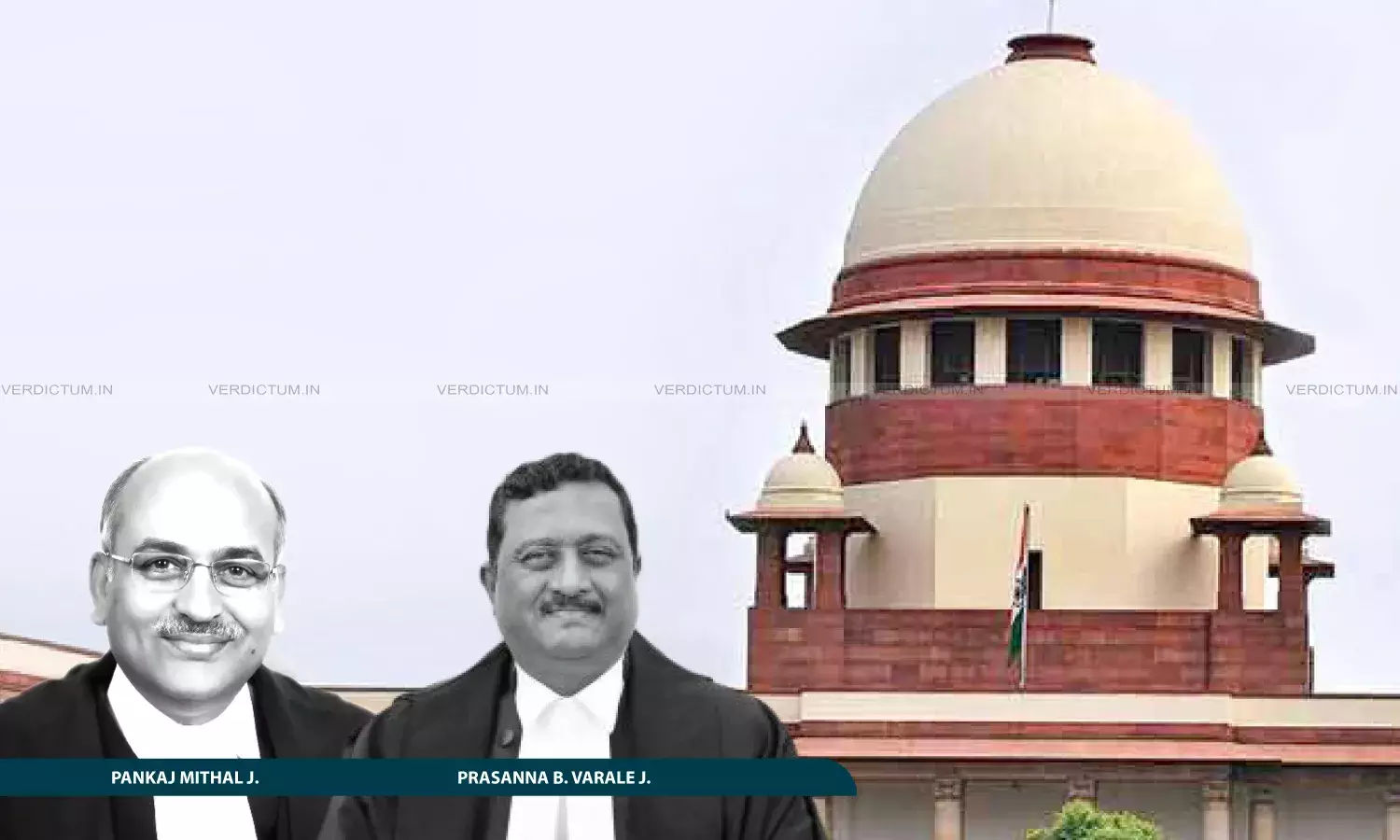
Justice Pankaj Mithal, Justice Prasanna B. Varale, Supreme Court
The Supreme Court has held that failure of the prosecution to examine an independent witness allegedly present during recovery proceedings creates a serious doubt regarding the genuineness of the alleged recovery of the dead body at the instance of the accused.
The Court observed that the requirement of independent witnesses under Section 100(4) of the Code of Criminal Procedure, 1973, is intended to lend credibility to the investigation and that withholding such a material witness undermines the prosecution's case.
The Court was hearing appeals filed by the complainant and the State of Rajasthan challenging the judgment of the Rajasthan High Court acquitting the accused persons of offences punishable under Sections 364, 302, 396 and 201 read with Section 120B of the Indian Penal Code, 1860. The Trial Court had earlier convicted the accused and sentenced them to life imprisonment.
A Division Bench of Justice Pankaj Mithal and Justice Prasanna B. Varale observed: “ …the requirement of independent witnesses, more particularly, as per Section 100(4) of Cr.P.C. is to provide credibility to the investigation. In the present case, admittedly, the dead body was recovered in the presence of one witness i.e. P.W. 2 who happens to be uncle of deceased and another person namely, Ramawtar who has not been produced by the prosecution for his examination before the Court.”
The Bench further observed: “On the backdrop of these facts, the High Court observed that Ramawtar, who was an independent witness and failure to produce him before the Court is nothing but withholding the material witness and this creates a doubt about the recovery of the dead body alleged at the instance of accused.”
“Therefore, the High Court was justified in holding that the prosecution failed to establish beyond reasonable doubt that the recovery of dead body was made pursuant to the disclosure statement of accused”, the Bench additionally held.
Advocate Milind Kumar appeared for the appellant, while Advocate Abhijeet Singh represented the respondents.
Background
The prosecution case arose from a written complaint lodged on 28.04.2007 by the complainant stating that his brother, who operated a Bolero Jeep as a taxi, had gone missing along with the vehicle after two boys hired the vehicle on 26.04.2007 for travel towards Lambi Road. The deceased was expected to return the same night, but neither he nor the vehicle returned thereafter.
During the investigation, five accused persons were arrested, including one juvenile who was separately tried before the Juvenile Justice Board. According to the prosecution, accused Balraj @ Tiloo was arrested on 28.04.2007 and, pursuant to his disclosure statement, the dead body of the deceased was allegedly recovered from a dry well on the same day.
The prosecution examined eighteen witnesses and relied upon recoveries of certain articles, including a tape recorder, wrist watch, towel, vehicle papers, and the Bolero Jeep allegedly recovered at the instance of different accused persons. The Trial Court convicted all four accused persons under Sections 364/120B, 302/120B, 396 and 201 IPC and sentenced them to life imprisonment.
The Rajasthan High Court, however, reappreciated the evidence and acquitted the accused persons, holding that the chain of circumstantial evidence was incomplete and that the prosecution had failed to establish guilt beyond a reasonable doubt. Aggrieved thereby, the complainant and the State approached the Supreme Court.
Court’s Observation
The Supreme Court observed at the outset that the prosecution's case rested entirely upon circumstantial evidence and therefore each incriminating circumstance relied upon by the prosecution had to be proved beyond a reasonable doubt and form a complete chain unerringly pointing towards the guilt of the accused.
Examining the alleged recovery of the dead body at the instance of the accused Balraj @ Tiloo, the Court found that the High Court had rightly doubted the prosecution version for several cogent reasons borne out from the record. The Court noted that when the accused was arrested, the police were not even aware that the missing person had been murdered, yet the arrest memo already mentioned offences under Sections 302, 394 and 201 IPC.
The Court further relied upon the testimony of PW5 Basant Singh, an independent witness, who stated that the police had already visited and examined the well from where the dead body was allegedly recovered and that the body could not initially be recovered only because a boring machine was unavailable. PW5 also stated that none of the accused persons was present at the spot when the recovery was eventually made. The Supreme Court observed that the Trial Court had ignored this crucial testimony, which materially undermined the prosecution's case.
The Bench reiterated that the requirement of independent witnesses under Section 100(4) Cr.P.C. is intended to ensure credibility and transparency in investigation. The Court found that although one independent witness named Ramawtar was allegedly present during the recovery proceedings, the prosecution failed to examine him before the Court without furnishing any explanation. This omission, according to the Court, created a serious doubt regarding the genuineness of the alleged recovery.
The Supreme Court also refused to rely upon the alleged recovery of the Bolero Jeep at the instance of the accused. Referring to Jaikam Khan v. State of U.P. (2021), the Court observed that recoveries made from open places accessible to all lose much of their evidentiary value. Since the vehicle was recovered from a public road and not from the exclusive possession of the accused, the Court held that no incriminating inference could be drawn against the accused on that basis.
As regards the accused Vijay Singh @ Sunder, the prosecution relied principally upon the “last seen together” theory and identification by prosecution witnesses. The Supreme Court, however, affirmed the High Court’s finding that evidence of “last seen” is inherently weak and cannot by itself sustain a conviction in the absence of strong corroborative evidence.
The Court quoted with approval the High Court’s observation: “At best, there is a strong suspicion that Vijay may have been involved in the murder of Ashok. But there is no proof that he must have been involved in his murder. In catena of cases, the Hon’ble Supreme Court has held that last seen is a weak sort of evidence. It is too weak a piece of evidence to convict a person.”
The Supreme Court also rejected the contention that an adverse inference ought to have been drawn against the accused under Section 106 of the Indian Evidence Act, 1872, merely because the deceased was last seen in their company. Referring to Manoj @ Munna v. State of Chhattisgarh (2025), the Court reiterated that Section 106 does not shift the primary burden of proof from the prosecution and that adverse inference can arise only after the prosecution establishes a complete chain of circumstances beyond a reasonable doubt.
The Court further found serious infirmities in the recoveries allegedly made from the accused Manjeet Kumar @ Billu. The tape recorder and wrist watch allegedly belonging to the deceased had never been subjected to a Test Identification Parade. Referring to Thammaraya v. State of Karnataka (2025), the Court reiterated that omission to conduct Test Identification Parade of recovered articles creates serious gaps in the prosecution story, especially where the prosecution case substantially rests upon recoveries.
The Bench also held that recovery of a towel allegedly used in the offence was wholly inconsequential since it was an ordinary household article and no bloodstains or other incriminating material connecting it to the offence were found on it.
Reiterating the principles governing circumstantial evidence laid down in Sharad Birdhichand Sarda v. State of Maharashtra (1984), the Supreme Court observed that the prosecution must establish a complete and unbroken chain of circumstances excluding every possible hypothesis consistent with innocence.
The Court observed: “The circumstances relied upon must be of a definite tendency unerringly pointing towards the accused’s guilt and must form a chain so far complete that there is no escape from the conclusion that within all human probability it is the accused and no one else who had committed the crime.”
Conclusion
The Supreme Court held that the prosecution failed to establish a complete and reliable chain of circumstantial evidence against the accused persons and that the High Court had rightly extended the benefit of doubt to them. The Court found no perversity or illegality in the High Court’s appreciation of evidence and reiterated that suspicion, however strong, cannot substitute proof in a criminal trial.
Holding that the view taken by the High Court was a plausible view based on proper appreciation of evidence, the Supreme Court declined to interfere with the order of acquittal and dismissed the appeals filed by the complainant and the State of Rajasthan.
Cause Title: Pawan Kumar Sharma v. Manoj Kumar & Ors. (Neutral Citation: 2026 INSC 539)
Appellants: Additional Advocate General Sansriti Pathak, Advocates Milind Kumar, Kailash J. Kashyap, Pankaj Kumar Singh, Archla, Saurabh Rajpal and Nidhi Jaswal.
Respondents: Advocates Abhijeet Singh, Anirudh Singh and Chitrangda Rashtraura, Group Captain Karan Singh Bhati
