

Allegation Of Forcible Sex Hard To Accept When Prosecutrix Voluntarily Travelled & Stayed With Accused: Supreme Court Acquits Rape Accused
The Bench said that a rape charge must be proved on the basis of hard evidence and not on the basis of the surmises and conjectures based on the value judgment of the presiding judge.

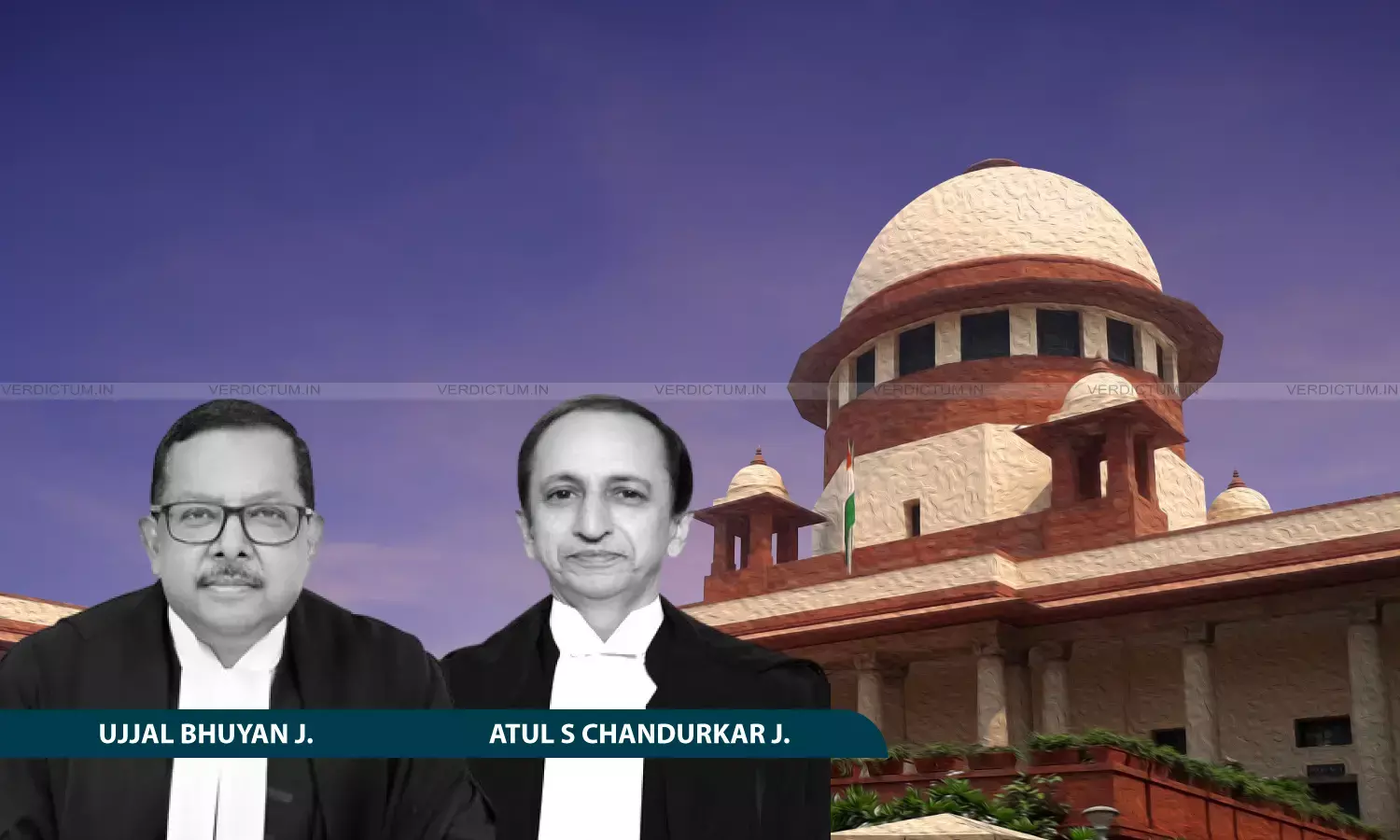
The Supreme Court has acquitted a man sentenced to ten years' rigorous imprisonment under Section 376 of the IPC, noting that forcible intercourse without consent was hard to accept given that the prosecutrix had voluntarily absented herself from home for five to six days, traveling all around with the accused and staying with him.
Setting aside the concurrent findings of the Trial Court and the Punjab and Haryana High Court, the Bench observed that a court cannot selectively rely on a prosecutrix's testimony to convict on one charge after finding the same evidence untrustworthy to acquit on a related charge. Pointing to major internal contradictions, including conflicting details of their journey and her failure to raise an alarm or attempt escape on crowded streets over several days, the Court held that her claims of forcible confinement and non-consensual intercourse were uncredible, emphasizing that moral impropriety cannot substitute for proof beyond reasonable doubt.
A Bench comprising Justice Ujjal Bhuyan and Justice Atul S. Chandurkar observed, “While the example given by the learned Sessions Judge that a lady may travel with a man to a far-off place and even spend a night with him but may not consent to having sex with him (though the use of the word ‘daring’ prefixing ‘women’ is totally uncalled for) may be true, the context is different. In the present case, PW-1, the prosecutrix, had absented herself from home for 5/6 days, only to travel all around with the accused-appellant voluntarily and stayed with him. It is therefore difficult to accept that accused-appellant had forcible intercourse with PW-1 without her consent”.
Advocate Rajiv Kataria appeared for the appellant and Advocate Nupur Kumar appeared for the respondent.
“While it is true that on the basis of the sole testimony of the prosecutrix, an accused can be convicted of rape but for such a conviction, it would also require that such statement of the prosecutrix must inspire the confidence of the court. There cannot be partial rejection of the evidence of the prosecutrix for the purpose of Section 366 IPC and partial acceptance of the very same statement for the purpose of proving the charge under Section 376 IPC. If the evidence of the prosecutrix is of unimpeachable character, it has to be accepted in its entirety. There cannot be part acceptance and part rejection of the statement of the prosecutrix. It is for this reason that we had analysed the materials for record qua the charge under Section 366 IPC though the accused-appellant was acquitted of the said charge considering its inter-twinedness with the charge under Section 376 IPC”, the Bench had further observed.
According to the prosecution, the appellant approached the prosecutrix, then said to be a student of Class VIII, near her home in Ludhiana on June 19, 2009, on the pretext of introducing her to his daughter, and took her by car to a flat where she stayed for two days. He then allegedly took her by scooter to an abandoned factory in Malerkotla, where she remained until June 25, 2009, when the two were intercepted by police and the prosecutrix's father near a railway colony in Ludhiana.
An FIR was registered under Sections 363, 366A and 376 of the IPC, and the appellant was chargesheeted under Sections 366 and 376 of the IPC.
The Sessions Judge, Ludhiana, acquitted the appellant of the kidnapping/abduction charge under Section 366 IPC, holding that the prosecutrix was a major at the relevant time and that her own evidence, including her failure to escape or raise alarm despite numerous opportunities while travelling through crowded areas, cast serious doubt on whether she had accompanied the appellant otherwise than voluntarily.
However, relying on the same witness's testimony regarding confinement and the presence of spermatozoa in her vaginal swab, the Sessions Judge convicted the appellant under Section 376 of the IPC, reasoning that a woman might voluntarily travel and even spend nights with a man while still not consenting to sexual intercourse.
The High Court affirmed the conviction, additionally invoking the presumption under Section 114A of the Evidence Act, 1872. Neither the State nor the informant challenged the acquittal under Section 366 IPC, which attained finality.
Before the Supreme Court, the appellant's counsel argued that the two charges were factually inseparable, that the prosecutrix was a consenting party as evidenced by the absence of any injury on medical examination and the recovery of her clothes from the scooter's storage compartment, and that a pre-existing civil dispute over an unpaid loan and a tenancy matter between the families furnished a motive for false implication. The State defended the conviction, submitting that the prosecutrix's denial of consent, coupled with the statutory presumption under Section 114A, was sufficient to sustain the finding of guilt, and that her age, assessed at about 15 to 19 years variously across the evidence, was in any event immaterial to the charge as framed.
The Court, upon examining the prosecutrix's testimony in detail, found her account of the return journey from Malerkotla contradictory, she deposed in examination-in-chief that she and the appellant returned by car, but in cross-examination stated they travelled by train, and held that her claim of having raised "hue and cry" while confined was inconsistent with her admitted silence throughout journeys past crowded, well-lit intersections over several days.
“When the learned Sessions Judge had disbelieved the prosecution version insofar the charge under Section 366 IPC is concerned, the very same prosecution version could not have been accepted to convict the accused-appellant under Section 376 IPC. While the conduct of the appellant may be immoral and unethical, that by itself would not justify a conviction under Section 376 IPC without any clinching evidence. Such a charge must be proved on the basis of hard evidence and not on the basis of the surmises and conjectures based on the value judgment of the presiding judge. Immorality of an act sans credible evidence cannot justify a conviction”, the Bench noted.
The Court accordingly held that the conviction under Section 376 of the IPC could not be sustained, set aside the judgments of the Sessions Judge and the High Court, and acquitted the appellant of the charge.
Cause Title: Paramjit Singh Bedi v. State of Punjab (Neutral Citation: 2026 INSC 1054)
Appearances:
Appellant: Rajiv Kataria, Advocate.
Respondent: Nupur Kumar, Advocate.