

Time Frame Quite Large To Term Death As Proximate To Attract Last Seen Theory: Supreme Court Acquits Murder Accused
The Court held that there could be no conviction based on the last seen together theory as the time frame was quite large to term death as proximate.

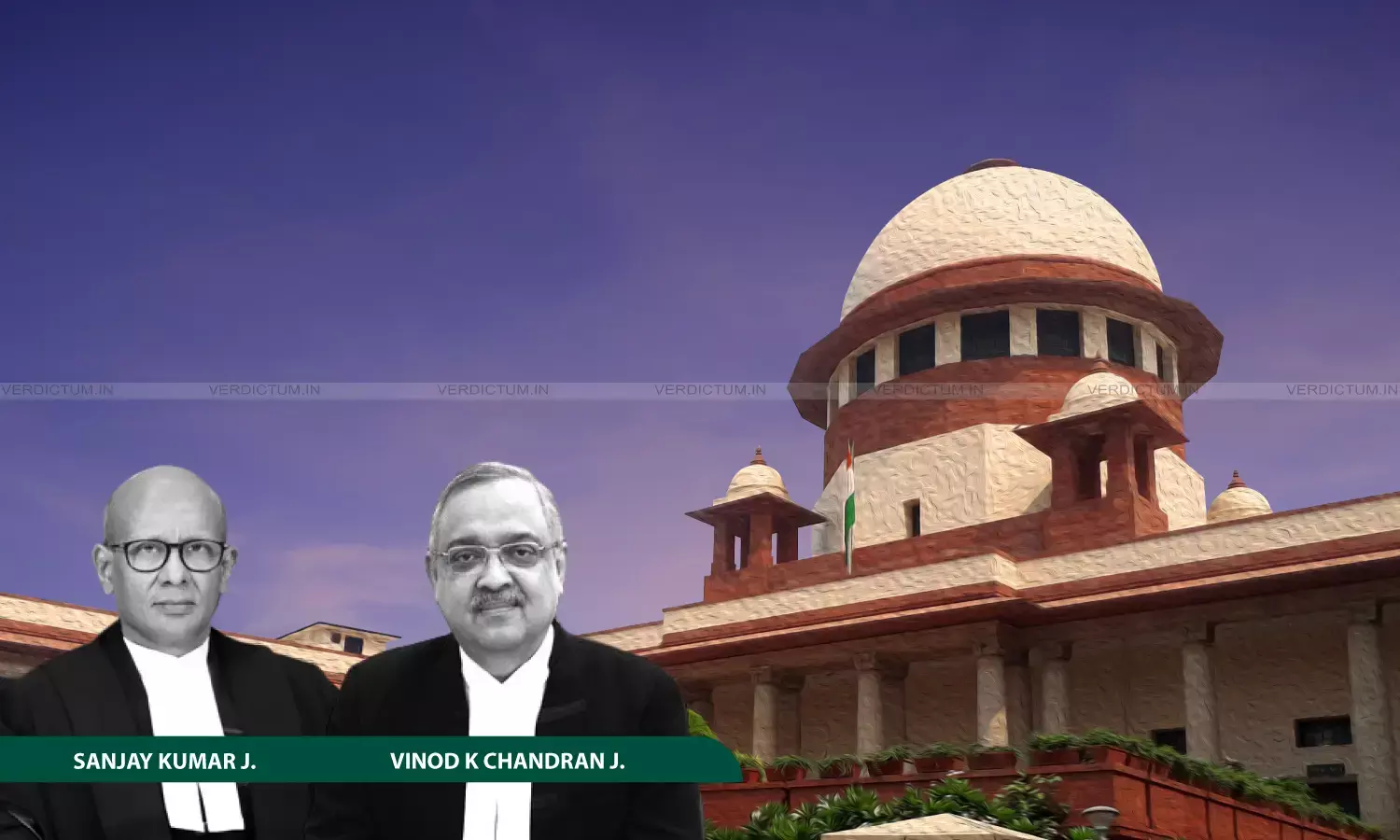
While reversing the order of conviction handed down by the Trial Court and affirmed by the High Court, the Supreme Court has held that there could be no conviction based on the last seen together theory as the time frame was quite large to term death as proximate.
The Apex Court was considering the appeal filed by two accused persons.
The Division Bench of Justice Sanjay Kumar and Justice K. Vinod Chandran stated, “What is pertinent in considering the circumstance of last seen together is that the postmortem report indicates the time of death as ‘24 hours not passed during examination after death of deceased’. The time provided is very elastic and since PW14 stated that he saw the deceased along with the accused at 5 PM on the previous day, death could have happened at any time in the intervening night or in the morning, before the body was recovered at around 10 AM on 31.10.2012. The time frame being quite large to term death as proximate, there can be no conviction based on the last seen together theory in the present case.”
Factual Background
The son of the de facto complainant found missing from the evening of October 31, 2012, turned up dead the next day in a field, head down with the legs sticking up from a ditch. His three companions of the previous day found drinking and roaming around, were rounded up and arrayed as accused. The prosecution went to trial with the circumstances of the last seen together theory, extra-judicial confession, recovery of the objects used as weapons, serological report etc. The Trial Court convicted the accused and sentenced them, which was confirmed by the High Court. Two out of the three accused approached the Apex Court in appeal, i.e. the first and second accused.
Reasoning
Considering the evidence of PW1 and PW14, the first of whom spoke of the accused having taken the deceased from his house at 4 PM, and PW14 having testified that the four persons together were seen roaming at around 5 PM, the Bench stated, “What assumes significance in placing reliance on the last seen together theory is the gap between the time they were seen together and the death having occurred. The proximity of the death having occurred within a short time after the accused and the deceased were seen together is most relevant, for the said fact to be taken as an incriminating circumstance against the accused.” Reference was made to the judgment in State of Goa v. Sanjay Thakran and Another (2007).
Referring to the postmortem report, the Bench stated that the death was delivered brutally, and the Doctor spoke of death having been caused due to the shock by reason of the wounds sustained and the resultant haemorrhage. The Bench also noticed that the Doctor did not speak of any single injury having led to the death.
Referring to the extra-judicial confession as spoken of by four witnesses and the third witness highlighting the exculpatory statement made by the first accused that it was the other two accused who killed the deceased, the Bench explained, “The exculpatory statement made absolving himself and accusing the co-accused, by its very nature is unreliable. It cannot be put against the other accused, for no cross examination being provided to them, of the one who made that statement. It cannot also incriminate the person who made the statement since there is no element of confession in the recital as spoken of by three witnesses, as against one.”
The Bench further stated that the recovery made in the case had no clarity. It was further noticed that the witness to the recovery categorically stated that neither the stone nor the glass piece was produced in Court and hence not confronted with the witness. It was further noted that the alleged weapons of assault were not shown to the Doctor to elicit his opinion as to whether the said objects could have caused the injuries found on the dead body. “The recoveries are of no avail and do not form a clinching incriminating circumstance against the accused”, it added.
The Bench thus concluded that none of the circumstances projected qualified as incriminating, linking the accused to the murder. Allowing the appeal, the Bench directed the release of the two accused. Dealing with the case of the third accused, the Bench directed the Member Secretary, National Legal Services Authority, to get in touch with the Member Secretary of the West Bengal State Legal Services Authority to provide sufficient assistance to him and ensure that an appeal is filed before the Apex Court.
Cause Title: Papan Sarkar @ Pranab v. State of West Bengal (Neutral Citation: 2026 INSC 528)