

Permission From Magistrate Required For Further Investigation After Filing Of Closure Reports: Supreme Court
The Appeal before the Supreme Court was filed by the accused persons booked in a case registered under Sections 406, 468, 471, 420, and 34 of the IPC.

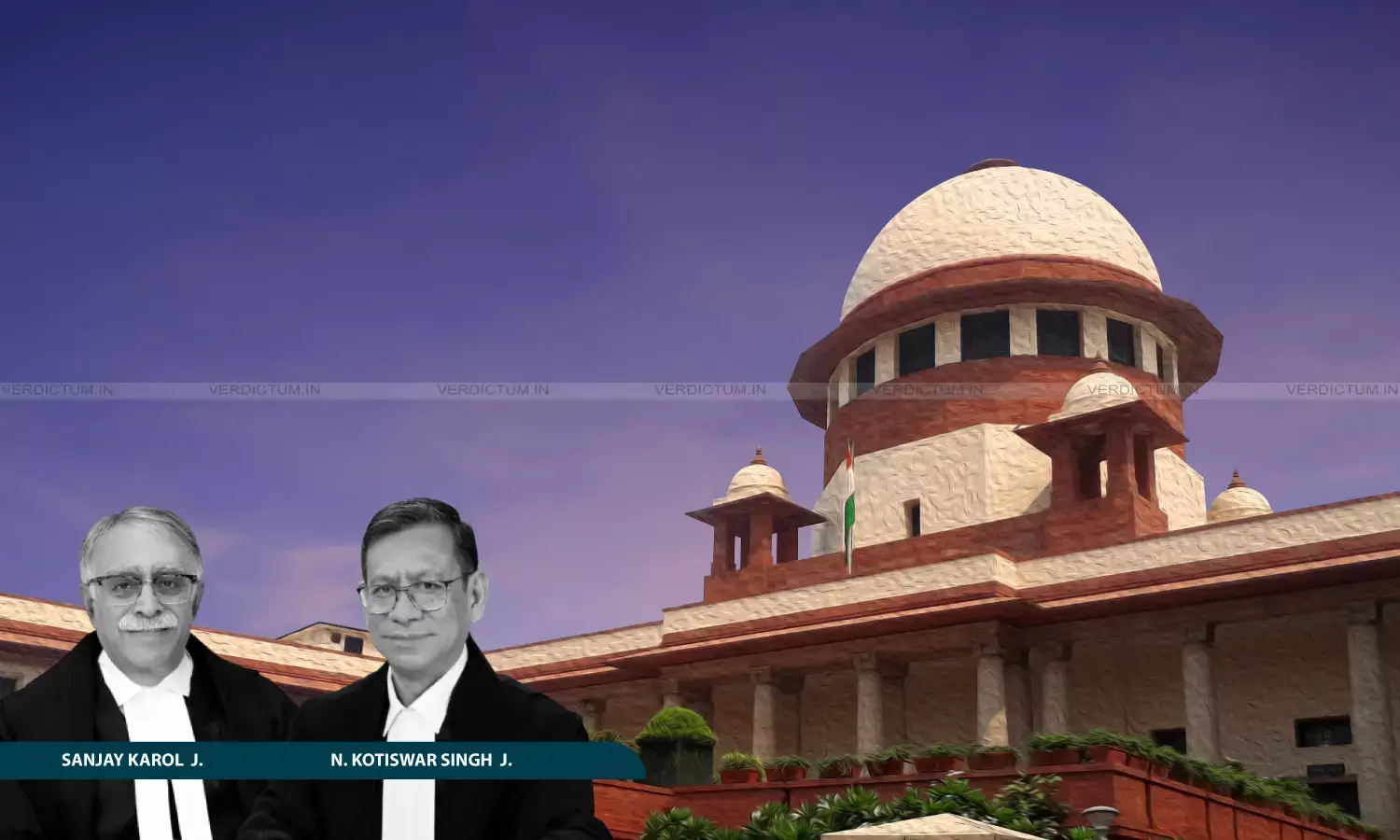
Justice Sanjay Karol, Justice Nongmeikapam Kotiswar Singh, Supreme Court
The Supreme Court has reiterated that the investigating authorities were required to obtain express permission from the Magistrate to initiate further investigation into the same set of allegations after the closure report had been filed twice.
The Appeal before the Apex Court was filed by 4 accused persons who were booked in a case registered under Sections 406, 468, 471, 420 read with Section 34 of the Indian Penal Code,1860 and were aggrieved by the rejection of their prayer for quashing of the case pending on the file of the Additional Chief Metropolitan Magistrate, Bangalore City.
The Division Bench of Justice Sanjay Karol and Justice Nongmeikapam Kotiswar Singh stated, “On both these questions, the law is no longer res integra. True it is that, as held in Rama Chaudhary v. State of Bihar 5 , the text of Section 173(8)CrPC does not explicitly mandate seeking of permission from the Magistrate and neither does 193(9) BNSS. However, the proviso to the said Section mandates that permission of the Court is explicitly required once the trial has begun. Even though the statute does not require express permission, the law as it has developed, has made abundantly clear that seeking of permission from the concerned Magistrate has evolved into a requirement.”
Senior Advocate V. Mohana represented the Appellant while Senior Advocate Gaurav Agrawal represented the Respondent.
Factual Background
The accused, together, ran M/s Kay Pee Exporters engaged in the business of exporting textiles and related products. The first two Accused persons, the managing partners of the firm, in the course of business, came in contact with the second Respondent, who was the private complainant, and ran businesses similar in nature to the Accused, in the United States of America and Canada. They developed a mutually beneficial business relationship wherein the complainant allegedly had to invest money into the business of the accused, in the form of aiding its expansion into these markets and in turn, he was to be entitled to 1/3rd profits of this venture.
The complainant’s case was that, upholding his end of the bargain, he periodically made investments into the business and also promoted a company by the name M/s Associated Textile Inc, established as per the laws of the Illinois State, but the accused had no intent of honoring their part. A case was instituted in the Northern District of Illinois, and the District Court granted the motion for entry of final judgment against the Respondents (ex parte) and granted total damages of $2,268,222.46. Shortly thereafter, the complainant filed a complaint under Section 200 of the Code of Criminal Procedure before the City Civil and Sessions Court, Bangalore, that led to the present proceedings. The complainant filed an application under Section 173(8) CrPC seeking permission for further investigation.
The same was dismissed by an order dated 8th October 2007. Shortly thereafter, a criminal miscellaneous petition was filed to restore the complaint and direct further investigation, which came to be allowed by the Sessions Court. A second closure report was filed, but then again, on February 25, 2012, the Police Inspector Indiranagar sought to continue the investigation after filing an application under Section 173(8) CrPC. The appellants contended to be unaware of all these proceedings till May 2022. The suit for recovery of money filed against the appellants was dismissed on account of the fact that the same had been decided ex parte. On coming to know of these proceedings, the appellants filed the quashing petition before the High Court, which came to be dismissed, leading the appellants to file the appeal before the Apex Court.
Reasoning
One of the issues before the Bench was whether it was open for the investigating authorities to initiate further investigation into the same set of allegations after the closure report had been filed twice, and whether the same could have been done in the absence of express permission from the Magistrate. Dealing with this aspect, the Bench referred to the judgment in Rama Chaudhary v. State of Bihar (2009), wherein it was held that the permission of the Court is explicitly required once the trial has begun.
“This proposition was approved in Vinubhai Haribhai Malaviya v. State of Gujarat and reiterated in Peethambaran v. State of Kerala”, it added.
The Bench noted that although an application was filed before the concerned Magistrate for further investigation a third time around, no order specifically granting permission was appended on record. “In view of the above judgments, submission of respondent no.2 that permission is not required has to be negated”, it stated.
The Bench was of the view that the First Information Report and the eventual chargesheet could be quashed in view of the aforementioned facts. The Bench further clarified that the dispute between the parties concerned the business relationship or was relating to the issue of establishment of a joint venture and thus was in the nature of civil dispute.
The Bench thus held that the criminal action against the appellants would be contrary to the authority of law and therefore an abuse of process of law for the reason that the third round of further investigation, as a consequence of which the chargesheet was filed, did not have the concerned Magistrate’s approval. Thus, allowing the appeal, the Bench quashed the FIR.
Cause Title: Paliniswamy Veeraraja & Ors. v. The State of Karnataka (Neutral Citation: 2026 INSC 561)
Appearance
Appellant: Senior Advocate V. Mohana, Advocates Ashwin Kumar D.S., Ishan Roy Chowdhury, Sreepriya K., AOR Surbhi Mehta
Respondent: Senior Advocate Gaurav Agrawal, AOR Patil Rekha Chandra Gouda, Advocates Joseph Pookkatt, Nilesh Sharma, Dhawesh Pahuja, M/s AP & J Chambers