

Supreme Court Imposes ₹1 Lakh Cost For Filing Article 32 Petition Seeking To Reagitate Conviction U/s. 138 NI Act
The Court said that it was a calculated attempt to unsettle concluded findings and to evade the legal consequences of a conviction under Section 138 of the NI Act that has attained finality.

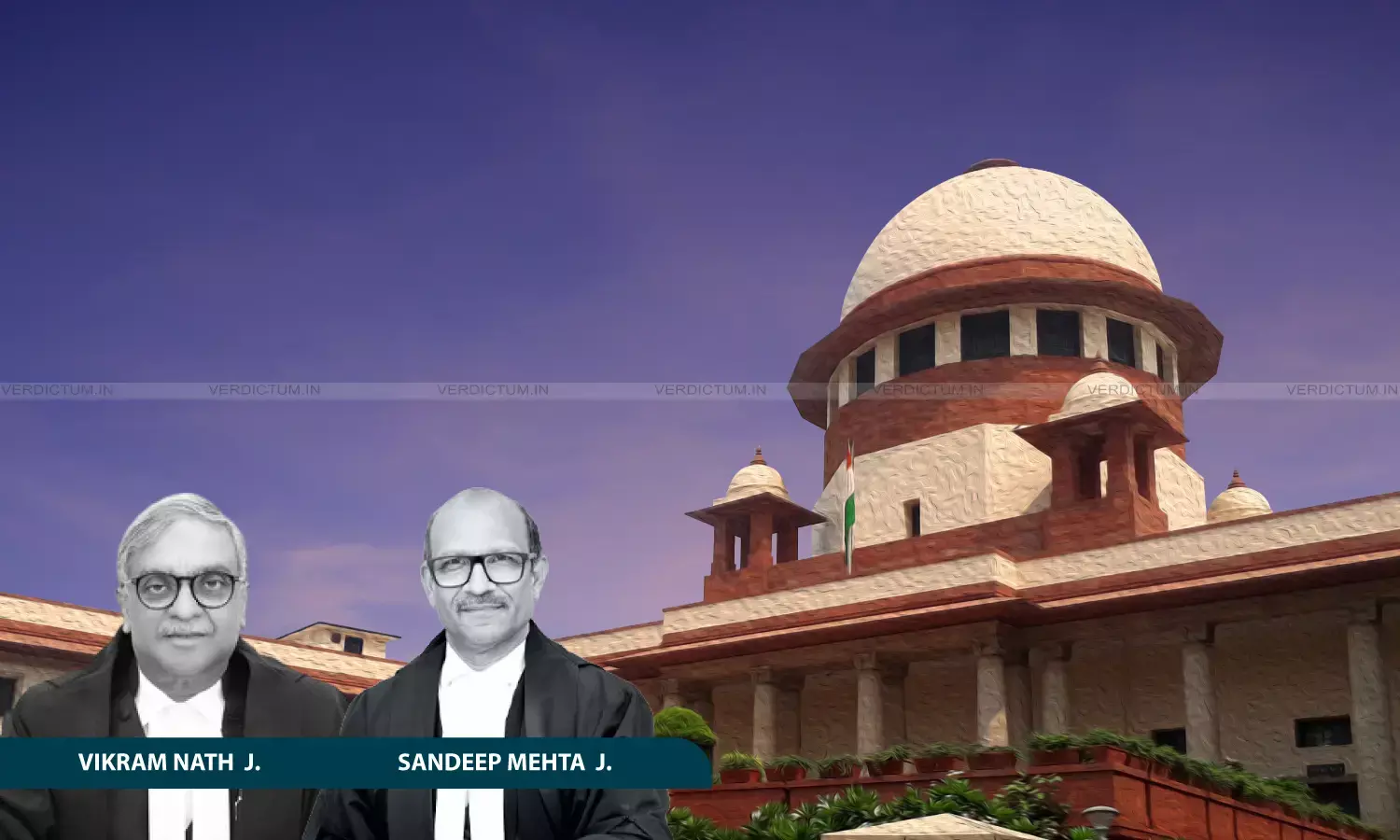
Justice Vikram Nath, Justice Sandeep Mehta, Supreme Court
The Supreme Court has imposed a cost of ₹1,00,000 on a petitioner for attempting to use the court's extraordinary jurisdiction under Article 32 to bypass a final criminal conviction under Section 138 of the Negotiable Instruments Act.
The Court characterized the petition—which inter alia sought new guidelines for unlicensed money-lending under the guise of public interest—as a "manifest abuse of the process of law."
The Court noted that the petitioner, who had already been convicted under Section 138 of the Negotiable Instruments Act and had previously exhausted all legal remedies including an SLP, was seeking to reopen concluded findings by introducing a new argument regarding the respondent's status as an unlicensed lender.
The Bench of Justice Vikram Nath and Justice Sandeep observed, "This Court is constrained to observe that such an attempt is nothing but a manifest abuse of the process of law. The Petitioner, having availed of the entire hierarchy of remedies, including indulgence from this Court, cannot be permitted to reagitate issues, whether directly or indirectly, under the guise of a writ petition. The conduct of the Petitioner reflects a calculated attempt to unsettle concluded findings and to evade the legal consequences of a conviction that has attained finality."
AOR Sahil Sharma appeared for the Petitioner, while AOR Gopal Verma appeared for the Respondents.
A writ petition was filed under Article 32 of the Constitution of India seeking framing guidelines in cases of alleged loan defaults involving unlicensed money-lenders, for strict enforcement of the Tamil Nadu Money Lenders Act, 1957, and for strengthening institutional safeguards to protect borrowers from unlicensed money-lenders.
The Petitioner was convicted for an offence punishable under Section 138 of the Negotiable Instruments Act, 1881, by judgment passed by the Trial Court, whereby she was sentenced to simple imprisonment for one year and directed to pay compensation of Rs.18,00,000/- (Rupees eighteen lakhs only) with 6% interest. The conviction and sentence were affirmed in appeal by the Sessions Court, and the Criminal Revision against the same was dismissed by the High Court.
Thereafter, the Petitioner had approached the Supreme Court via SLP, through which the Court granted limited indulgence by setting aside the sentence of imprisonment subject to deposit of an additional sum of Rs.18,00,000/- towards interest on the reasoning that interest cannot ordinarily exceed the principal, thereby modifying the order of the Trial Court to that extent.
The Petitioner now invoked the extraordinary jurisdiction under Article 32, seeking to reopen the controversy on an altogether new footing by contending that Respondent No. 2 is an unlicensed money-lender and that the underlying transaction is, therefore, unenforceable.
The Court said, "In light of the foregoing, we are satisfied that the present petition is a clear misuse of the process of this Court and is wholly misconceived. The writ petition is, accordingly, dismissed. Given the conduct of the Petitioner, costs of Rs. 1,00,000/- (Rupees One Lakh only) are imposed. The said costs shall be deposited with the Registry of this Court within a period of six weeks from the date of this order. The amount so deposited shall be transmitted to the accounts of Supreme Court Bar Association (SCBA) and Supreme Court Advocates’ On Record Association (SCAORA) in equal shares within two weeks of the deposit."
Accordingly, the Court dismissed the writ petition.
Cause Title: S. Gayathiri v. The State of Tamil Nadu and Ors. [Writ Petition(s)(Civil) No(s). 479/2026]
Appearances:
Petitioner: AOR Sahil Sharma, Advocates Karan Bharihoke and Devanshu Yadav.
Respondents: AOR Gopal Verma and Advocate Umang Verma.