

Stray Bovine-Related Accidents A Growing Concern: Supreme Court Suggests Compensation Mechanism, Animal Tagging
The Apex Court awarded ₹15 lakh to the widow of a man who suffered fatal consequences after being hit by a stray bull, while suggesting that governments consider compensation mechanisms for pedestrian and vehicular accidents caused by cattle.
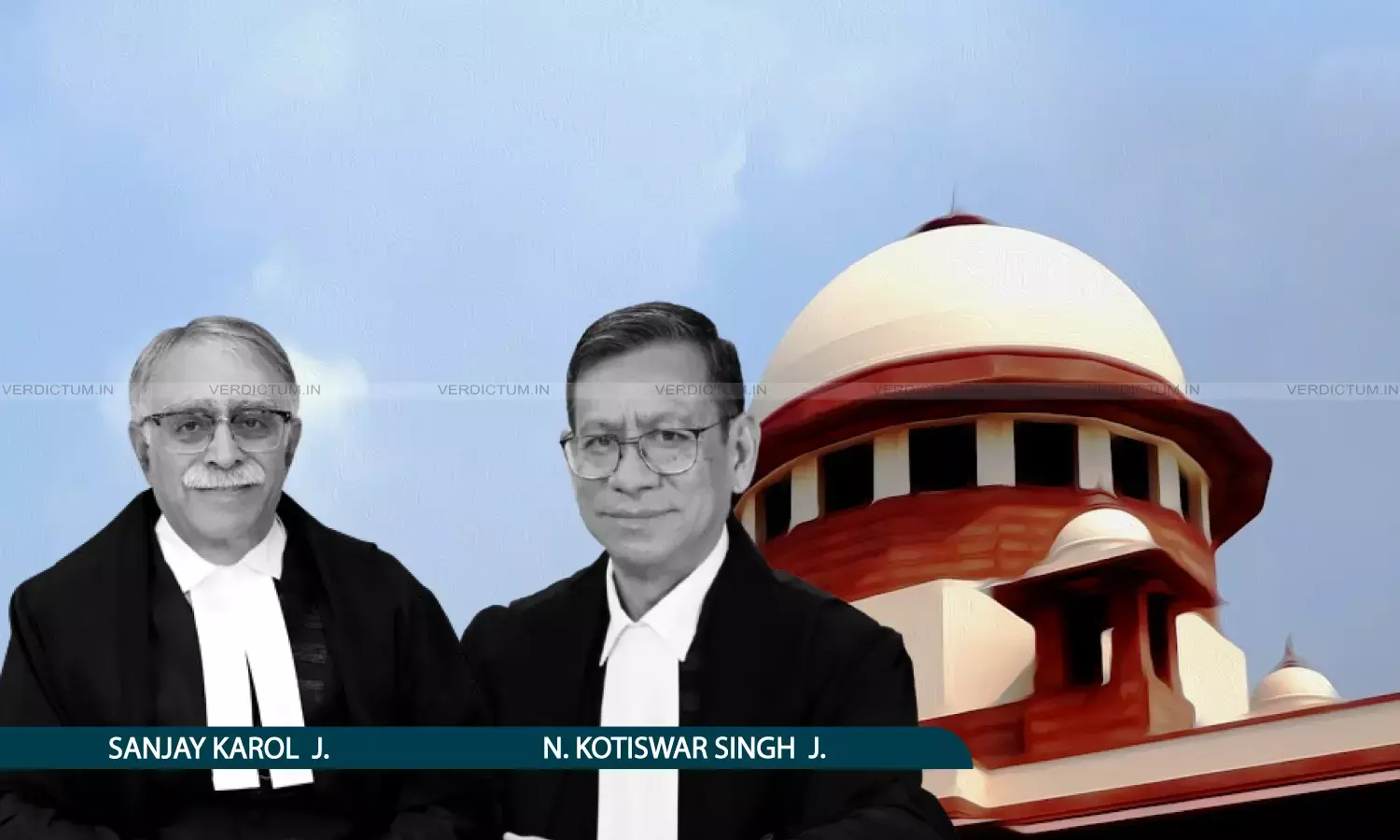
Justice Sanjay Karol, Justice N. Kotiswar Singh, Supreme Court
The Supreme Court has observed that accidents with a direct and proximate bovine cause are “not few and far between”, and suggested that the Centre and State Governments consider measures including complete implementation of cattle laws, compensation mechanisms for cattle-related accidents, tagging of animals, responsibility of owners, and nodal officers for shelters and digitised records.
The Court was hearing an appeal by the widow of a man who was hit by a stray bull while walking on the road, suffered a head injury and became unconscious. A Single Judge of the High Court had awarded compensation, but the Division Bench set aside that relief on the ground that the matter involved disputed questions of fact and relegated the claimants to a civil court.
A Bench of Justice Sanjay Karol and Justice Nongmeikapam Kotiswar Singh allowed the appeal, noting that sending the claimant to a civil court at this stage would leave her remediless.
The Bench observed: “… what has happened in this case is not unique or unheard of. It is commonplace to see reports in newspapers regarding Bovine related incidents and accidents. So, while this case presents a particular instance before us, we are of the view that the larger issue of these incidents must also be addressed. What is the mechanism in place to deal with the loss of animal life in incidents of vehicular accidents, and what is the status of enforcement thereof? Further, when such incidents lead to injury or loss of human life, how is the family of the deceased or the injured themselves compensated?”
Senior Advocate Ravi Prakash appeared for the appellant, while Advocate Sanchar Anand appeared for the respondents.
Background
The incident took place when the deceased was hit by a stray bull while walking on the road. The incident was reported to the police, and a DDR entry was recorded. During his lifetime, he sought compensation from the authorities, but the request did not yield relief. After his death, his wife approached the High Court.
The Single Judge awarded compensation by applying principles governing compensation under the Motor Vehicles Act, 1988. The Division Bench reversed the award, holding that such disputed questions could not be adjudicated in writ jurisdiction and granted liberty to approach a civil court.
Before the Supreme Court, the appellant argued that the incident was old and that it would be unjust to relegate the claimant to a civil suit when no real disputed question of fact arose. The respondents argued that the liability of the Municipal Council had not been established and that Motor Vehicles Act principles could not be applied mechanically.
Court’s Observations
The Supreme Court noted that the deceased had approached the Deputy Commissioner seeking compensation, and that the request was rejected because the authority did not receive any funds that could be paid as compensation.
The Court stated: “Noteworthy, here is the factum that the incident was never questioned or denied in any manner. However, after this application, the deceased sent a legal notice and, receiving no reply thereto, filed the subject Writ Petition. Prior thereto, even an FIR reporting the incident was lodged. Hence, all facts are undisputed.”
The Court said the matter was not an isolated case and that bovine-related incidents are commonly reported. It posed the larger question of how animal deaths, human injuries and loss of human life caused by such incidents are to be addressed.
The Court remarked: “It is not only these animals but also the humans that at times meet the most painful of ends while driving merrily along for no other reason but the fact that all of a sudden, an animal comes in front of the vehicle leading to a collision. Sometimes, the same may happen as it did in this case, without there being a vehicle in the equation. It may be that another animal provoked them, or sometimes, sans any immediate provocation, the animal may choose to attack a bystander or a pedestrian, severely injuring them or even killing them, for example, by impaling them with their horns”.
The Court referred to Article 48 of the Constitution, which directs the State to organise agriculture and animal husbandry on modern lines and prevent slaughter of cows, calves and other milch and draught cattle.
The Bench observed: “Granted that the present case and other cases of motor accidents are not ‘slaughter’ within the literal sense of the term, but the end result is that either they or humans lose their lives and hence, it is a serious problem that calls for attention. After all, they are not meant to be natural speed breakers, placed willy-nilly on the National Highways, roads and streets.”
The Court also referred to Article 51A(g), noting that compassion for living creatures is part of the constitutional scheme. It cited State of Gujarat v. Mirzapur Moti Kureshi Kassab Jamat (2005), where the Supreme Court had linked Articles 48, 48A and 51A(g).
The Supreme Court observed that owners must remain responsible for animals under their care, and that abandoned or aged animals need proper shelters rather than being left on roads.
The Court stated: “The immediate answer is that owners of the animals should be held responsible and ensure that the animals return to their specified dwellings at the end of each day; or in other cases where animals have been let go for whatever reason, be it infirmity or old age, there should be adequately stocked and staffed animal shelters which would patrol the areas and round up animals at the end of the day to house them safely.”
The Court examined the Prevention of Cruelty to Animals Act, 1960, the Cattle Trespass Act, 1871, and State laws relating to cattle preservation, shelters, goshalas and control of stray animals. It noted that at least 24 States and Union Territories had enacted legislation specifically aimed at cattle preservation and protection.
The Court noted that the Punjab Municipal (Registration and Proper Control of Stray Animals) Bye-Laws, 2006, provided for a fund for payment of compensation to victims of stray cattle, but did not quantify the amount. Later, Punjab bye-laws and notifications quantified compensation, but could not apply to the present case.
The Court held: “Obviously, in the present case, neither of the latter two Rules can apply. Since the 2006 Rules established a fund but do not quantify an amount, the question of the amount to be paid to the appellants remains unanswered. The method adopted by the learned Single Judge, which applies the standard under the MV Act, cannot be accepted as being applicable as a matter of rule in every case.”
Considering the long pendency and the severe injury with which the deceased lived before his death, the Court awarded a lump sum of ₹15 lakh, to be remitted within four weeks. It clarified that the award was passed in the attending facts and circumstances and would not be treated as a precedent.
The Court then issued suggestions for consideration and implementation by the Centre and State Governments.
The Bench stated: “In view of the above discussion, having noted that accidents with a direct and proximate bovine cause are not few and far between, we make few suggestions to the Centre and State Government(s) for consideration and implementation:
- All States that have enacted their own laws pertaining to cattle should take steps to ensure complete and immediate implementation thereof in letter and spirit;
- Necessary amendments may be carried out or rules promulgated, as is deemed fit by the competent authority, to develop a mechanism for payment of compensation in accidents caused as a result of bovine/cattle, in both categories of cases i.e., pedestrian or vehicular;
- Tagging of all animals be mandated. This furthers the ability to keep track of them, ensuring their long-term health service, linking to veterinary check-ups and vaccinations;
- The reality of animals being let go after they cease to serve a useful, economic purpose cannot be denied. The owners choosing to make such a decision should be held responsible and ensure safe transfer of such animals to the shelters run by the appropriate authority. The authorities at such shelters should issue a receipt acknowledging such transfer and cause the details of such animal to be entered/altered in the database of tagging;
- In order to ensure that the tagging, digitisation of records and smooth running of these shelters is duly undertaken, the authorities may depute a particular officer in every Corporation/Department who shall be the nodal officer for such purpose.”
The Court directed that a copy of the judgment be sent to all Chief Secretaries, Administrators of Union Territories and Member Secretaries of State Legal Services Authorities for appropriate action.
Conclusion
Allowing the appeal, the Supreme Court awarded ₹15 lakh to the appellant, payable within four weeks, and disposed of the pending applications.
Cause Title: Nisha v. Municipal Council Sangrur & Ors. (Neutral Citation: 2026 INSC 774)
Appearances
Appellant: Senior Advocate Ravi Prakash with Advocates Aman Malik, AOR, Ali Khan, Astu Khendelwal and Taha Yasin
Respondent: Advocates Sanchar Anand, Dr Ravinder Kumar Anand, Apoorva Singhal, AOR, Rajat Rathee, Aman Kumar Thakur, Arpit Yadav and Nupur Kumar, AOR
