

Taking Pending Disputes To Press To Allege Bias Against Judge Unbecoming Of Advocate: Supreme Court Refuses To Interfere With Contempt Proceedings
The Court said that the grievances against judicial orders must be pursued through legal remedies, not public commentary that may scandalise the institution.

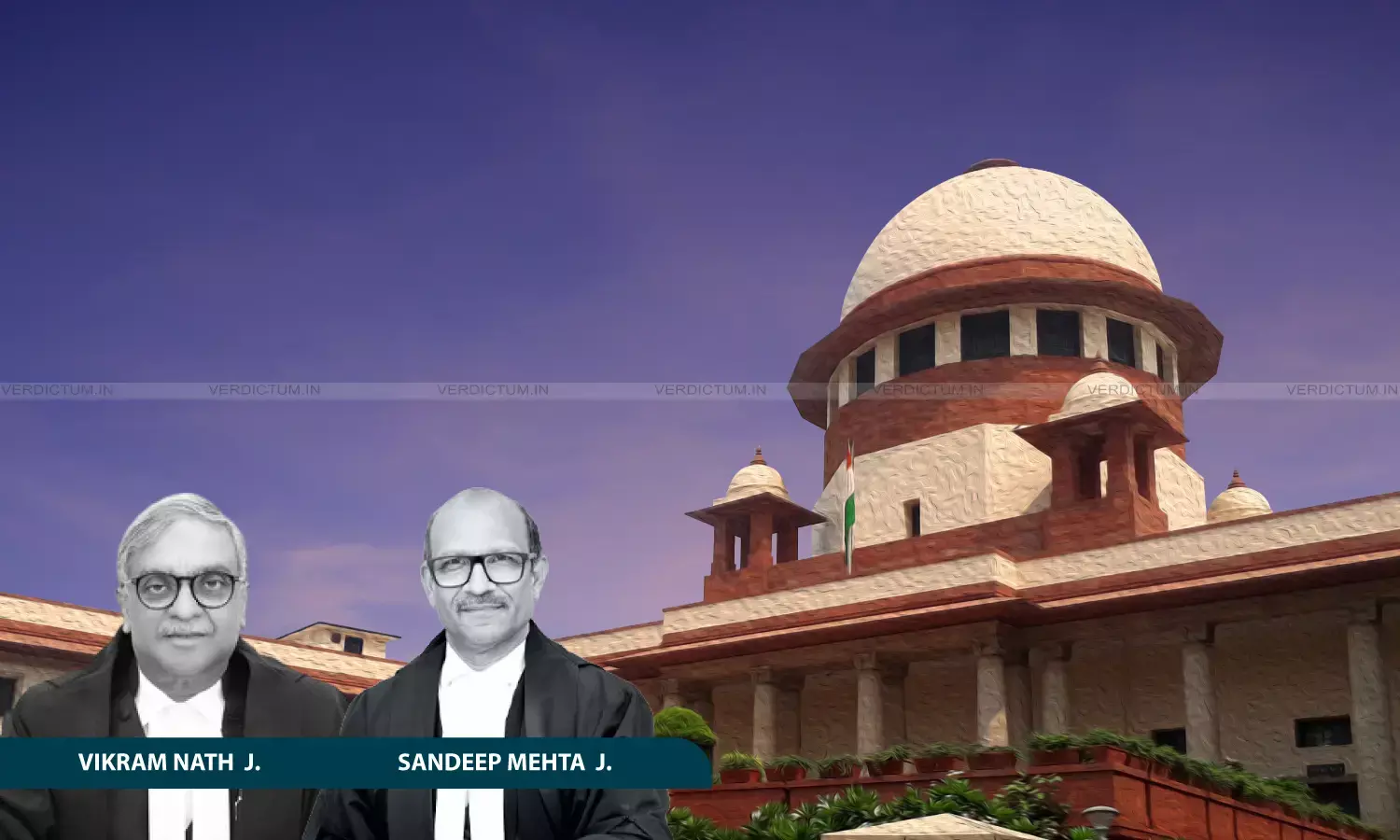
Justice Vikram Nath, Justice Sandeep Mehta, Supreme Court
The Supreme Court has held that an advocate carrying a pending judicial controversy into the public domain and alleging bias against a sitting judge is inconsistent with professional discipline.
The court refused to interfere with ongoing contempt proceedings initiated by the Bombay High Court.
Holding that professional ethics require advocates to ventilate grievances through established legal remedies, the Court observed that public commentary capable of influencing perceptions about judicial integrity or fairness, particularly through press conferences, may prima facie scandalise the institution and warrant scrutiny under contempt jurisdiction.
Justice Vikram Nath and Justice Sandeep Mehta was hearing criminal appeals filed by advocate Nilesh C. Ojha challenging orders of the Bombay High Court refusing his impleadment application and directing initiation of a separate suo motu contempt proceeding. “…The manner in which the press conference was convened and the allegations were projected is, prima facie, unbecoming of a member of law professional and falls short of the standards of propriety, restraint, professional, and ethical responsibility which the legal profession demands. An advocate, more than any other stakeholder in the justice delivery system, bears a heightened duty to uphold the dignity of the institution and to act with circumspection in matters touching upon the administration of justice…”, the Bench observed.
Advocate Ghanshyam Dayalu Upadhyay appeared for the appellant and Sandeep Sudhakar Deshmukh, AOR appeared for the respondent.
The matter pertained to a press conference addressed by the appellant in relation to a pending criminal writ petition, wherein he levelled allegations against a sitting High Court judge and sought her recusal on grounds of alleged personal connections. The concerned judge addressed a communication to the Chief Justice, following which suo motu contempt proceedings were initiated and placed before a five-judge Bench.
During the course of proceedings, the appellant sought discharge from contempt, impleadment of the judge as a party, and recall of adverse orders. The High Court rejected these applications, holding that a person merely furnishing information to the Chief Justice is neither a complainant nor a necessary party, and further directed registration of a separate contempt case based on allegations made in the pleadings.
Before the Supreme Court, the appellant contended that his statements constituted permissible criticism and a bona fide defence. The High Court, on the other hand, maintained that the conduct amounted to scandalising the court and undermining judicial dignity.
The Court noted that while fair and reasoned criticism of judicial decisions is permissible in a constitutional democracy, imputing motives to judges without demonstrable foundation crosses the permissible boundary.
“They are not confined to identifying any error of law or fact, but extend to imputing motives without any demonstrable foundation. Assertions of this nature, particularly when directed against a sitting Judge of the High Court, require a degree of responsibility and substantiation commensurate with their seriousness. The tenor and sweep of the allegations, therefore, raise concerns that go beyond the immediate lis between the parties”, the Bench noted on the nature of the allegations.
“In our considered view, allegations of this character, if left unchecked, possess an inherent tendency to erode public confidence in the administration of justice. While accountability and scrutiny are integral to a constitutional democracy, imputations of personal nature against a Judge must rest on unimpeachable material and be pursued strictly in accordance with law, failing which, they risk undermining the very edifice of judicial independence”, the Bench further noted.
Therefore, noting that no case for interference was made out at this stage, the Court dismissed the appeals and requested the High Court to proceed expeditiously. It clarified that its observations were confined to a prima facie assessment and would not influence the merits of the contempt proceedings.
Cause Title: Nilesh C. Ojha v. High Court of Judicature at Bombay & Ors. (Neutral Citation: 2026 INSC 390)
Appearances:
Appellant: Ghanshyam Dayalu Upadhyay, Pritam Biswas, Prem Sunder Jha, AOR, Gaurav Khanna, Vinayak Tyagi, Ankit Pandey, Shighra Kumar, Advocates.
Respondent: Sandeep Sudhakar Deshmukh, AOR, Nishant Sharma, Ankur Savadikar, Kartik Sharma, Parminder Singh Bhullar, AOR, Rajeev Kumar Gupta, Advocates.