

Breaking: Supreme Court Bars Coercive Action Against Students; To Appoint Independent SIT To Probe NEET Protest Violence
The Court issued interim directions to preserve evidence, protect student privacy, and release detained minors while seeking responses from the Centre and States.

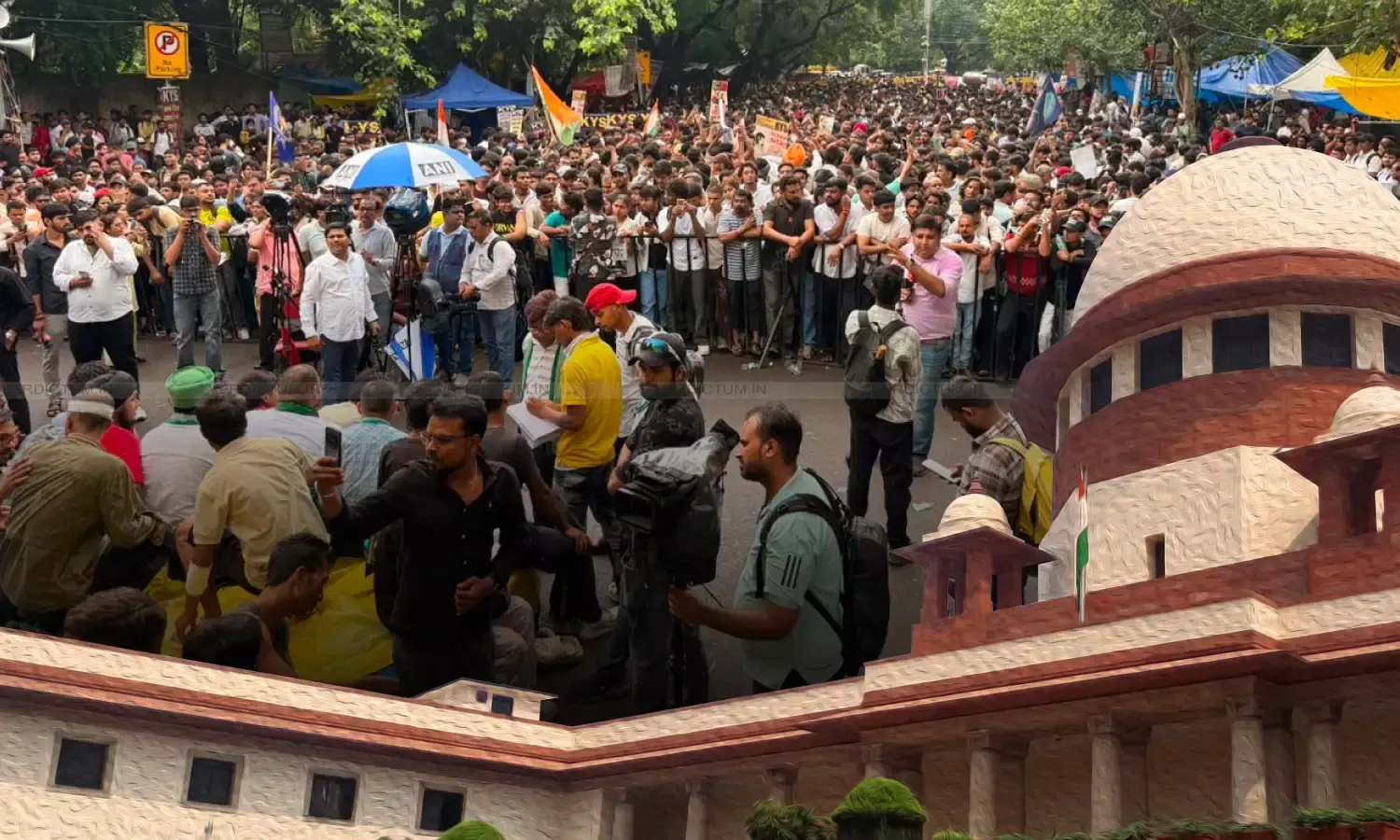
The Supreme Court has indicated its inclination to order an independent and fair probe into the widespread violence and alleged police excesses during student protests over the NEET 2026 paper leak.
The Court noted that allegations of excessive force—including the use of pellet guns, rubber bullets, and nail-embedded lathis—prima facie make out a case for a comprehensive inquiry that also addresses attacks on on-duty police personnel.
While issuing notices to the Union Government, the NCT of Delhi, and seven major States to place their responses on record, the apex court issued interim directions prohibiting coercive action against students without criminal antecedents, ordering the immediate release of all detained minors, and mandating the preservation of all digital evidence and CCTV footage.
The Court was hearing a batch of writ petitions and intervention applications concerning alleged police excesses against students protesting the NEET paper leak, alongside pleas highlighting violence against on-duty police personnel.
Yesterday, the Court remarked that the right to peaceful protest is an essential constitutional guarantee that cannot be denied, while emphasizing that injury to any individual—whether a student or a police officer—is of equal concern.
The Bench of Chief Justice Surya Kant, Justice Joymalya Bagchi and Justice V Mohana ordered, "We find that the allegations made by the petitioners prima facie make out a case for an independent and fair probe into the incidents of violence...Such a probe will effectively address the claims brought both by the members of the public and by the learned Solicitor General of India as well...However, before passing any such order on the basis of representative opinions, we deem it appropriate in the interest of justice to grant a short time to the NCT of Delhi and the Union of India to place on record their response by way of an affidavit, along with relevant material...Similarly, we deem it appropriate to provide a brief audience to the several states where similar incidents of violence took place, as the proposed probe will include an investigation into the circumstances in those respective states as well...Consequently, we issue notice to the Chief Secretaries of the States of Maharashtra, Bihar, Assam, West Bengal, Kerala, Uttar Pradesh, and Madhya Pradesh, and request their respective Advocates General or standing counsel to enter an appearance."
Senior Advocates Gopal Sankaranarayanan, Shadan Farasat, Shyam Divan, Abhishek Manisinghvi and Vrinda Grover appeared for the Petitioner, while Solicitor General Tushar Mehta appeared for the Union of India and the State of NCT of Delhi
The Court issued the following interim directions: (i) All CCTV, drone, body-worn camera, wireless communication records, and PCR call details shall be preserved.
(ii) The respondents/police shall ensure that all digital data of protesters collected is preserved and not brought into the public domain.
(iii) No personal data or details of protesters shall be published.
(iv) No coercive action shall be taken against protesting students. However, this protection shall not extend to persons with criminal antecedents.
(v) All states are directed to immediately release children below the age of 18 who were arrested during the student protests.
The Court recorded, "The allegations are there that excesses have been committed in violation of the fundamental rights guaranteed under Articles 14, 19, 21, and 22 of the Constitution...Even though young students came to protest being aggrieved by the leak of question papers pertaining to the NEET examination 2026, the petitions on record place a multitude of instances alleging indiscriminate and excessive use of force by the police in the National Capital Territory of Delhi, that includes lathi charge, use of pellet guns, and tear gas, etc.
The nature of instances highlighted in this batch of petitions indicates that:
1. Pellet guns were used that led to injuries to even students, including one boy allegedly losing his eyesight.
2. Rubber bullets were used that caused injury to various persons, including a woman.
3. Electric batons were used to disperse the crowd.
4. Lathis embedded with nails were also used, resulting in permanent disability and life-threatening injuries to the protesters.
5. Even a media person was assaulted with serious injuries."
"The violence was allegedly perpetuated by persons in police uniform or civil dress, etc...Photographs and pen drives, etc., of such instances of violence have also been placed on record. We will also record that, as per the submissions made by learned counsel representing the police personnel or their family members, similar kinds of allegations have been made by them, stating that protesters or anti-social elements who entered the protest site indulged in stone-pelting and other acts of violence, thereby causing multiple serious injuries to police personnel while they were performing their duty", the Court added further.
CJI Kant highlighted the grave nature of the allegations, pointing to specific instances involving a young boy injured by pellet guns, severe injuries caused by electric batons, the targeting of media personnel, and physical assault and molestation by police officers, including an instance where a woman was slapped.
Observing that the students were engaged in a peaceful, constitutionally protected demonstration to raise their demands, the CJI noted that excessive force was used by those tasked with maintaining order.
The Court also acknowledged the grievances raised by the families of police personnel, including claims that individuals with ulterior agendas infiltrated the protests to act as co-hosts, and orally remarked on the necessity of instituting an independent probe to comprehensively investigate all aspects of the violence.
Senior Advocate Gopal Sankaranarayanan, appearing for the petitioners, submitted that the ongoing proceedings pertained to widespread student agitations spanning multiple States across the country, including Bihar, Madhya Pradesh, Uttar Pradesh (Agra), West Bengal, and the National Capital, rather than being isolated to Delhi or Jantar Mantar alone.
He highlighted that the batch of petitions brought to light serious instances of police excesses—such as lathi-charges, the use of pellet guns, and physical brutality against student demonstrators—while concurrently addressing allegations of violence and physical attacks directed against on-duty police personnel by certain protesters.
Emphasizing the legal requirements governing public order, senior counsel pointed out that regulatory measures, such as orders promulgated under Section 144 of the Code of Criminal Procedure, must be duly issued before enforcing restrictions, noting that no such orders were in place for the Jantar Mantar demonstrations.
Drawing a parallel to the precedent set during the Ramlila Maidan incident, he urged the Court to lay down comprehensive, uniform guidelines to prevent such administrative and law enforcement failures in the future.
He urged the Bench to fix accountability higher up the command chain, emphasizing that without command responsibility, police personnel would continue to operate under the assumption of impunity.
CJI Kant said, "We are trying to indicate that once protocol is fixed and then somebody is trying to violate the protocol...then that can take care of them...Once guidelines are laid down...any person who took the law into their own hands can be brought to book."
Intervening in the matter, Senior Advocate Shoeb Alam informed the Bench that the Bihar Police had suspended the police officer responsible for firing an AK-47 during the protests.
Senior Advocate Shyam Divan suggested that an SIT may be made headed by the former Chief Justice of India. He submitted that systematic efforts were made to deter citizens from exercising their right to protest, alleging that young demonstrators were threatened with false implication through the fabrication and planting of evidence in unrelated narcotics cases.
To substantiate this, he relied on a widely circulated CNBC-TV18 video clip from July 22, 2026, wherein a uniformed police officer was captured threatening two young protesters with planting 50 grams of contraband on them to ruin their lives and deny them bail. He also cited media reports, including an article in The Hindu, documenting similar threats and detentions of student protesters by the police.
Turning to instances of gender-based violence and police excesses against women and children—an issue previously flagged by the Bench—counsel referred to a Hindustan Times report detailing an incident from July 28 in central Delhi, where a senior Delhi Police officer was seen slapping a female protester without provocation before being removed from the site.
Divan urged that any such investigation must remain strictly confined to the recorded facts and be conducted in an independent, fair, transparent, and thorough manner, adding that the precise contours of the probe would be addressed at a later stage.
Divan further submitted that the petitioners had set out well-established legal principles, noting that the primary task before the Court was their compilation and application within the current constitutional context. He pointed out that while different precedents, such as Anita Thakur or decisions arising out of police actions in Kerala, addressed distinct sets of issues, there was a need to harmonize these principles.
Responding to this, CJI Kant said, "The time has come that all these principles need to be collated and expanded. This is the right time. That is why we said that a judicial protocol is required, which not only means the composition of the directions issued in the past. We may also consider that now in 2026, the principles framed in 2018 to what extent they remain relevant and how it is made more to season 2026."
Senior Advocate Shadan Farasat flagged the alarming situation in Bihar, informing the Court that despite the State's decision to withdraw FIRs, nearly 150 demonstrators—including 13- and 16-year-old minors—remained in illegal detention beyond the mandatory 24-hour limit without prompt magistrate production. The Chief Justice of India assured that the proposed high-powered committee would comprehensively examine these regional violations at a national level.
Advocate Prashant Bhushan, appearing for petitioner Junaid Malik, submitted that his client was illegally detained and taken blindfolded to Mussoorie. He also drew the Court's attention to a large truck filled with stones that was brought to the protest site at 4:00 AM, prompting the Chief Justice of India to remark that allegations had been made attributing the truck to the protesters.
Concluding the submissions for the petitioners, Senior Advocate Dr Abhishek Manu Singhvi presented a State-wise compilation of news reports and detailed instances regarding the use of pellet guns against demonstrators.
Solicitor General Tushar Mehta submitted, "In a nutshell I am with students, I do not think that the students have perpetratted any crime, and if students have suffered in any manner, the perpetrator's must be brought to the court as per your lordhsip satisfaction...Government is ready. Your Lordship may appoint the committee, but before that, kindly give me couple of days more to place my facts on record so that your lordships would have a holistic picture and thereafter we would not oppose to anything at a particular stage...I would not like my names to be opposed by them or their name to be opposed by me..."
Another bench of the Supreme Court has also made suggestions in a plea concerning structural and administrative reforms for conducting the NEET-UG examination, highlighting the urgent need to transition from temporary measures to permanent institutionalization.
Recently, the Delhi High Court had also issued notice to the Delhi Police and the Union of India in a Public Interest Litigation (PIL) alleging excessive use of force by the Delhi Police during the Cockroach Janta Party’s protest march at Jantar Mantar, New Delhi.
Cause Title: Shailendra Mani Tripathi v. Union of India & Ors.[W.P.(Crl.) No. 280/2026] and Himanshu v. Union of India & Ors. [W.P.(Crl.) No. 279/2026]