

Magistrate Need Not Record Evidence U/S 244 CrPC Before Committing Case Exclusively Triable by Sessions Court: Supreme Court
The Court held that legislature consciously dispensed with pre-committal inquiry under new CrPC; directing witnesses to depose twice serves no useful purpose and is not mandate of law.

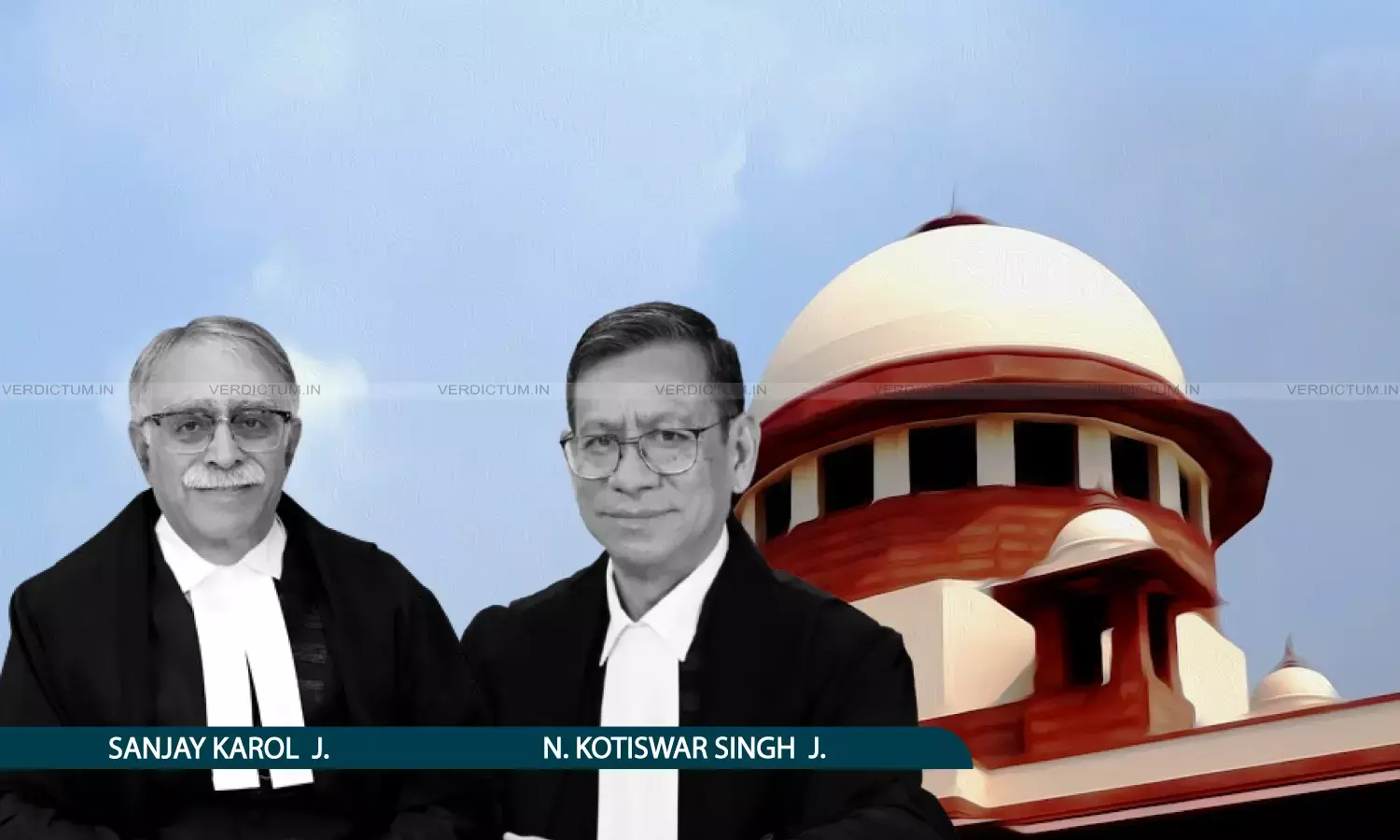
Justice Sanjay Karol, Justice N. Kotiswar Singh, Supreme Court
The Supreme Court has held that a Magistrate is not required to record evidence under Section 244 CrPC when the offence alleged is exclusively triable by the Court of Sessions. The Court held that the legislature had consciously dispensed with the pre-committal inquiry under the new CrPC, constricting the Magistrate's role at the committal stage to what has been described as a "narrow inspection hole", and that directing witnesses to depose about the same facts twice serves no useful purpose and is not a mandate of law.
While setting aside the Punjab and Haryana High Court's order remanding a complaint-based murder case to the Magistrate with a direction to record pre-committal evidence under Section 244 CrPC, the Court held that Section 244 applies only to offences triable by Magistrates and has no application where the offence, as here, under Section 302 IPC, is exclusively triable by the Court of Sessions, in which case Section 209 CrPC mandates direct commitment without any pre-committal inquiry.
Pertinently, the reasoning adopted by the Punjab and Haryana High Court was that the Section 244 CrPC requires that a Magistrate hear all prosecution evidence irrespective of whether or not the offence with which the evidence is concerned is triable by the Magistrate or not.
Therefore, a Bench comprising Justice Sanjay Karol and Justice Nongmeikapam Kotiswar Singh while setting aside the order, observed, “If the reasoning of the High Court is accepted, a number of witnesses would be required to depose about the same set of facts and circumstances, at least twice. This may not be of any particular use, nor mandate of law”.
Advocate Amitabh Chaturvedi appeared for the petitioner and Sanjay Jain, AOR appeared for the respondent.
The case arose out of an altercation on April 12 2007 in which the appellant's father died. A complaint was filed before the Magistrate under Section 156(3) CrPC, and after evidence was recorded under Sections 200 and 202 CrPC and summons were issued in December 2009, the case was committed to the Sessions Court, which framed charges against only one of the three respondents in April 2011.
The appellant challenged the discharge of the other two respondents by way of criminal revision before the High Court. The High Court, instead of deciding the revision on merits, remanded the matter to the Magistrate holding that pre-charge evidence under Section 244 CrPC was required to be recorded since the case was instituted on a complaint. The appellant challenged this remand order before the Supreme Court.
The Court held that Section 244 CrPC is located in the part of Chapter XIX dealing with warrant cases instituted otherwise than on a police report, and applies only to offences triable by Magistrates.
Where the offence alleged, as here, under Section 302 IPC, is exclusively triable by the Court of Sessions, Section 209 CrPC mandates commitment without any pre-committal inquiry. Relying on the Constitution Bench decision in Hardeep Singh v. State of Punjab (2014) 3 SCC 92, the Court held that at the pre-committal stage, the Magistrate performs acts in the nature of administrative work rather than judicial work and is forbidden from going into the merits of the case.
“…to observe that the Legislature has consciously built in this difference of doing away with the hearing and evidence at pre-committal stage. This is what V.R. Krishna Iyer J. in Sanjay Gandhi v. Union of India, observed to be frustrating the purpose of the Legislature if the Magistrate goes into the merits of the matter. The power of the Magistrate has been described to be a ‘narrow inspection hole’”, the Bench noted.
The Court also relied on State of Orissa v. Debendra Nath Padhi (2005) 1 SCC 568 and Rattiram v. State of M.P. (2012) 4 SCC 516, both three-judge bench decisions, which traced the legislative history showing the conscious abolition of the committal inquiry in the new CrPC. The three judgments relied upon by the High Court were distinguished on facts.
The impugned order was set aside and the Court was directed to hear the appellant's revision as well as the respondent's petition afresh and decide both within nine months, with parties to appear before the High Court on July 16, 2026.
Cause Title: Neeraj Gupta v. Pardeep Kumar Bansal and Others (Neutral Citation: 2026 INSC 660)
Appearances:
Appellant: Amitabh Chaturvedi, Pankaj Gupta, Shubhaankar Ray, Rakhi Ray, AOR, Advocates.
Respondent: Sanjay Jain, AOR, Shreekant Neelappa Terdal, AOR.